



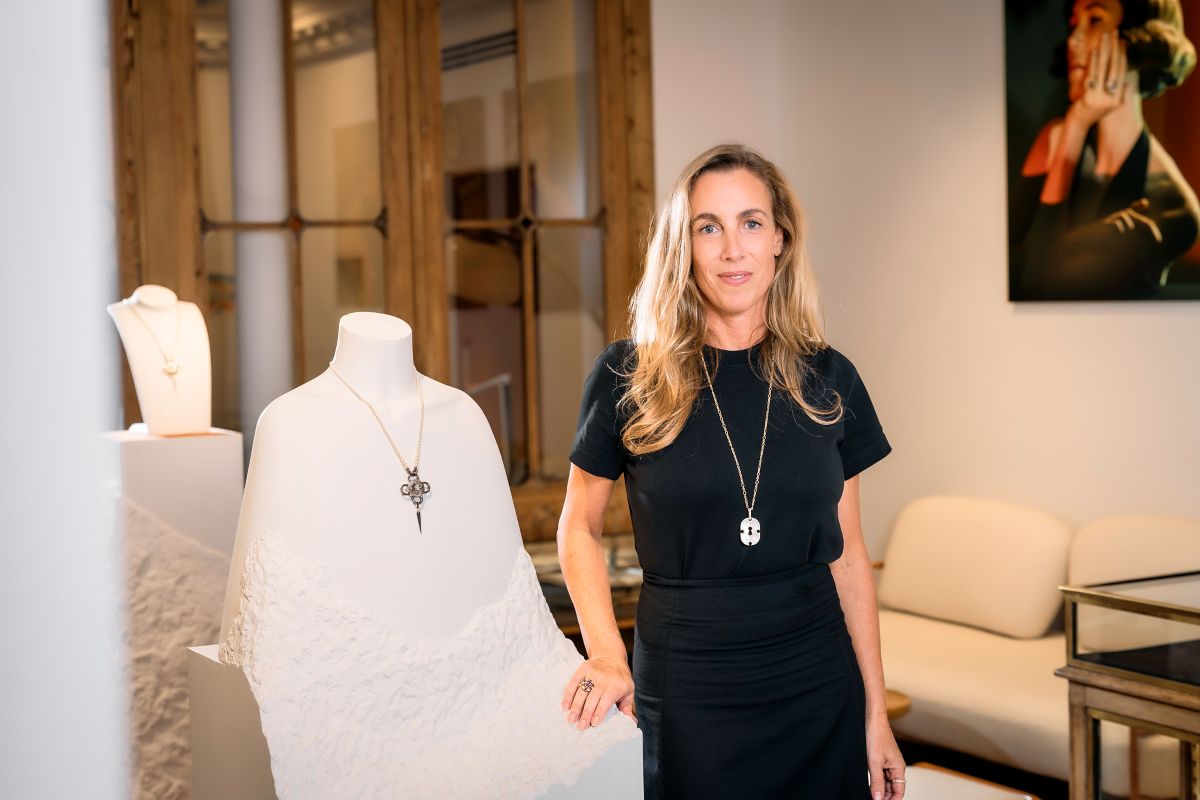
After more than twenty years spent at the heart of the great houses of high jewelry and international luxury, from Cartier to Hermès, from De Beers to LVMH, between Paris, London and New York, Marie Berthelon could have continued along a perfectly mapped trajectory at the summit of the system. Instead, she chose to step away from it to revive Rouvenat, a nineteenth-century Maison that had disappeared and that she is now reactivating as a living territory, at the crossroads of heritage and the avant-garde.
At the head of a small, deeply committed structure, she defends a singular vision of high jewelry: a luxury of circularity and memory, where recycled gold, antique stones rediscovered in forgotten safes, and raw or polished materials do not seek perfection, but light. A jewelry that does not add itself to the world, but awakens it, transforming what already existed into a contemporary presence.
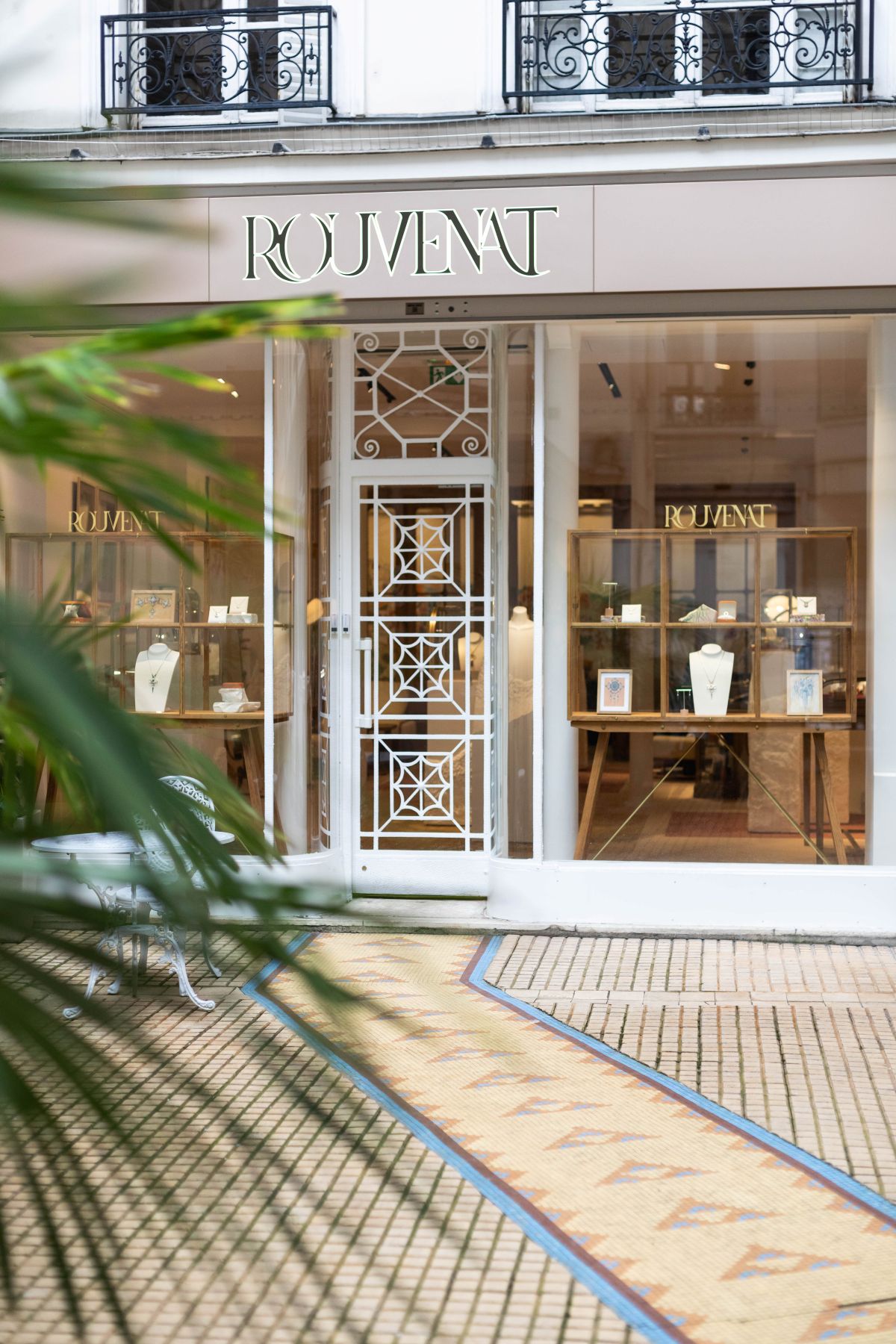
This text was not planned, and was not meant to exist in this form. It was born from a lunch beneath the glass roof of 416 rue Saint-Honoré, at Rouvenat, in the presence of Marie Berthelon, co-founder of the Maison, through a conversation that gradually moved beyond the frame of the moment.
The table was long, covered with fresh flowers. The cuisine, precise and luminous, was signed by Servan. And in the light filtered through the glass roof, the lunch unfolded gently, almost naturally, as though the place itself were setting the rhythm of the exchanges.
A Maison Born of a Living Paradox
Marie begins without detour. Rouvenat is “a start-up with 150 years of history.” In that sentence, everything is already there, though not yet unfolded.
A Maison founded in 1852, later disappeared, and now reactivated as a contemporary presence, as though time had folded in on itself without ever erasing it.
Before that, there was a long journey through the great luxury houses: Cartier, Hermès, De Beers, between Paris, London and New York. Marie rejects none of it, but gradually moves away from it, until reaching that tipping point where a necessity asserts itself: “To leave the highly structured world of corporate life and return to something more embodied, freer, more human.”
It is within this shift that Rouvenat tightens around a rare form: only five people in the team, each with a plurality of roles. “Everyone does almost six jobs,” she says, not as an organizational model, but as a way of remaining as close as possible to the material.
Luxury as Living Memory
Very quickly, another grammar of luxury emerges, less theoretical than sensory, almost organic. Marie speaks of a luxury “with heart, consciousness and circularity,” but these words do not describe a system: they describe an attention.
Because here, nothing truly begins with creation. Everything is set in motion by the gaze. “Making something new out of the old,” she says at first, before immediately refining the idea: above all, it is about “bringing a new gaze to what already exists.”
It is in this tiny gap that the entire philosophy of the Maison resides. It requires a certain gaze, almost a discipline: learning to see differently, to slow down, to accept searching where things still lie dormant. And also a form of courage: that of not moving toward the obvious new, but returning to what was already waiting to be awakened. From this attention are born pieces that do not seek effect, but presence: “Pieces with heart and spirit.”
Living Matter, Active Light
In this high jewelry, matter is never decorative. It is tension, passage, circulation. Raw or polished, assembled or living alone, recycled gold or silver captures light without freezing it. It transforms it according to the angle, as though each surface possessed its own breath. The creations go beyond the idea of recycling. They belong to a movement of continuous transformation, in which existing materials are reinterpreted rather than replaced.
The stones, antique ones, are rediscovered in forgotten safes, opened after years of silence, sometimes decades, and it is in this return to the surface that their story begins again. “Entirely existing materials,” Marie says, as if to remind us that nothing here starts from zero, but that everything begins again elsewhere.
Léon Rouvenat and the Memory of a Sign
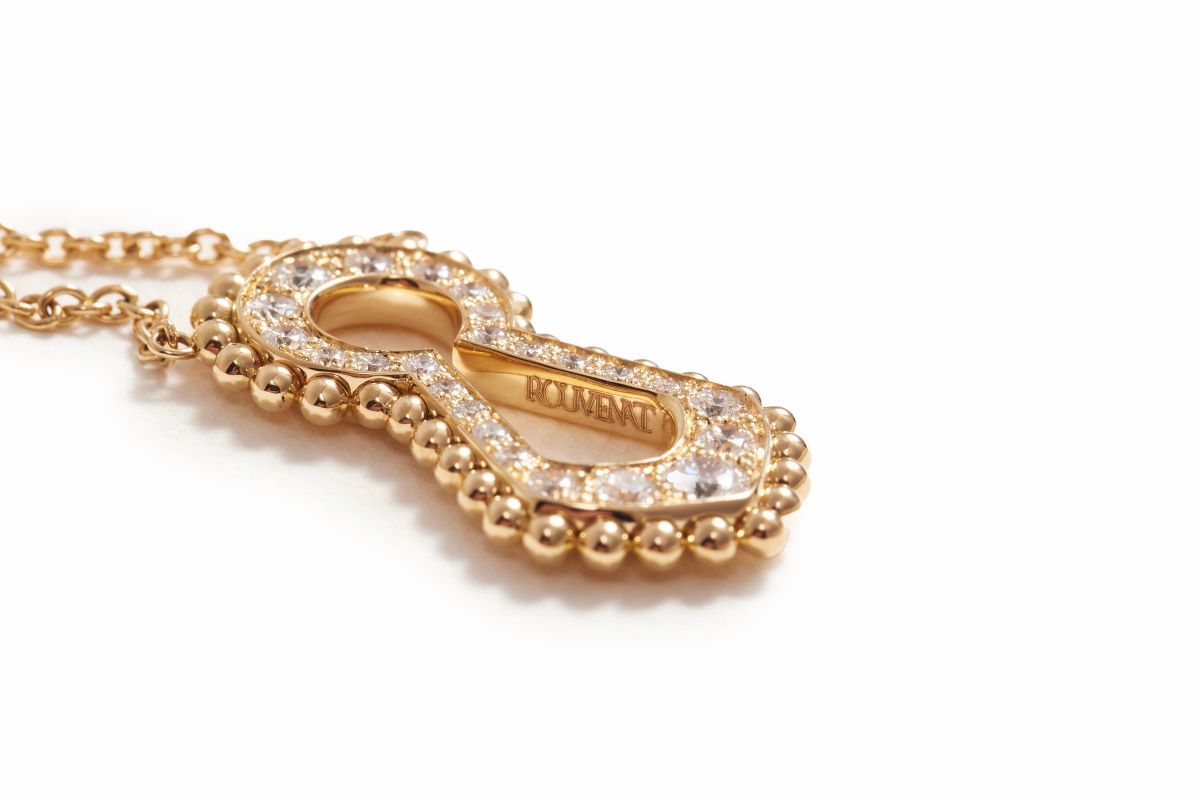
To understand this vision, one must return to the nineteenth century. Léon Rouvenat, a partner of Christofle, founded the Maison in 1852, at a time when jewelry was becoming a true industry of art, structured and international. It stood out then for a modernity that was astonishing for its time. Its historic hallmark, a discreet, almost secret detail, was a keyhole. A sign conceived as an invitation: to open the jewel, to reveal its interior, to make it an object of passage rather than a closed object.
This symbol now irrigates the rebirth of the Maison and notably inspires the Unlock collection, where the keyhole motif becomes a contemporary language, between threshold and intimacy.
Around this heritage, several lines structure the current universe, such as Unlock, precisely, where the jewel becomes passage, secret and opening, or Bolt, with its more architectural writing, where forms seem to lock and then free themselves in the light. Frame, for its part, frames the stone like a living image, without ever fixing it. In this continuity, Rouvenat does not seek to reproduce a past, but to extend its gesture: that of a jewel conceived as an object to be read, opened, crossed through.
Rediscovery as a Starting Point
That said, nothing begins as a strategy. The adventure is born at a Parisian bouquiniste. There, Marie discovers more than 3,000 old Rouvenat gouaches. An intact material, still vibrant. The shock is discreet, but immediate.
From there, she does not organize a reconstruction: she attempts a reactivation. “I wanted to give it a voice again,” she says simply. In the boutique beneath the glass roof, this idea becomes tangible. Recycled gold, recycled silver, antique stones rediscovered in safes, certified and reworked materials: everything already exists, but nothing is fixed. What matters is not the origin of the elements, but the way in which they are put back into circulation. And in this movement, matter becomes language: a language of light, contrast, density and breath.
The Cases as an Extension of the Gesture
More broadly, Rouvenat opens its universe to dialogues with contemporary artists, entrusting them with the creation of its jewelry cases: recycled, these become unique pieces, extensions of their creative worlds. Jewelry thus enters a space of exchange between matter, trace and memory, and ceases to be an isolated object to become a shared territory.
It is within this movement that the collaboration with Senz takes shape. A multidisciplinary artist, Senz explores typography, photography and digital printing through dense and symbolic cultural collages. He intervenes on existing cases, made from old boxes that have been found and then transformed, reinterpreting them through pictorial gestures and interventions drawn from urban art, shifting their initial status without freezing them, but instead putting them back into circulation.
Over the course of the lunch and the exchanges, one idea runs through everything without ever becoming fixed. Luxury is no longer an accumulation, but a relationship to materials, memories and layered times. And perhaps, above all, a way of looking, with enough slowness for what was buried to begin appearing again. True luxury today may be precisely this: knowing how to reveal, with creativity, the echo of stones that was already there.
In conclusion, when the lunch comes to an end, nothing truly closes. The flowers remain on the table as though they were still inhabiting the light, and the glass roof continues to let something slow, almost suspended, filter through. The conversations, for their part, do not seem to stop; they simply move elsewhere.
With Marie, nothing resembles a rupture. Rather, it is a continuous shift between eras, gestures, materials and memories. And within Rouvenat, something takes shape with discreet evidence. A high jewelry that does not add, does not overload, but shifts the gaze until things reappear.
A Maison traversed by artists and materials, where cases, collections and contemporary gestures prolong one and the same movement: that of a jewelry memory that continues to circulate.
With the OIF, Francophone Literature Breaks Down Borders
Eva Gonzalès: Subtle Freedom Through the Brush
September News: The Battle of Lebanon
The Samir Kassir Festival, or the Lebanon Yet to Be Born
Why Habermas Remains Urgently Relevant
المزيد من Yasmina Comair
عرض الكل


المزيد في Culture
عرض الكل



'Byblos' at the IMA: a cultural resistance in the face of war
الأحدث من Levant Time
عرض الكل


