

Gibran Khalil Gibran: A Bridge of Light Between East and West (3/3)


As we have seen previously, Gibran Khalil Gibran was a multifaceted artist – at once poet, thinker, writer, and highly gifted painter. Although he is best known in the West for his literary work The Prophet, published in numerous languages, his pictorial work is equally remarkable and was recognized during his lifetime.
“Art is the expression of thought through brush,
chisel, pen, or song.
It is the divine spark that burns within each of us.”
“I would like to paint what lies
at the very depths of the human heart.”
Gibran showed an aptitude for drawing from childhood. In 1904, his first drawings were exhibited at Fred Holland Day’s studio in Boston, thanks to Mary Haskell, his mentor. In 1908, encouraged by her, he enrolled at the Académie Julian as well as in Auguste Rodin’s studio in Paris in order to refine his painting technique. This encounter with Rodin marked a turning point in his vision of the human body. Rodin himself compared Gibran to William Blake. Like Blake, Gibran illustrated his own texts, seeking to create a “total” work in which word and image echo one another.
In Paris, he also studied under the painter Pierre Marcel-Béronneau, whose technical mastery and mystical inspirations he particularly admired.
Gibran, the painter as much as Gibran the writer, represents a synthesis of two worlds: on one side, the United States and his Parisian academic training, and on the other, his Lebanese roots, steeped in the beauty and mystical spirituality of the Lebanese mountains.
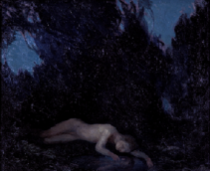
“Self Contemplate, 1914.” Oil on Canvas. (Gibran Khalil Gibran Museum)
His Work
Gibran was essentially self-taught. He produced a substantial body of artistic work. From the very beginning, his pieces were exhibited in prestigious galleries, including the Montross Gallery and M. Knoedler & Co. in New York.
His Style: Mystical Symbolism
“Art does not consist in copying reality,
but in capturing the emotion that reality awakens in us.”
Gibran’s pictorial work is an extension of his philosophy. His artworks are not meant to be merely looked at, but contemplated.
Gibran’s style belongs to a romantic and spiritual symbolism that does not align with the artistic movements of his time, such as Cubism or Fauvism. He gives primacy to the human body, which he sees as the temple of the soul – “beauty in its purest state.” Through human forms, he seeks closeness to God and to reveal the unity of the universe. His figures, often nude, represent humanity in its original state of purity, stripped of social conventions. The bodies, with their blurred and ethereal outlines, seem to emerge from mist or dreamlike haze, suggesting the spirit’s liberation from matter.
Gibran frequently uses muted tones, with gradients of brown, pale blue, and pinkish beige. His washes are light, almost transparent.
He excels in pencil drawing, charcoal, and watercolor. His oil paintings retain the same diffuse softness, prioritizing emotion over realism.
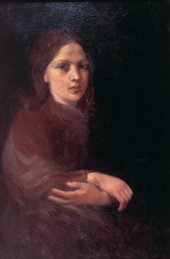
“The Sad Mona Lisa, 1914.” Oil on Canvas. (Gibran Khalil Gibran Museum)
Where to See His Works?
The largest collection is housed at the Gibran Museum in Bsharri, Lebanon. His works can also be seen in some of the most prominent American museums, including the Metropolitan Museum of Art in New York, the Museum of Fine Arts in Boston, the Newark Museum, as well as at Mathaf, in Qatar.
The Gibran Museum
The museum is located in Bsharri, his hometown, in the Qadisha Valley, within the former Mar Sarkis Monastery (Saint Sergius), a cave monastery whose origins date back to the 7th century.
At the end of his life, Gibran expressed the wish to acquire this monastery as a retreat and, eventually, as his burial place. After his death, his sister Miriana, with the help of Mary Haskell, purchased the site to fulfill his wish.
The museum, which officially opened its doors in 1975, spans sixteen rooms and houses Gibran’s tomb as well as more than 440 original works. It also preserves his personal belongings, private library, New York furniture, manuscripts, and, most notably, his Bible.
The site is managed by the Gibran National Committee, which carefully safeguards and transmits his cultural legacy.
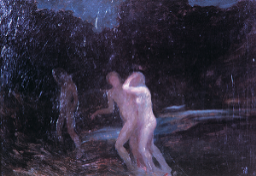
“The Exiled from Love, 1914.” Oil on Canvas. (Gibran Khalil Gibran Museum)
(Re)Discovering Gibran
“When you reach the summit of the mountain,
you will finally begin to climb.”
The only way to (re)discover Gibran the painter is to visit his museum in Bsharri, to absorb the distinctive atmosphere of the site and the surrounding nature, and then to take time to contemplate his paintings in silence.
As for the writer, one would need to obtain his complete works and read them gradually in their original language, savouring each word as though it were a precious nectar.
“A little time, a moment of rest upon the wind, and another woman shall give me birth.” (The Prophet)
Read more:
Gibran Khalil Gibran: A Bridge of Light Between East and West (1/3)
Gibran Khalil Gibran: A Bridge of Light Between East and West (2/3)
With the OIF, Francophone Literature Breaks Down Borders
Eva Gonzalès: Subtle Freedom Through the Brush
September News: The Battle of Lebanon
The Samir Kassir Festival, or the Lebanon Yet to Be Born
Why Habermas Remains Urgently Relevant
المزيد من Micha Moussallem
عرض الكل


المزيد في Culture
عرض الكل



'Byblos' at the IMA: a cultural resistance in the face of war
الأحدث من Levant Time
عرض الكل


