

Palestine Put to the UN Test
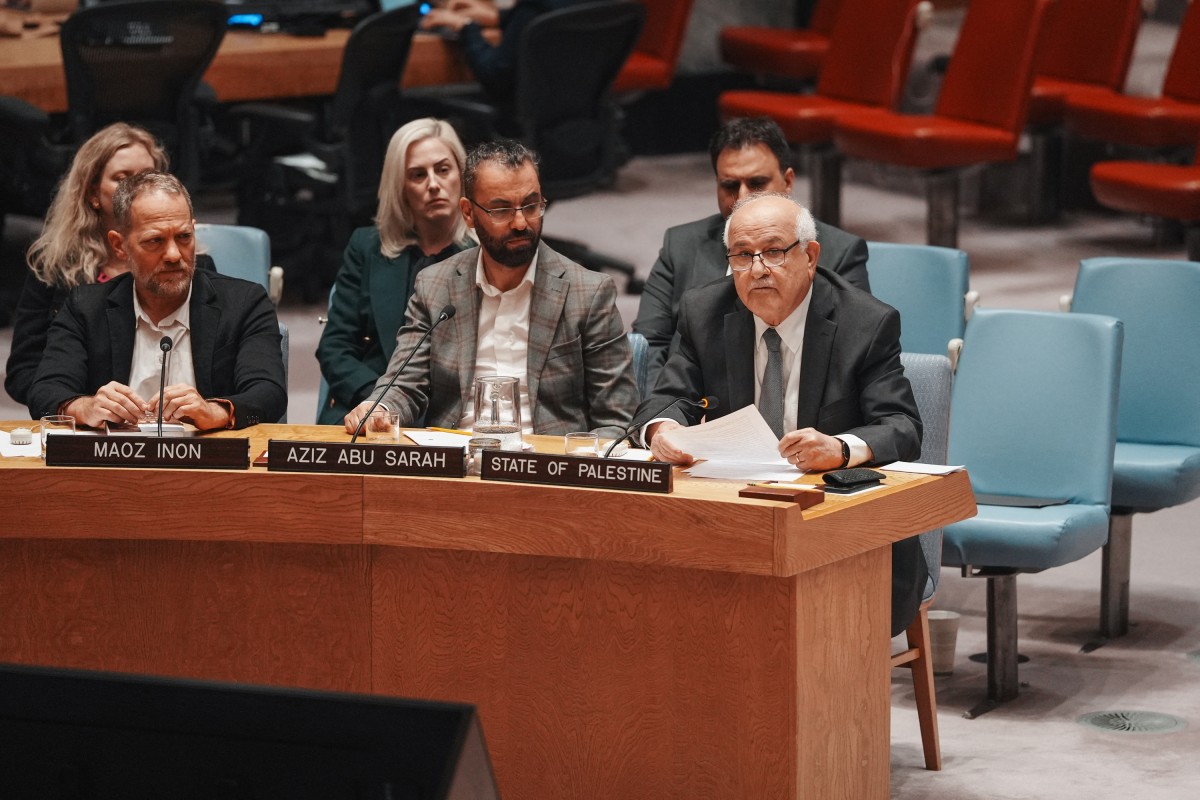
The Israeli prime minister returned from New York disappointed. Only a handful of delegations listened to him, and his speech contained no language suggesting any effort to make peace in the Middle East. He addressed only those whose votes he hopes to secure in the next Knesset elections in order to remain in power.
By contrast, the Palestinians achieved a clear political and diplomatic success on this international stage despite their weakness, the siege and the continuing pressure. We therefore witnessed a wave of frenzy in the West Bank, as the olive harvest season coincided with the limited Palestinian achievement secured during the 81st session of the United Nations General Assembly.
Upon Netanyahu’s return, the number of Israeli occupation troops in the West Bank was doubled, from one military division to two. Armed settlers, protected by the army, carried out 117 attacks and assaults across the West Bank. Twenty-five vehicles were destroyed, trees were cut down, livestock was stolen, as were water tanks and garbage containers, while dunams of land were bulldozed to separate villages from the outskirts of cities and to build roads reserved for settlements. Finally, a comprehensive closure was imposed on the West Bank from September 28 to October 3 for the Jewish holidays, with new checkpoints and gates being deployed, bringing their number to more than one thousand. The number of Palestinians detained in the West Bank reached 9,400, including 3,198 administrative detainees held without charge, 88 women and 370 children.
It was a week of frenzy and revenge instead of a week of holiday celebrations. This is the reality of religious extremism and its tangible manifestation on the ground. It is organized madness, protected by the power of the occupation army and the policy of its government.
Gaza After New York: The Plan on Paper and the Test on the Ground
New York this year was not merely another stop on the United Nations calendar, nor simply another occasion to exchange speeches and statements about the war in Gaza. The international community appeared to arrive at the General Assembly carrying a more urgent question: what comes after the war ends? Who will govern Gaza? Who will guarantee its security? Who will rebuild it? Most importantly, can Gaza become a gateway to reunifying Palestinian geography, or will the transitional period add yet another chapter to the division?
What emerged from the meetings of recent days does not resemble a final agreement, but it goes beyond traditional statements. A political, security and economic map for the postwar period is beginning to take shape, bringing together the plan to end the war, Security Council Resolution 2803, the Peace Council, the National Committee for the Administration of Gaza, the International Stabilization Force and the recovery and reconstruction plan, alongside the broader path toward the establishment of a Palestinian state.
On September 22, United Nations Secretary-General António Guterres clearly set out the political framework when he affirmed that Gaza and the West Bank, including East Jerusalem, must remain a single political, economic and territorial unit under one Palestinian government, and that the political solution is based on two states along the pre-1967 lines.
What was new, however, was not the reaffirmation of these principles, but the attempt to turn them into practical arrangements.
The following day, at a meeting on early recovery in Gaza, the United Nations put forward an equation according to which reconstruction and politics cannot be separated. Services cannot be rebuilt without an authority capable of managing them, and a transitional authority cannot be stabilized without providing electricity, water, healthcare, education and housing. The United Nations therefore articulated a more specific principle: one Palestine, one recovery plan and one aid mechanism, with Palestinian institutions serving as the central point of reference.
At the same time, the “Peace Council” began to move from a political idea toward a planning structure. The National Committee for the Administration of Gaza was formed from Palestinian technocrats and tasked with managing civilian affairs during the transitional period, which is intended to serve as a bridge toward restoring unified Palestinian administration over Gaza and the West Bank. The paradox, however, is that despite having been formed and operating for months, the committee has still been unable to enter Gaza and perform its duties on the ground. Nor has the International Stabilization Force yet deployed inside the Gaza Strip.
This is where the real distance between the plan and reality begins.
The plan can define institutions and roles, draw up reconstruction timetables and determine how funds are distributed. But it cannot by itself open the crossings, resolve the question of weapons, impose an Israeli withdrawal or enable the Palestinian committee to enter Gaza and begin its work.
This is the knot that followed the New York meetings from one session to the next.
The Arab and Muslim countries involved in the plan did not reject its course. Rather, they pushed toward moving to its next phase: disarming the factions, securing an Israeli withdrawal, deploying the Stabilization Force, then allowing the transitional Palestinian administration to assume its responsibilities and launching reconstruction. The implementation of these elements, however, remained dependent on the positions of the parties present on the ground, not on international agreement alone.
Disarmament can therefore be seen as one of the keys to the new phase. The UN report submitted to the Aid Coordination Committee confirms that Hamas and the armed factions have not yet been disarmed and that the transitional arrangements stipulated in Resolution 2803 have not yet become operational inside Gaza.
Yet reducing the problem solely to Hamas’s weapons would oversimplify the picture. There is also the Israeli question: when and how will withdrawal take place? What will be the limits of the international force? Who will guarantee security during the transitional period? Will Israel accept Gaza’s transition from an international-Palestinian transitional administration to a unified Palestinian administration, or will the security arrangements remain open-ended?
There is, in turn, the Palestinian question: will the National Committee for the Administration of Gaza become a bridge enabling the Palestinian Authority to return to the Gaza Strip, or will the length of the transitional period transform it into a new political and administrative structure?
The United Nations is clearly trying to prevent the second possibility. Its latest report stresses the need not to create Palestinian institutions parallel to the Authority and states that the ultimate goal is for Gaza and the West Bank to be governed by a single Palestinian government.
This is where the importance of the New York meetings lies. They returned the Palestinian question to the center of the equation after the Gaza war had nearly reduced it to a humanitarian and security issue. On September 24, nearly one hundred countries and organizations took part in a meeting of the Global Alliance for the Implementation of the Two-State Solution, reaffirming that Gaza and the West Bank constitute a single unit and that the transitional arrangements must lead to one Palestinian government, while linking reconstruction to the broader political process.
But this international consensus runs into another obstacle of equal importance: what is happening in the West Bank.
While New York speaks of reunifying Gaza and the West Bank, the UN report records the continued expansion of settlements, settler violence, displacement, restrictions on movement and the Palestinian Authority’s severe financial crisis. The report states that these developments undermine the prospects for a contiguous and viable Palestinian state.
Here lies the great paradox of the entire picture: the international community is working to rebuild Gaza while, in the West Bank, the geographic and political conditions supposed to make Gaza part of a single Palestinian state are being eroded.
On the financial front, the plan has also moved another step from generalities to figures. Projects for Gaza’s recovery and reconstruction have been presented, while the United Nations stresses that the available funding remains far below the scale of the needs and that the various financing mechanisms require coordination so that the proliferation of funds and institutions does not create further fragmentation.
We therefore face an extremely complex equation: money is needed for reconstruction; reconstruction requires security; security requires political arrangements; political arrangements require a Palestinian administration; Palestinian administration requires the reunification of Gaza and the West Bank; and their reunification requires a political horizon for a Palestinian state.
In other words, every link in the chain depends on the others.
For this reason, the outcome of New York cannot be read as the birth of a new agreement on Gaza. What emerged was something else: an attempt to place the postwar period within an integrated international political framework that does not merely seek to reconstruct destroyed buildings, but also attempts to rebuild authority, administration, security and the economy, while linking all of this to the future of the Palestinian question.
The danger, however, lies in the possibility that the transitional period may last longer than Gaza can bear. Every additional day without an effective administration, stable services, clear funding and an internal Palestinian movement capable of dealing with the new reality widens the distance between the plan and the people it is meant to serve.
The question after New York is therefore no longer: is there a plan for Gaza?
The plan exists.
Nor is the question any longer: is there money for reconstruction?
There are pledges, financing mechanisms and projects under preparation.
The real question has become: who has the ability to implement the plan?
That is where the entire issue lies. If the Palestinian committee is able to enter Gaza, if the Stabilization Force deploys, if the Israeli withdrawal begins according to a clear timetable, if progress is made on disarmament and if reconstruction is placed under a unified Palestinian framework, the New York plan could become the beginning of a new political process.
But if these elements remain suspended, each waiting for the others, the “transitional period” could turn into a period without end.
New York has therefore drawn the road, but it has not yet opened it.
The difference between the two is what the coming weeks will reveal.