

Challenges to World Peace
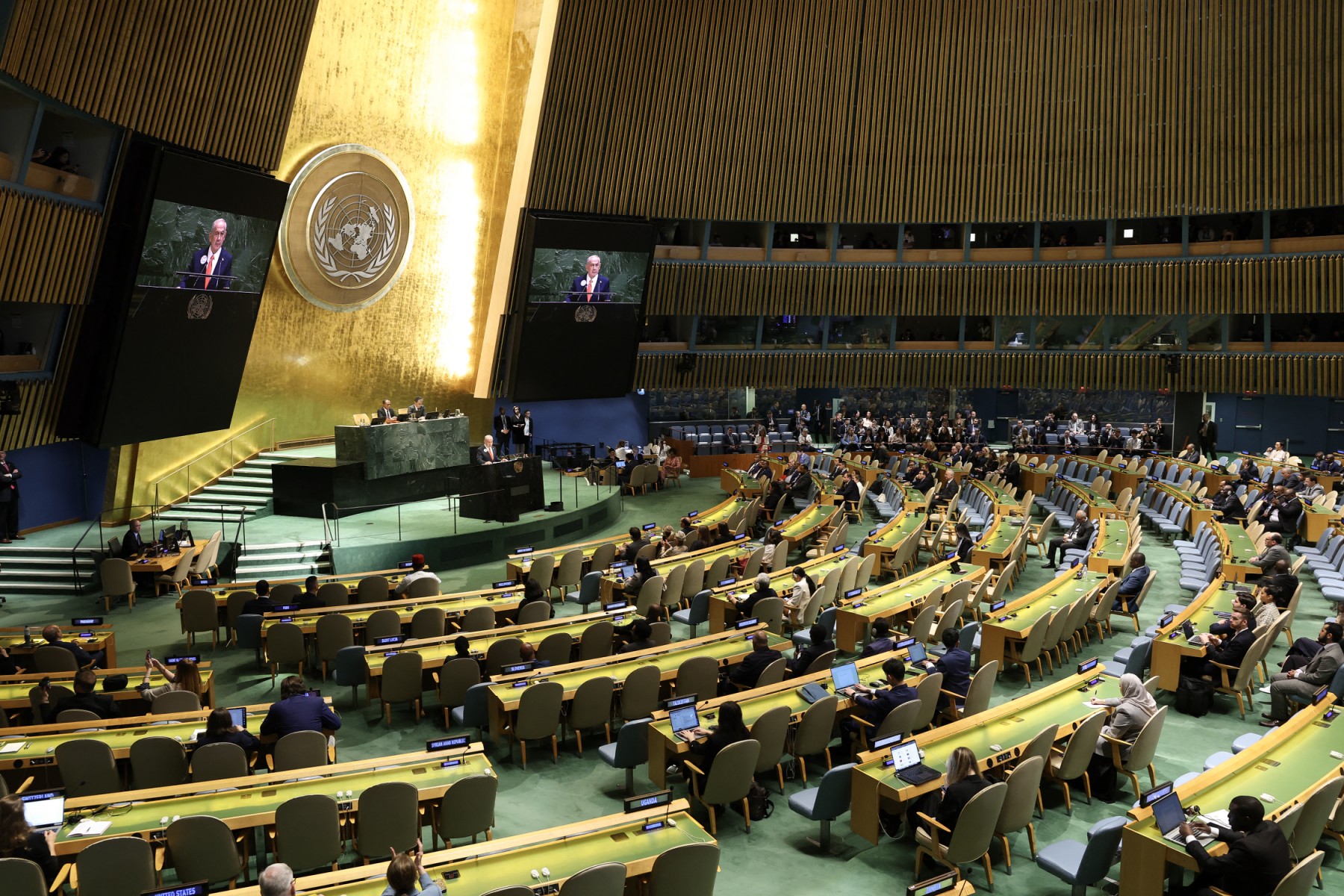
At this time every year, New York City hosts the largest gathering of elites devoted to discussing issues of world peace and the future of life on this planet. Something akin to a political-media fever takes hold, as the question of the role and function of the United Nations rises in intensity, along with the extent of its ability and authority to fulfill the primary mission assigned to it at the time of its founding.
Visible signs of age and deterioration can also be seen in its headquarters, which are in need of renovation. Some, however, believe the building needs to be demolished and comprehensively rebuilt, a necessity imposed by the sweeping transformations the world has undergone over the past eight decades. These developments have left the “Security Council” unable to guarantee world peace, just as it has proved unable to enforce its own resolutions.
A full year has passed without the “Security Council” managing to bring an end to ongoing wars, whether between the United States and Iran or in Ukraine, Sudan, Lebanon and Palestine, to name only a few examples.
This reveals the problematic nature of the serious attention given to each war separately, depending on its impact on states’ interests and its resonance among their populations. The civil war in Sudan is one example. It has produced millions of displaced people and widespread destruction of the infrastructure of cities and villages, yet it is treated as a localized war that merits little more than a news item.
By contrast, the crisis in the Strait of Hormuz, because of its impact on global trade and energy, receives daily scrutiny down to its smallest details, while the international legal basis for addressing it remains absent and the Security Council is unable to reach a decisive resolution, even as Yemen, Lebanon and the Arab Gulf states directly bear the burden of its catastrophic consequences.
Our second example can be seen in the Gaza Strip and the West Bank, where resolutions have piled up in the hope of ensuring the success of the “Peace Council,” yet people there have seen no tangible improvement in their way of life, which continues instead to deteriorate.
The world is also witnessing how the Israeli government, through its army and settler militias, is attempting to erase Palestine from the political map and force its people once again to leave, returning the conflict with the Palestinian people to the cycle of violence behind biblical narratives that have no scientific basis.
International Polarization
The United Nations did not have enough time to fulfill the commitments set out in its Charter before bipolarity cast its heavy shadow with the beginning of the Cold War.
The “veto” wielded by both sides became the weapon that cut dialogue short and diverted the UN compass from its purpose. This conclusion does not mean that everything failed. The United Nations succeeded in resolving many wars, disputes and issues to the benefit of humanity, while a number of fair decisions were implemented in health, education, the environment and human development when the veto does not serve any of those who benefit from it at the expense of others.
The veto thus became a privilege translating policies of national superiority, evasion of accountability and obstruction of justice rather than the protection of world peace.
Three decades have now passed under the dominance of a single American pole in determining the fate of international issues. It has become clear in practice that the shadow of the Cold War weighed less heavily than unipolarity in its impact on the course, role and functions of the United Nations.
We have witnessed a rapid deterioration in areas in which the Western camp once took pride and used to criticize the socialist bloc, foremost among them human rights, freedom of expression, protection of the global climate and the handling of issues of humanitarian displacement and asylum, whether forced or voluntary.
This has gone so far, among other examples, as calls to terminate UNRWA’s services and withdrawals from cultural institutions and agencies such as UNESCO under political pretexts unrelated to established standards. Most recently, sanctions have been imposed on international courts and judges in an effort to obstruct the course of international justice.
These factors, along with many others that cannot be listed here, have led veto-holding powers such as Russia, China and France to embrace the idea of working toward a multipolar world. This has also encouraged regional powers such as India, Brazil, Iran and others to move in the same direction.
This appeal may have contributed positively to the growing role of the influential G20, but outside the framework of the United Nations. Yet the G20 has not managed to produce policies deep enough to bring about fundamental change in the role or working methods of the UN. It too has experienced setbacks in several areas, including security, the economy and overall resources.
This has driven regional states to build partnerships with a protective character and function in order to preserve their role and weight, such as the “BRICS” grouping as an economic model and the “Mecca Agreement,” which evolved into the “Mecca Defense Alliance,” as a military-security model.
Both models are rooted in the sharp decline of the international system that is supposed to uphold international law, as well as in the practical failure of the Security Council in its handling and policies toward severe international crises such as the “invasion of Iraq,” the U.S.-Iranian conflict, the war in Ukraine and other bloody and comprehensively destructive conflicts, most recently the genocide in the Gaza Strip. In these cases, the U.S. administration imposed its vision outside the United Nations and in confrontation with it.
At this point, the idea of a “multipolar world” needs to be unpacked in order to examine whether the necessary power and concrete realities are actually in place.
It should be recalled here that Russian President Vladimir Putin’s anger toward President Barack Obama was linked to a shift in the American position, from prioritizing partnership with Moscow to establishing an initial partnership with Beijing. This change redirected Russian foreign policy away from reconciliation with the West toward parity and confrontation, particularly on the Eurasian stage, eventually leading to the destructive conflict we are witnessing in the war with Ukraine.
The U.S.-Chinese partnership, meanwhile, has gone through sharp fluctuations, driven mainly by American choices that had led to the concentration of 70% of military forces around China. The October 7 operation brought those forces back to the Middle East, while hard-line policies toward Beijing receded in favor of rebuilding a new partnership championed by President Xi Jinping, who achieved relative success in advancing this direction during his current visit to Washington.
China’s call for partnership, accompanied by certain incentives offered to President Trump, gives Beijing time and room to maneuver away from a costly and dangerous arms race. Beijing has not presented itself to Washington as a second, equal pole because it knows its strengths and weaknesses very well.
Accordingly, Beijing neither embodies the call for a “multipolar world” nor regards it as an objective. Rather, it sees its role advancing quietly toward a renewed bipolar world, this time between Washington and Beijing. Until that point is reached, the Silk Road is preferable to war. This is the logic of Chinese moderation as practiced so far.
Anyone who believes that a “multipolar world” awaits us is therefore, without doubt, operating under a degree of illusion in reading international transformations.
The United Nations thus remains hostage to this transitional equation prevailing on the international stage. It preserves its old structures while trying to do something useful for humanity wherever it can address issues that do not require the use of the veto.
In our Middle Eastern region, stability will not be achieved without the U.S.-Iranian conflict reaching its conclusion, so that political, security, military and economic conclusions can be drawn from its outcome.
It must also be said that the Mecca Agreement initiative and the alliance formed under it constitute the largest force for stability and moderation capable of helping shape the region’s future in partnership with Washington and Beijing, in addition to existing partnerships with the European Union and Russia.
Finally, the United Nations remains a necessary institution, and preserving it is a general international responsibility that serves humanity and the forces of moderation. The speech by the Spanish prime minister, in which he referred to the need to end the veto in order to open the way more fully to scrutiny and accountability, falls within this context.
Achieving that goal, however, faces obstacles and difficulties whose scale cannot presently be assessed.
But the effort is worth making.