

The Twin Towers - Manhattan Today
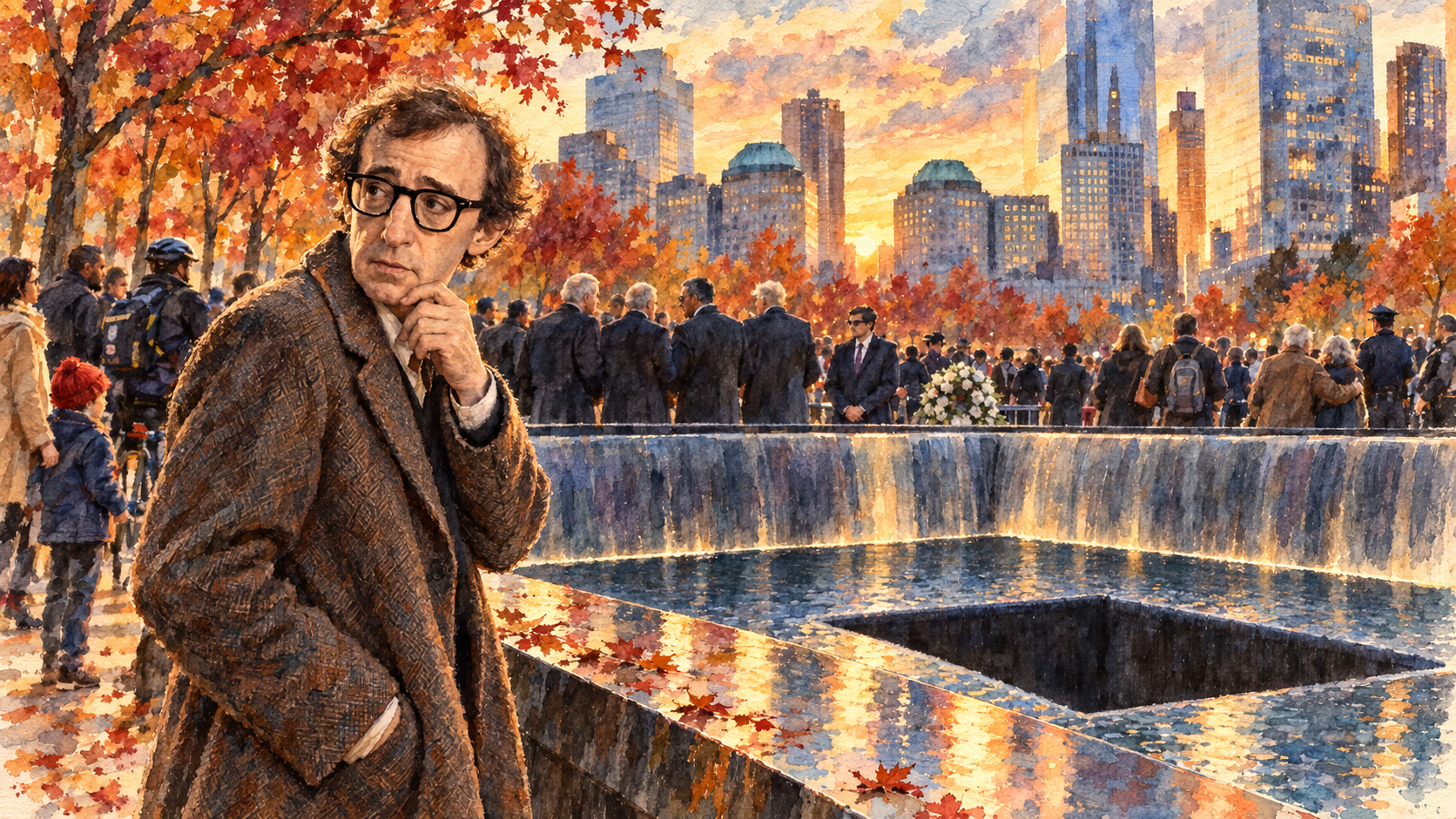
What if Woody Allen had been present this year at the commemoration of the fall of the Twin Towers? He would have thought, watched and listened. He would have observed Bill Clinton, who once heralded the Third Way for the new millennium, while George W. Bush’s eyes might have closed upon the spectacle of the invasion of Iraq, and Obama, the dark-skinned savior, shifted from one policy to another with an ease that matched his physical agility. Beside him, Joe Biden might have been sleeping standing up, his face marked by sadness, age and boredom, like a copy that no longer resembled the original.
I think Allen would have watched more closely than anyone else the newcomer at City Hall, Zohran Mamdani, trying to understand how he had burst onto the scene from outside the circle of presidents seated in the front row. Had the city allowed him to do so during one of history’s moments of distraction, or does he carry the new voice of New York? And why is he so different from the presidents present, quite apart from his sharp confrontation with President Trump, who chose to be alone at the Pentagon for the commemoration?
Perhaps the scene would have prompted Allen to explore the complex human relationship with the structure of this great city, its economic, political, scientific and cultural role, the immense amount it gives and what it also takes away from the lives of its inhabitants. He who loves the city, criticizes its elite and has affection for its ordinary people.
Perhaps he would have perceived a different balance in the sight of the dark memorial pools, of water that flows away and never returns, endlessly disappearing as though summoning the souls of the victims of terrorism and their screams.
Perhaps he would have said: enough. The Twin Towers must be rebuilt, and not with light alone, so that we may move toward a future capable of healing both heart and mind.
But perhaps he would also have agreed with the city’s elite on the need to combine the imperative of never forgetting with the necessity of being reborn. For the significance of the matter has gone far beyond that of a city embracing people from every nation and every tribe on earth.
A city that still holds a central place in global decision-making. Without that identity, Zohran Mamdani would not have stood in the second row behind the four presidents, gazing with fascination at Barack Obama, who had preceded him in making the great breakthrough to the summit of power. Without this city, Mamdani would not have been able to challenge President Donald Trump and defeat him in his own stronghold.
The annual commemoration once again opens the debate over new approaches and a new reading of a quarter-century of global conflict. Such approaches require, first of all, that the facts be brought to light so that we may recover some measure of balance. For the shock of the Twin Towers continues to send tremors across the globe every day, while violence keeps escalating and is still met with nothing but more violence. And yet, one can still say that Manhattan is better today.
Riyadh
In Washington, presidents continue, on the anniversary of the September 11 attacks, to repeat with the public the pledge: “We will never, ever forget, and that is why we fight,” and, “We have no choice, we can only prevail” over terrorism and terrorists.
These are not only Osama bin Laden, the figure behind the attack, nor Khalid Sheikh Mohammed, its principal planner, detained for twenty-nine years and still awaiting trial before the American justice system, nor the handful of suicide attackers, most of whom were Saudi nationals. Rather, they became a label under which came an endless series of policies, decisions and measures that changed, once and for all, the American nation, the institutions of the state and every center of political, economic, military and security power, as well as the media.
From that fateful moment until today, and with this profound transformation of the American state apparatus, or what is often called the deep state, the world too was bound to change. Saudi Arabia, in turn, had to absorb this global shock as the country whose nationality was held by most of those who struck the symbols of American power and dealt them a devastating blow.
At the time, Prince Abdullah bin Abdulaziz was crown prince. He and the pillars of the royal family in Riyadh understood that what was happening was not merely a security incident. Their communication with President George W. Bush was not intended to prove the Kingdom’s innocence, but to determine how to deal with the repercussions of an event capable of shaking the foundations of the strategic alliance between Washington and Riyadh.
Thus, in one of his speeches, Crown Prince Abdullah said: “An entire religion or an entire people must not be held responsible for the actions of an extremist group.” He also called for the formation of a “coalition against terrorism” to strike with an iron fist.
Later, we witnessed a series of political, cultural, social and military initiatives, foremost among them the “Arab Peace Initiative” launched in Beirut in 2002.
The systematic policies pursued by the current crown prince can be traced back to that moment, to the shock of the Twin Towers that struck Washington and Riyadh alike.
Yet this neither explains nor means that the American policies we have witnessed over the past two decades were correct or legitimate simply because they were rooted in the events of September 11.
Bloodshed
No one objected when the international coalition against terrorism was formed and Washington decided to target the Taliban government that had provided shelter to Al-Qaeda. The same was true of subsequent operations that eventually reached most continents.
For a long time, the definition of “terrorism” was specific and clear, grounded in intelligence evidence and patterns of armed conduct, whether involving groups, individuals or states that sponsor terrorism. But this is where another problem begins, one unrelated to direct terrorist acts: the expansion of the concept of “terrorism” and the designation of “state sponsors of terrorism,” which is more dangerous still.
The principle of counterterrorism thus became an elastic standard, tailored to suit policies pursuing other objectives. Iran provides one example. It does not conceal facts that can easily be demonstrated and that justify describing it as a state sponsor of terrorism, yet it entered into partnership with Washington in facilitating American operations against the Taliban government, something certain commanders of the Revolutionary Guards openly boasted about.
If the reasons for that partnership were purely tactical from the Pentagon’s perspective and can perhaps be understood in the Afghan case, the US-Iranian partnership in the invasion of Iraq cannot simply be overlooked. No security or political expert within the American deep state can justify it. This became clear later through everything that surrounded the invasion of Iraq and its catastrophic consequences, which can be summed up as an immense bloodbath. The available data and figures point in that direction, including American acknowledgements, quite apart from independent reports.
Some therefore came to view Iraq as the Arab and Muslim target selected in place of Saudi Arabia. Others saw the US-Iranian partnership in the invasion of Iraq as the key to redrawing the map of the Greater Middle East, from Tunisia to Afghanistan.
The course taken by events afterward lends credibility to this political interpretation. There is no need here to recount the major wars, special operations and continuing events in Libya, Sudan, Yemen, Syria and Palestine, with the current conflict with Iran’s Revolutionary Guard regime at their center.
Naza
Let us now leave aside the Woody Allen hypothesis and what he might have said about Manhattan, and turn to the documentary discussed by the press at the Venice Film Festival last week. It was directed by Yuval Abraham and Rachel Shor, both Israeli and Jewish, and received what was described as the longest standing ovation ever recorded at a film festival, according to Emmanuel Levy, a correspondent for the website “Zman Israel.” The two filmmakers reportedly received twenty-four and a half minutes of applause, breaking the previous record of twenty-two minutes following the screening of The Voice of Hind Rajab.
The reason, according to the Israeli journalist, is that the film “presents in detail the systems underlying the mass and deliberate killing of Palestinian civilians in Gaza by the Israeli military.” Because of the sensitivity of the subject, “the film was produced under exceptional circumstances… and shot in complete secrecy.”
He also revealed that “the filmmakers were given unprecedented access to direct testimony from at least 24 intelligence officers and soldiers who served in the Gaza war.” He added that the title of the film, Naza, is a term used to refer to collateral damage.
If we consider that collateral damage in Gaza has today reached more than 73,000 dead and 174,000 wounded alone, while collateral damage in Iraq exceeded half a million people during the invasion war alone, then the definition of terrorism itself must be reconsidered, for it has now been reduced to little more than bloodshed.
The question remains: how do we heal the trauma of the Twin Towers so that the bloodshed can finally stop?