


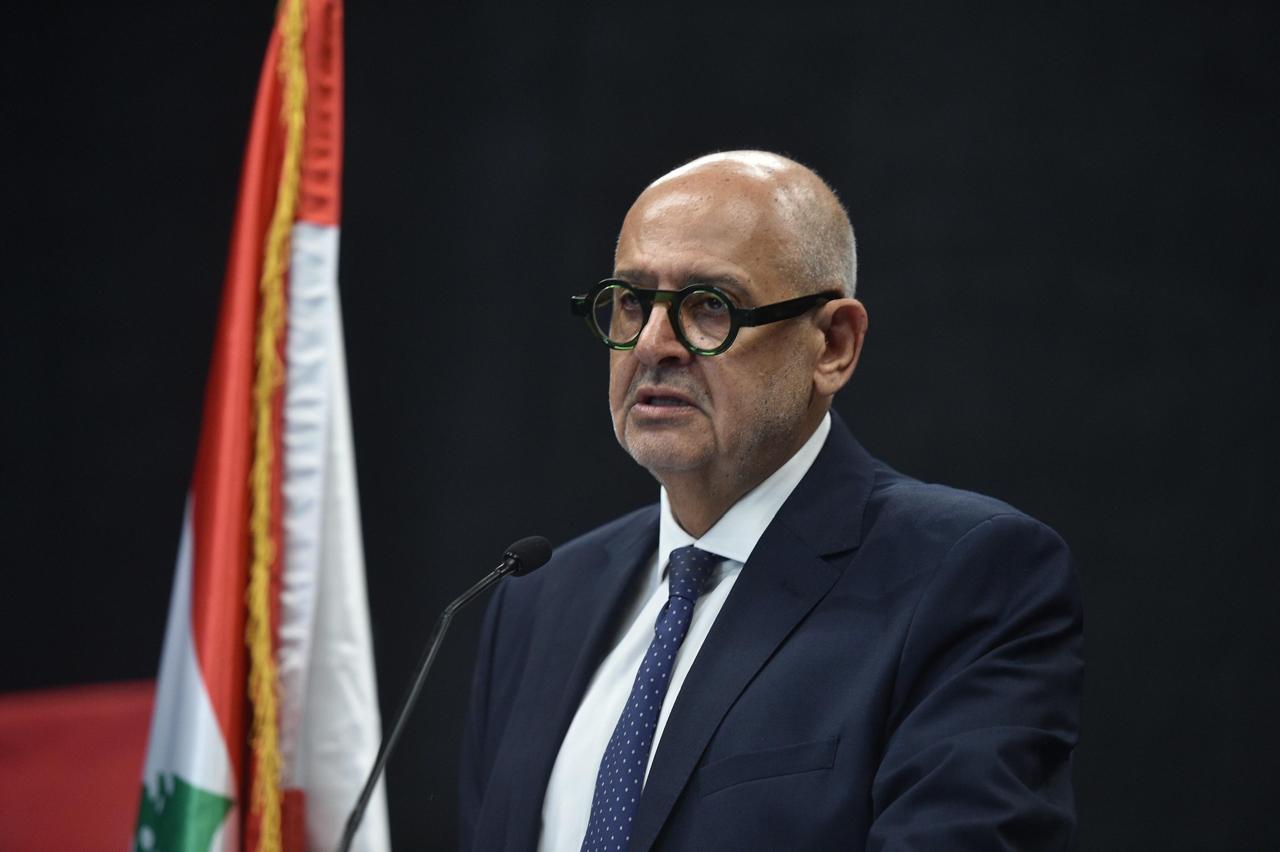
On the anniversary of Nassib Lahoud's passing, in a country accustomed to consuming its presidents even before putting them to the test, and lowering expectations before raising them, Nassib Lahoud's name remains outside this game of consumption. Not because he disappeared from political life, but because he was present in another way: the presence of an idea, not an agreement; the presence of a project, not a power-sharing arrangement. Thus, every time Lebanon goes through a new presidential crisis, Nassib Lahoud's name resurfaces as that of the “ideal president”; not as a romantic nostalgia, but as a moral and political benchmark, a symbol of what could have been.
Nassib Lahoud was not the product of a fleeting moment, nor a candidate of circumstances. He was the product of a well-defined political school: the school of the State. A State of constitution and institutions, not a State of compromise, above or below the table. From his entry into politics, he presented himself as a visionary, not as a man of power. He did not aspire to the presidency as an end in itself, but as a tool for the reconstruction of the State. In a country where the presidency had become a consolation prize or an instrument of obstruction, Lahoud presented it as a sovereign function with clear constitutional guarantees.
Nassib Lahoud distinguished himself by three qualities rare in the Lebanese political landscape. The first was clarity. He did not mince his words and did not hide behind vague formulas. On the issue of sovereignty, he was unequivocal: no state possessing weapons outside its control, and no true partnership with an usurped security apparatus. On reforms, he was direct: no economy without an independent judiciary, no social justice without a fair tax system, and no administration without accountability. This clarity made him “unsellable” in a political market that favors ambiguity, as it offers greater room for maneuver.
His second quality was independence. Nassib Lahoud owed allegiance to no axis, was prisoner to no power, nor was he subservient to any foreign power. His independence was not a slogan, but a daily practice: it shone through in his positions, his discourse, and his alliances. His name was therefore not forged in the shadows, nor was it propelled by a regional decision. This was precisely both his strength and his weakness: his strength with the people, and his weakness in the face of a system that abhors those who are not accountable.
The third characteristic is his political ethics. In a country where politics is practiced according to the logic of domination or blackmail, Lahoud proposed a different model: respect for the adversary, adherence to the Constitution, and the primacy of public interest over personal gain. He was not known for corruption, hidden maneuvers, or resorting to incendiary rhetoric. Because of this, in the eyes of many, he seemed too “idealistic.” But the real question is: did the problem lie in his idealism or in the decline of politics?
When his name was seriously considered for the presidency at critical moments, the Lebanese system seemed to reject him outright. Not due to incompetence, but because he was more competent than a system based on mutual obstruction would allow. A president like Nassib Lahoud would have marked the beginning of true accountability, a redefinition of relations between the State and weapons, between the government and the judiciary, and between internal and external affairs. He would also have sounded the death knell for the grey area where an entire system thrives.
Today, after the financial collapse, the disintegration of institutions, and the erosion of both national and international trust, Nassib Lahoud appears more relevant than ever in his political career. His ideas on the State, sovereignty, and reform have become evident to a large part of the Lebanese population, who have paid the price for ignoring them. Cruel irony: Lebanon needed this collapse to understand that the “ideal president” was not an intellectual luxury, but an existential necessity.
Nassib Lahoud was neither a saint nor infallible. But he was a man of principles. And in politics, principles outweigh tactics. Thus, when we say that Nassib Lahoud remains the ideal president, we are referring not so much to his person as to the model he embodied: a president who does not compromise with the State, does not reduce it to a mere instrument, and does not exploit it. A president who restores meaning to the presidency, prestige to the State, and dignity to the citizen.
As long as the system is not mature enough to elect a man like Nassib Lahoud, his name will remain an unrelenting mirror: every president is judged by his measure, and every compromise is laid bare by comparison. Perhaps it is in this lasting symbolic presence that his profound significance lies.
From the Clash of Civilizations to the Security of Humanity
Who, then, claimed the annexed Golan?
Lebanon: Is Neutrality the Next Project?
But Who Are These Houthis Threatening Freedom of Navigation?
We Do Not Want a Lebanese Hashd al-Shaabi
More from Jad Akhawi
View All


More in Opinion
View All


Latest from Levant Time
View All


