

Iran Strikes, Israel Retaliates, Trump Intervenes
US President intensifies pressure on Netanyahu to preserve negotiations


Just when it seemed Iran had definitively shelved its war machines in their silos, Tehran launched around thirty ballistic missiles against the Jewish state late Sunday evening.
Iranian authorities presented this attack as retaliation for an Israeli strike on the southern suburbs of Beirut, a Hezbollah stronghold, which killed two people and wounded twenty.
The message is clear: Iran opposes the Lebanese-Israeli negotiations conducted under Washington's auspices and intends to position itself as a defender of Lebanon "against the Israeli enemy," even at the risk of further escalation. Tehran continues to insist that the conflict between Israel and Hezbollah be addressed within the same framework as the broader confrontation opposing it to Israel and its allies in the Middle East.
On Monday at midday, Iran's armed forces command announced "the cessation of the operation," described as a "severe retaliation" against Israel. It warned, however, that "in case of continued aggression and hostilities, including in southern Lebanon, far more severe and punitive actions than before will be undertaken."
"We have broken the equation of concluding a ceasefire on paper and systematically violating it on the ground," commented Iran's chief negotiator, Parliament Speaker Mohammad Bagher Ghalibaf.
Tel Aviv was quick to react by destroying several Iranian defense systems. Against all expectations, however, Israeli retaliation was heavily restrained by its main ally, the United States.
While President Trump had thrown himself wholeheartedly into the conflict when strikes against Iran were launched on February 28, he explicitly asked Israeli Prime Minister Benjamin Netanyahu on Sunday and Monday to show restraint, lamenting that the negotiation process was hampered by "ignorance or stupidity."
In recent days, Donald Trump has not hidden his disagreements with Benjamin Netanyahu. According to the White House, the two leaders spoke by phone on Monday, with the American president this time taking a firm stance to impose a suspension of hostilities.
As midterm elections approach, the occupant of the White House is seeking an end to a conflict that has become particularly unpopular in the United States. His Monday intervention, as well as his repeated statements affirming that he remains the sole final decision-maker, have fueled speculation about the circumstances that led to the launching of attacks against Iran in February, even as negotiations were still ongoing.
Several American analysts and elected officials thus accuse Benjamin Netanyahu of precipitating the United States into war, shortly after the first strikes by Israeli aviation.
In an interview given to media outlet Axios on Sunday, the American president warned the Israeli prime minister against any retaliation following the Iranian missile strikes: "I'm going to call Bibi (Netanyahu's nickname, ed.) right now to tell him not to retaliate. Israel had its strike and Iran had its strike. We don't need another one."
Netanyahu, at the risk of irritating his closest international ally, nonetheless gave the green light for new strikes.
Since the ceasefire that took effect on April 8, this is the first time Tehran has directly targeted Israeli territory and Israel has bombed Iranian soil.
On the Israeli side, the Prime Minister is also under strong domestic pressure to maintain a hardline stance toward Iran.
In an interview given to the Financial Times on Sunday, Donald Trump argued that the Israeli leader should accept any agreement negotiated by Washington.
"He won't have a choice," the American president told the business newspaper. "It's me who decides. It's me who decides everything. He doesn't decide…"
Responding to remarks from the White House resident, Netanyahu assured that his country would retaliate "with force" against any new Iranian attack.
The man who had ordered strikes against Iran despite the American president's objections also responded to him, "with respect," that Israel would exercise its right to defend itself "whenever necessary."
Earlier in the day, Israeli Defense Minister Israel Katz stated that his country "would continue to act" against Hezbollah. He promised that "any Iranian attempt to create a link between Lebanon and Iran to attack Israel would receive a response of great force."
In an interview broadcast Sunday night on NBC, Donald Trump called for more "surgical" strikes against Hezbollah, saying he wanted "a better life" for Lebanon.
Hezbollah dragged Lebanon into the war by attacking Israel to avenge the death of Iranian Supreme Leader Ali Khamenei, killed in an Israeli-American offensive.
In another interview published last Wednesday by the New York Post, the American president confirmed having had a particularly tense exchange with Benjamin Netanyahu two days earlier. During this phone conversation, he reportedly reprimanded his close ally about the Israeli offensive being conducted in Lebanon.
When asked about a possible integration of Lebanon into an agreement with Iran, the Republican leader responded: "no, no." "Not at all. I don't demand anything. I think they would like that, but I don't demand anything," he said.
The risks of escalation were high Monday, with the intervention of Yemeni Houthi rebels, allies of Iran, which fueled fears of a new widening of the conflict. The Yemeni militia claimed an attack against Israel from its territory. It also decreed a ban on Israeli navigation in the Red Sea, another major strategic maritime axis along with the Bab el-Mandeb Strait.
Hezbollah denies any contact with Washington
Moreover, Hezbollah official Mahmoud Qomati indicated Monday, in response to a question from AFP, that his party had had "no direct" contact with Donald Trump, despite the American president's statements to that effect.
"We spoke with Hezbollah for the first time," the American president said on June 3 to journalists.
Two days earlier, when Israel was threatening to strike the southern suburbs of Beirut, the stronghold of the Islamist movement, he had claimed to have had "a conversation with representatives of Hezbollah leaders," who "agreed to stop firing on Israel and its soldiers."
President Trump "may have been referring to the fact that the advisor to Parliament Speaker Nabih Berri communicates with the American ambassador and conveys messages," explained the Hezbollah official.
"These allegations show how ready the American administration is to abandon Lebanese power as soon as the slightest indication of contact with the strong and influential parties in Lebanon appears," Qomati assessed.
Lebanese Prime Minister Nawaf Salam, for his part, reiterated Monday that "only the Lebanese state negotiates on behalf of Lebanon, and no one else."
In Tyre, deaths and threatened heritage
On the ground, Israeli strikes fell Monday on more than a dozen locations in southern Lebanon, particularly in Tyre, where 14 people were killed and 20 others injured.
One of the strikes targeted a car near a Lebanese Red Crescent building in this coastal city. Four first responders were injured in the attack, hit by flying glass.
For its part, Hezbollah claimed new attacks against Israeli forces in southern Lebanon, but none against northern Israel.
The Israeli army, for its part, stated that three projectiles were fired from Lebanon "in the direction of Israeli soldiers operating in southern Lebanon", and that a fourth projectile "landed near troops" without causing any injuries.
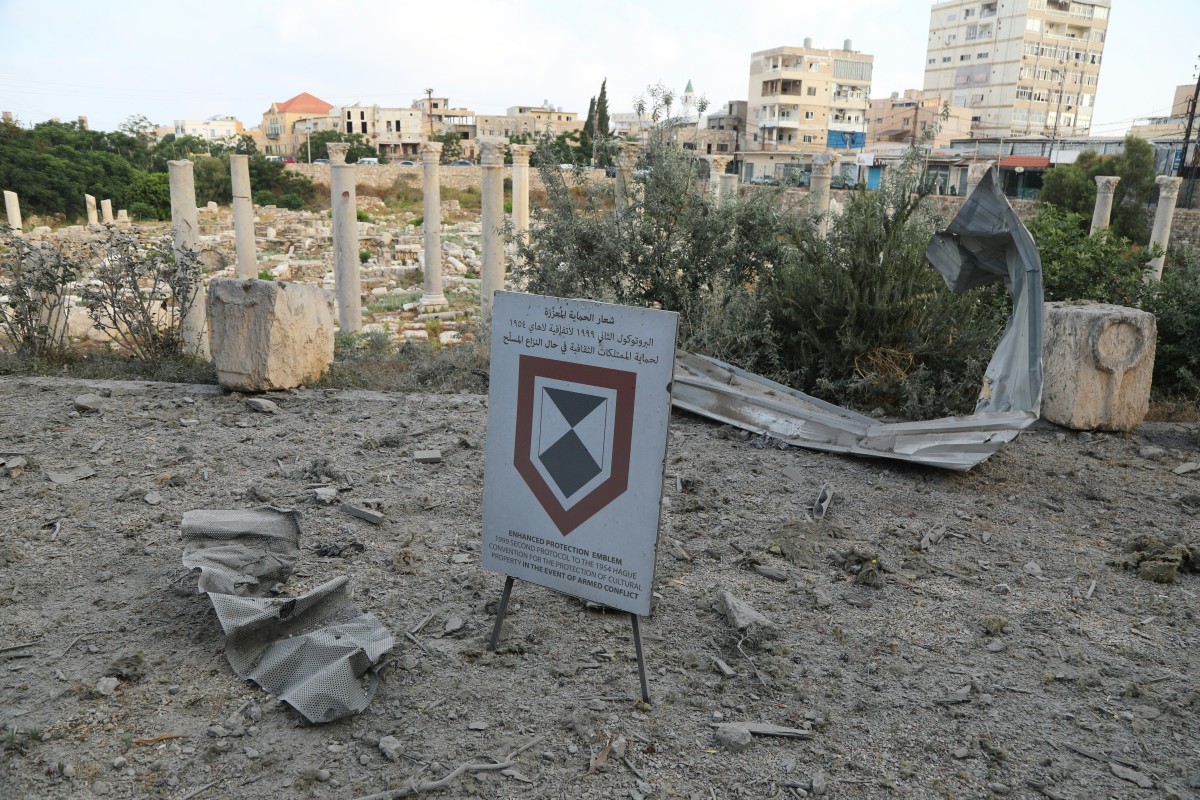
Tyre is one of the oldest cities in the Mediterranean world and has two Roman sites under "provisional reinforced protection", inscribed on the Unesco World Heritage list. (AFP)
Lebanese Culture Minister Ghassan Salamé again "called for avoiding targeting the country's archaeological sites, particularly the ruins of Tyre which are part of humanity's common heritage".
The ruins of Tyre, listed as a Unesco World Heritage site, were damaged by Israeli strikes on Sunday.
This is the "greatest damage to the site since the start of the war", Ali Badaoui, director of archaeological sites in southern Lebanon, told AFP. "Some archaeological artifacts were damaged when debris hit them, as a shower of rubble fell over a vast area", affecting notably "columns, capitals, column bases, mosaics", he listed.
Ghassan Salamé stated that Israel "does not respect" the Hague Convention, which requires the preservation of cultural property during armed conflict, nor the "Blue Shields", a symbolic emblem established by a committee linked to Unesco to protect the Tyre site.
Following the previous war between Israel and Hezbollah in 2023-2024, Unesco placed over 70 heritage sites in Lebanon, including Tyre, under "provisional reinforced protection".
The city has been targeted by a campaign of Israeli strikes since the start of the war with the pro-Iranian Hezbollah on March 2, and was hit again on Monday.
On Sunday, the Israeli military issued a new evacuation order for an area encompassing one of the two archaeological sites, containing Roman remains, before conducting strikes.
France Avoids a State of Emergency but Prepares for the Worst
A Nobel Peace Prize to Save International Law in Peril
A Lebanese-Iranian Meeting in New York, but Several Political Messages
“No State Can Have Two Armies and Two Decision-Making Authorities,” Salam Says in New York
Trump Pulls Back at the Last Minute From Strikes on the Houthis
Mais de LevantTime .
Ver tudo


Mais em Today's Essential
Ver tudo


O mais recente do Levant Time
Ver tudo


