

If It Is Not Syria, Then It Is Turkey, and Vice Versa!

After being endorsed in Washington, General Joseph Aoun was then officially welcomed in Ankara at the end of July — a capital that received him with all the honors befitting his rank. The red carpet, the presidential guard presenting arms with fixed bayonets,süngü tak, and cannon salutes were no small thing in the eyes of the career military man that the Lebanese president is.
Obviously, he would not be the one to pick a fight with a Turkish trade delegation, as President Elias Hraoui had done at the very start of his term.
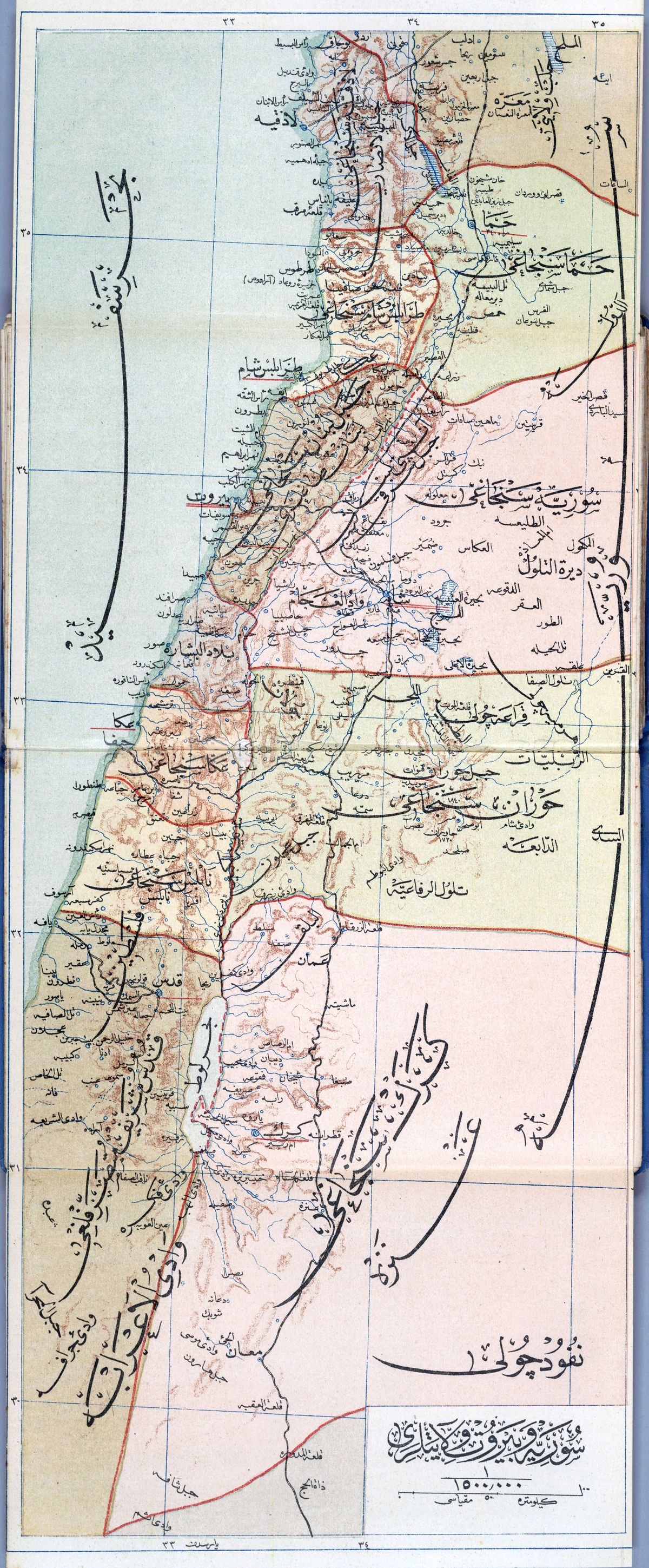
A complete map of the sanjaks of the vilayets of Beirut and Syria in 1909. The vilayet of Beirut encompassed the sanjaks of Nablus, Acre, "Bilad al Bechara" (present-day South Lebanon or Jabal Amil), the city of Beirut, and the sanjaks of Tarablus ash-Sham and Latakia. The term Tarablus ash-Sham was used to avoid confusion with another Ottoman city: Tarablus el-Gharb, the city of Tripoli in Libya, which retained its name. (Wikimedia Commons)
Who still remembers the quarrel between Hraoui and our Turkish guests, who — delighted to develop cultural and economic ties with Tripoli — had made the mistake of invoking the historical links between Turkey and Lebanon's northern capital?
No one knows what got into "Abou Elias" at the time, but he retorted stubbornly that Lebanon was a sovereign state — imagine that! — and would not tolerate a resurgence of Ottoman influence in its territory, let alone a privileged relationship between Ankara and a Lebanese region at the expense of the central government.
Some circles had a field day with this episode, mocking the head of state's incongruous reaction, when all the chambers of commerce of two Mediterranean countries were trying to do was revive ties of trade and prosperity.
Tarablus as-Sham and Greater Lebanon
That incident had long been forgotten when certain questions resurfaced in our minds during the visit of Chaibani, Syria's foreign minister, to Tripoli on July 2nd.
Given the enthusiasm of the reception, hints were dropped that the city might be yearning for a destiny other than a Lebanese one!
Let us recall that it had always borne the nameTarablus as-Sham, and that it had long resisted the French Mandate, never truly accepting its incorporation into Greater Lebanon.
But let us not jump to conclusions too quickly. Crowds are known for their knee-jerk reactions, and Tripoli had suffered too much under the Baathist occupation not to openly vent its frustration and relief at the first opportunity.
In the wake of the triumphant welcome given to Chaibani, a native Tripolitan went even further, saying: "If Turkish troops were to march through our streets today, they would be greeted with widespread jubilation."
If this seasoned observer was to be believed, buildings would have been draped in red flags bearing the crescent and star — the very same banners of the janissaries of the Ottoman Empire.
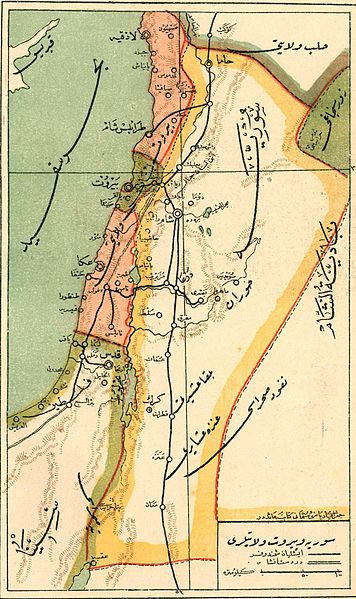
A 1913 map showing the vilayets of Syria and Beirut. In the center, in green, the Mutasarrifate of Mount Lebanon. (Wikimedia Commons)
There was some truth in that exclamation, even if it was purely a matter of emotion and exasperation.
For, once again, the proud city had endured, under both Assad father and son, the brutal subjugation of its population and Alawite control over its vital economic centers.
Does this mean, however, that Turkey is about to become deeply involved in Lebanon in the name of a supposed neo-Ottomanism, a hidden osmanli sultan, or Muslim Brotherhood solidarity?
Neo-Ottoman imperialism or mere economic expansion?
Whatever Ankara's ambitions may be, they will only materialize through a broad regional policy encompassing the Syrian-Lebanese-Jordanian sphere as a whole. This is bound to stir fears and apprehensions here as elsewhere.
Nevertheless, it is worth bearing in mind that when the AKP, President Erdoğan's party, invokes the glorious Ottoman legacy, it does so for electoral and domestic purposes. The idea of restoring a three-continent empire would never cross the minds of Turkey's elites, especially since Putin's adventurism in Ukraine has delivered a sobering lesson to warmongers.
Or so we believe!
Besides, isn't it said that Turkish interference operates mainly in the realm of soft power, with Turkey's economic "success story" serving as a model for Middle Eastern entrepreneurs?That is certainly plausible, now that the xenophobia championed by Arab nationalism has lost much of its appeal and mobilizing power, and now that Turks are no longer held responsible for four centuries of Arab underdevelopment.But Turkey cannot be satisfied with commercial success alone. It is neither Singapore nor Dubai; it cannot confine itself to the role of a financial hub — not when it already projects considerable power and its defense industry has carved out a significant share of the international arms market.
Syria: Turkey's key relay
Is it not the case that Ankara is, in practice, the principal patron of Ahmed al-Chareh's rule1? And so what, comes the retort — even if it provides military, political, and economic backing, it will never be able to turn the Syrian regime into a fully obedient proxy.
Besides, the "Umayyad" policy is well on its way to diversifying and deepening its ties with the Gulf states.
And on reflection, one can always count on Turkish haughtiness to cool the enthusiasm of even the most eager Damascene looking to offer his services and cooperate.
That said, in the current configuration, it is through the Erdoğan–Chareh axis that Turkish penetration into Lebanon can be envisioned, with Ankara fearing that the United States might hand Tel Aviv too large a slice of the Middle Eastern cake — a region still struggling to reconstitute itself.
A daunting task for the Turkish president in Bilad al-Sham. He must contend with Iran's ideological, military, financial, and sectarian influence — Iran, which will in all likelihood attempt to regain a foothold in Syria and reassert its dominance in Lebanon.
But should the mullahs be definitively pushed off the stage, Erdoğan will need to fill the vacuum their retreat leaves behind.
And that is not all, for the further Turkey pushes southward, the more it will find itself face to face with Israel — a country with which relations are visibly deteriorating, and which is just as formidable a partner as it is an adversary2.
To put it plainly, while President Erdoğan has helped steady the steps of General Joseph Aoun3, he is simultaneously working without pause to consolidate Ahmad al-Chareh's regime.
So when Turkey's hour comes, Syria will be Ankara's strategic complement, its armed wing — and why not its proxy!
1See the joint press conference of August 6 between Syrian Foreign Minister Chaibani and his Turkish counterpart Hakan Fidan.
2Recep Tayyip Erdoğan declared last June that his country's security "does not begin in the province of Hatay, but in Aleppo, Damascus, and Beirut," and that Turkey would not tolerate the illusions of the "Promised Land." He further stated that "Israeli attacks against Syria and Lebanon had reached a level that now threatens Turkey as well."
3During talks held in Ankara, Erdoğan promised Joseph Aoun Turkish troops as part of a broader military alliance, to replace UNIFIL forces whose mandate expires at the end of the year.
From the Clash of Civilizations to the Security of Humanity
Who, then, claimed the annexed Golan?
Lebanon: Is Neutrality the Next Project?
But Who Are These Houthis Threatening Freedom of Navigation?
We Do Not Want a Lebanese Hashd al-Shaabi
المزيد من Youssef Mouawad
عرض الكل


المزيد في Opinion
عرض الكل


الأحدث من Levant Time
عرض الكل


