

Aoun's Visit to Washington, a Cornerstone of the Government's Sovereignist Orientation
Two French diplomats assaulted by Iranian security services in Tehran

Lebanese President Joseph Aoun's official visit to Washington — and more specifically, his scheduled meeting at the White House with President Donald Trump this Tuesday, July 21 — could, or rather should, give a major boost to the clearly sovereigntist direction the Lebanese leadership has taken. This direction — echoing the March 14 movement's slogan of "Lebanon First" — has been most openly and unequivocally expressed since March 2, when Hezbollah unilaterally dragged the country (despite warnings from the government) into yet another futile war, solely to support the Iranian regime and ostensibly "avenge" the death of Supreme Leader Ali Khamenei, who was killed in the early hours of the American-Israeli strike on Iran on February 28.
In order to gauge the real strategic impact that the Washington meetings could have on Lebanon's fate in the short and medium term, it would be useful to step back and take a broader view — to soberly assess the multiple upheavals that the Levant region has witnessed since the fateful October 7, 2023, when Hamas launched its deadly attack on Israeli territory from Gaza.
That operation marked a turning point for the region. It was the starting point of a long series of major political and military developments that have unfolded at a rapid pace, continuing to this day, with the cumulative effect of accelerating the decline of the so-called "rejectionist" camp (the mou'mana'ah).
This decline began, right from the outset, with the destruction of Gaza and the dismantling of Hamas. It quickly continued with the assassination of Hassan Nasrallah, the decapitation of Hezbollah's political and military leadership, the resulting drastic weakening of the pro-Iranian party, the fall of the Assad regime (which stripped the Islamic Republic of its vital strategic corridor), and most recently the rise to power in Iraq of a leadership team waging an all-out struggle against Iranian influence in the country.
The new direction emerging in Baghdad over recent weeks was further consolidated during the recent visit of new Prime Minister Ali al-Zaidi to Washington, where he was received by President Trump, who emphasized his firm support for the new Iraqi leadership in its fight against Iranian influence.
The Islamic Republic is thus losing yet another vital sphere of influence that had served it well on multiple levels.
It is against this broader regional backdrop — defined by the strong and inexorable progressive decline of the mullahs' regime — that these "Lebanese days in Washington" are taking place.
President Aoun's talks with Secretary of State Marco Rubio on Sunday, and with President Trump on Tuesday the 21st, should significantly consolidate and cement the government's sovereigntist orientation, which fits squarely within the broader framework of weakening — or even dismantling — the expansionism of the Islamic Revolutionary Guard Corps.
The direction taken by the Lebanese leadership in this regard is, moreover, openly framed as freeing Lebanon from Iranian tutelage.
American officials have not failed to underscore the strategic importance of this guiding principle, which is shaping ongoing developments across the region — going so far as to speak of an "alliance" between Beirut and Baghdad against Iranian influence.
And to make Washington's unequivocal support for restoring the authority of the central government unmistakably clear, Secretary Rubio has expressly invited Lebanon and Syria to jointly issue a formal declaration centered on mutual respect for each country's sovereignty.
As if anticipating the outcome of President Aoun's visit to Washington, the Secretary of State emphasized on Monday that the head of state will be able to tell the Lebanese people, upon his return to Beirut, that it is he — thanks to his national vision — who has succeeded in putting the country back on the path to recovery.
Mr. Rubio was keen to stress that Washington has no interlocutor in Lebanon other than President Aoun and legitimate state institutions — and certainly not the Iranian regime.
Launch of the 'pilot zones' implementation
It is on the basis of this same commitment to restoring a sovereign and free Lebanon that the Trump administration is throwing its full weight behind the implementation of the framework agreement signed on June 26 between Lebanon and Israel.
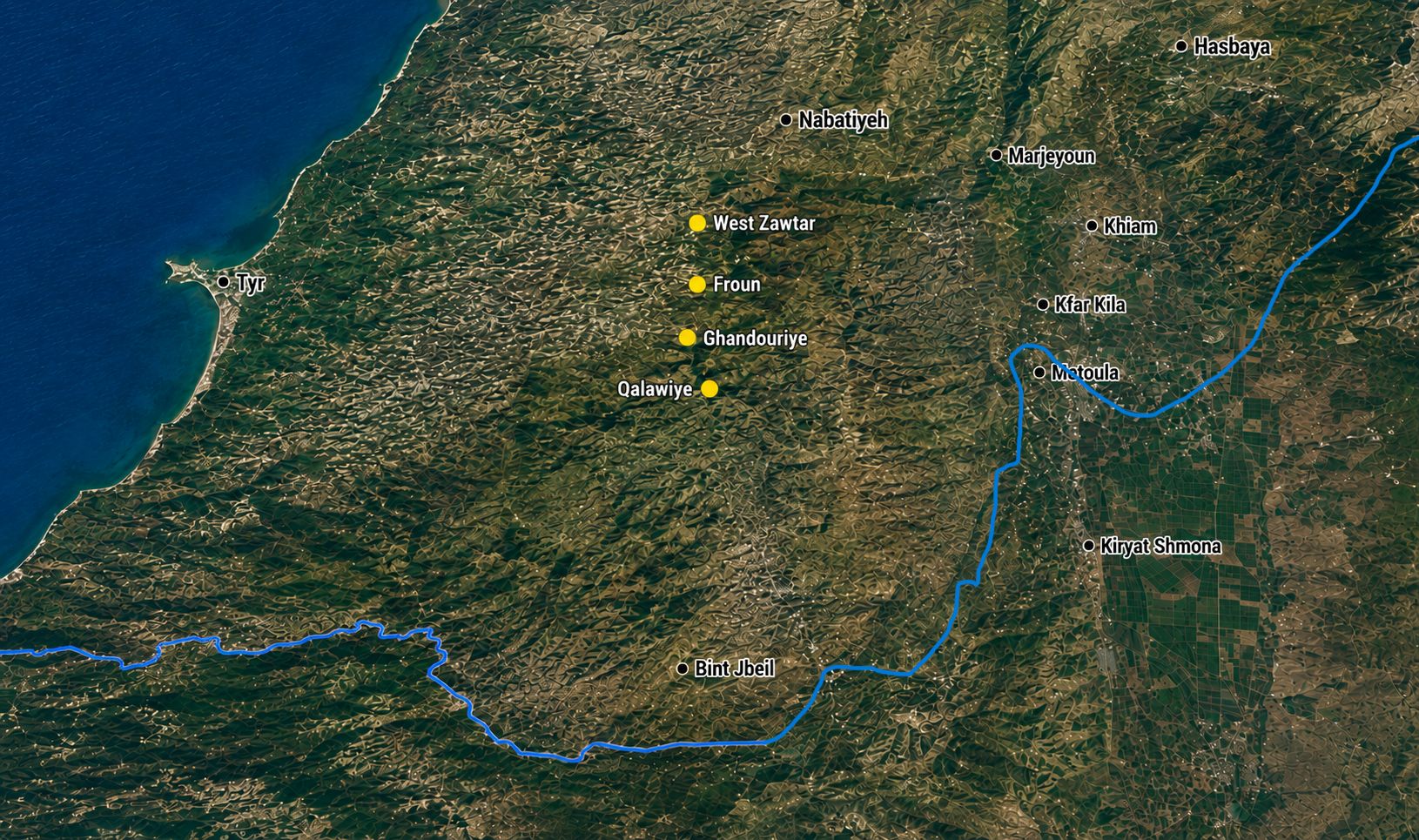
The establishment of the pilot zones provided for under the Lebanese-Israeli agreement began Monday evening and was expected to continue Tuesday, with the withdrawal of Israeli forces from the first pilot zone — comprising the villages of Froun, Srifa, and Zawtar al-Gharbiyeh — where the Lebanese army is set to deploy on Tuesday and ensure, under American supervision, that the area is free of any Hezbollah militia presence.
If this process continues without incident, it will undoubtedly confirm the success of the government's decision to pursue direct negotiations with Israel in order to initiate the withdrawal of Israeli forces and resolve the situation in southern Lebanon.
The State Department was quick to note on Monday that the launch of the 'pilot zones' is a direct result of the recent Lebanese-Israeli talks held in Rome just days ago.
It is worth recalling that President Aoun and the Nawaf Salam government committed to this path despite pressure and maneuvers from the Iranian regime, which sought to impose 'its' solution to the South in order to claim the right to control the Lebanese card — the better to strengthen its position in its bargaining with the Trump administration.
The Lebanese government firmly rejected the Iranian approach, making clear that it is the Lebanese state, and the Lebanese state alone, that has the right to negotiate on Lebanon's behalf.
Back to 'negotiations' with Tehran?
As Lebanon continues on its path toward restoring its sovereignty, a faint glimmer of hope appeared to emerge on the regional horizon Monday evening.
Reports from Islamabad indicated that a ceasefire proposal — yet another one — lasting around ten days was being floated.
This pause, which would include freedom of navigation through the Strait of Hormuz, would be used to explore ways of resuming talks between Washington and Tehran.
At this stage, then, what is being discussed are negotiations aimed at paving the way… for negotiations on the contentious issues themselves.
Yet discussions with the Islamic Republic on these very issues — the nuclear program, uranium enrichment, ballistic missiles — have been dragging on for more than twenty years.
They began in the early 2000s, and between 2006 and 2010 were even the subject of six UN Security Council resolutions demanding that Iran halt uranium enrichment. To no avail.
Over the past twenty-four hours, the Iranian regime expressed its willingness to revive talks with the United States and dispatched its Interior Minister to Islamabad for that purpose, to explore how to restart the ceasefire in the Gulf in line with the memorandum of understanding reached with Washington in June.
Iran's Foreign Ministry was expected to issue a statement on Monday underscoring the need to 'remain committed to negotiations with the Americans.'
This suddenly "pacifist" approach appeared all the more surprising given that a statement attributed late last week to the mysterious Supreme Guide, Moujtaba Khamenei, declared that "the signature Donald Trump placed on the memorandum of understanding carries no value" — which, in Tehran's eyes, implicitly renders null and void the very same memorandum of understanding that some Iranian leaders are now seeking to revive…
Such inconsistency follows, it should be noted, nine consecutive nights of intensive American bombardment targeting positions, military infrastructure, and weapons and ammunition depots belonging to the Revolutionary Guards.
Attack on two French diplomats
In any case, while emphasizing its desire to resume "dialogue" with the United States, the mullahs' regime simultaneously did not refrain from launching missiles and drones on Monday evening against Kuwait, Bahrain, and Jordan.
At the same time, two new attacks on vessels transiting the Strait of Hormuz were reported on Monday, even as the Iranian president reaffirmed earlier that day that "Iran's role" in the Strait of Hormuz "is non-negotiable"!
A senior Iranian official stressed for his part that this waterway would remain off-limits to any country "cooperating with the United States"!
As for the Speaker of Parliament and chief negotiator with Washington, Mohammed Bagher Ghalibaf, he made highly discourteous remarks toward the Americans, condemning the delivery of military equipment by the US army while the US "claims to want to end the war."
He further revealed his combative stance by adding: "They are betting on the fact that our intelligence is as limited as their own IQ"!
Iran-backed Houthi rebels in Yemen, for their part, announced a "maritime blockade of Saudi Arabia," following an exchange of fire between the two sides last week.
More seriously still: France's Foreign Minister, Jean-Noël Barrot, stated on Monday evening that two French diplomats "were detained without cause" in Tehran by security services "for several hours, were interrogated, and one of them was physically assaulted"! Mr. Barrot condemned what he called "an extremely serious act of intimidation."
This rapid accumulation of aggressive actions and hostile rhetoric speaks volumes about the true mindset of Iran's power centers and the way in which they have, for more than twenty years, perceived their relationship with the West and the international community at large.
The Nobel Prizes and the Search for a Glimmer of Light in Human Behavior
Iran: Executions of young people, a favored tool of repression
A Chinese Perspective on Lebanon's Collapse
Dahr el-Baidar Explosives: Toward the End of Complacency?
Lebanese Moderation Needs a Project
Mais de Michel Touma
Ver tudo


Mais em Analyze
Ver tudo


O mais recente do Levant Time
Ver tudo


