

After Ali al-Taher… Has the Battle for Geography Begun, from the South to the Bekaa?
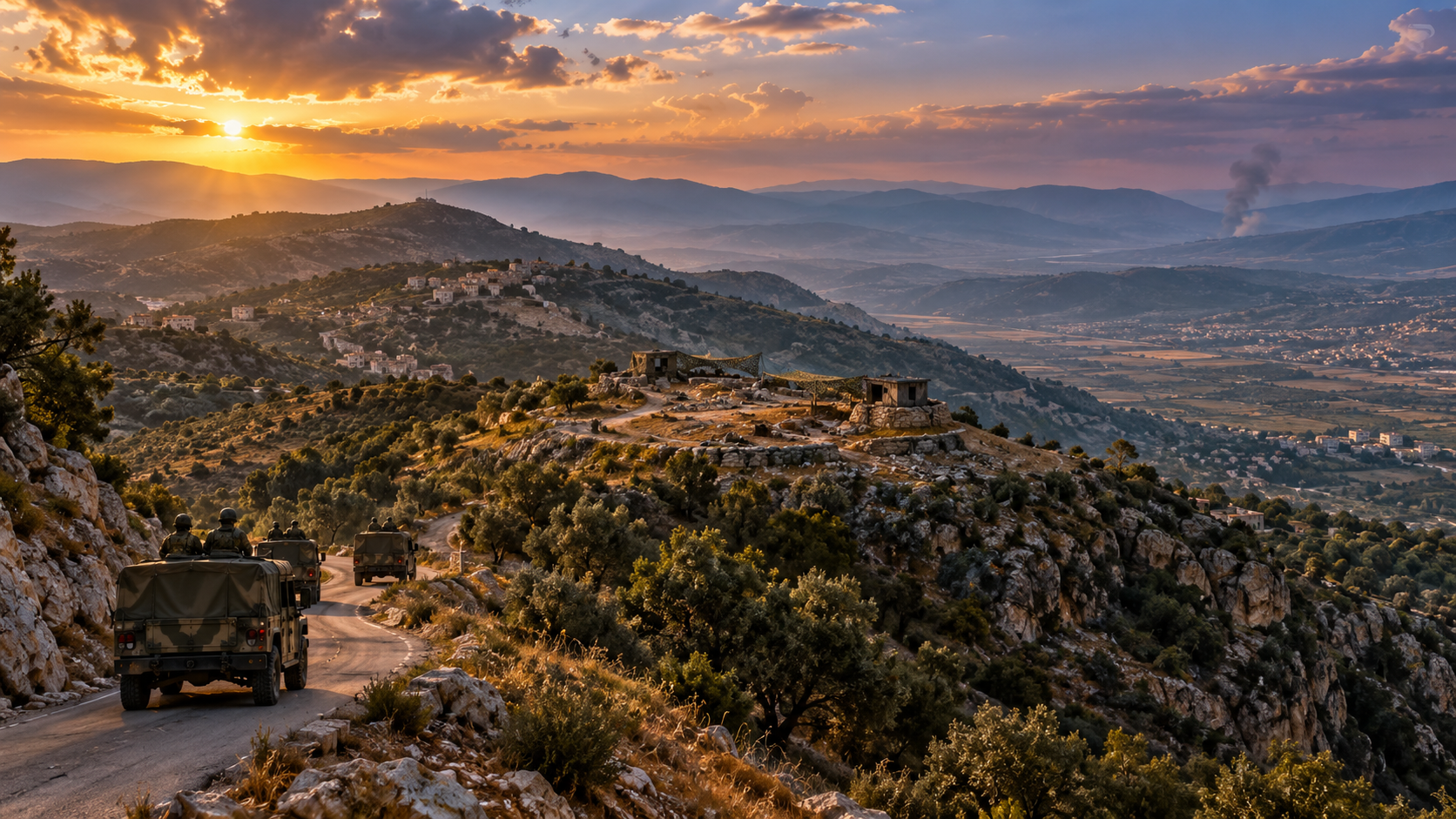
Ali al-Taher is not just a hill whose story is over.
It may be the beginning of a new map.
After what happened there, the question is no longer where Israel will strike tomorrow, but how far Israel wants to extend the security perimeter it is trying to impose inside Lebanon. Will it stop at the border, or move from Ali al-Taher toward the heights of Iqlim al-Tuffah, al-Rayhan and Jabal Safi, and perhaps farther toward the Bekaa?
That is the most dangerous question today.
Not because there is evidence that Israel has decided to occupy all these areas. So far, there is no information that would justify such a conclusion. But there is enough to raise the possibility that Israel has moved from a strategy aimed at striking Hezbollah’s capabilities to a broader one: reshaping the military geography the party has built over decades.
What happened at Ali al-Taher should therefore be seen as a warning, not as an isolated incident.
From the Border to the Depth
For a long time, the Lebanese debate was confined to the area south of the Litani. But the war has changed the equation.
If Israel’s objective is to prevent Hezbollah from rebuilding a military capability that could threaten northern Israel, then it is logical for Tel Aviv to try to push the danger zone as far away from its border as possible.
This is where the importance of the heights of Iqlim al-Tuffah, al-Rayhan, Jabal Safi, Soujoud, al-Jabbour, al-Qatrani and others comes into focus.
These are not merely the names of villages and mountains. They form a belt of high ground linking the inland South to the western Bekaa and providing a natural strategic depth to the areas behind Nabatieh.
The real fear after Ali al-Taher is that the model could become a rule:
Israel demands that Hezbollah facilities be evacuated and handed over to the Lebanese Army. Implementation is delayed or stalls. Israel then concludes that the state is unable to meet its commitments. It intervenes militarily, destroys the facilities and imposes a new reality on the ground.
If this scenario is repeated, the issue becomes far larger than Ali al-Taher.
It becomes a war against Hezbollah’s military geography inside Lebanon.
Are al-Rayhan, Safi and Iqlim al-Tuffah Next?
Caution is essential here.
There is still no reliable information allowing us to say that Israel has decided to invade or occupy these areas.
But it would be equally wrong to ignore their importance.
Al-Rayhan, Iqlim al-Tuffah and Jabal Safi form the natural extension of the mountainous depth into which any military force withdrawing from areas closer to the border could redeploy.
From an Israeli perspective, pushing military infrastructure only a few kilometers away from the border would make little sense if it could simply be rebuilt on more distant heights farther inland.
The objective, therefore, may not be to occupy these mountains.
It may be to neutralize them militarily.
And there is a major difference between the two.
Israel could seek to impose a wider zone free of Hezbollah military infrastructure without occupying every meter of it. It could use airstrikes, intelligence, threats, American pressure and negotiations to achieve that goal.
This is where the Lebanese Army moves to the heart of the battle.
The Real Race: The Army or Israel?
After Ali al-Taher, the question is no longer only what Hezbollah will do.
The question is: who reaches the ground vacated by the party first?
The Lebanese Army or the Israeli military?
This may be the most dangerous equation Lebanon has faced since the end of the war.
Every military site abandoned by Hezbollah and not immediately taken over by the state becomes a vacuum.
And geography does not tolerate a vacuum.
If the state does not fill it, others will try to.
This is also where Hezbollah’s own responsibility comes into play.
If the party says its objective is to protect the land, what prevents it from handing over to the army positions and facilities that are no longer militarily sustainable?
And if Israel wants to use the existence of these sites as a pretext to continue its operations, why give it that pretext?
One cannot claim to defend the land while preventing the state from taking control of it.
And What About the Bekaa?
The Bekaa represents another level of escalation.
Any military or logistical Hezbollah presence there is likely to remain exposed to Israeli strikes as long as the confrontation continues. But moving from airstrikes to an attempt to impose territorial control in the Bekaa would mark a much greater strategic shift.
Yet the Bekaa enters the equation in another way.
If Israel succeeds in dismantling the military continuity between the South, Iqlim al-Tuffah, al-Rayhan and the western Bekaa, it will not merely have struck isolated positions. It will have disrupted the territorial and logistical continuity linking the different parts of Hezbollah’s military network.
And that may be the longer-term objective.
Not to occupy Lebanon.
But to make the rebuilding of the old military infrastructure more difficult, and then to consolidate that new reality through a political and security agreement.
This is precisely where war meets negotiation.
Israeli Elections Are Part of the Map
Israel is heading toward elections, and Netanyahu needs to present Israeli voters with a clear result.
That result will not be measured only by the number of missiles destroyed or commanders killed.
The question that matters to residents of northern Israel is simpler:
Can Hezbollah return to the border?
If the electorally required answer in Israel is “no,” it becomes easier to understand the hard line on withdrawal, the high ground and military sites.
The period before the elections may therefore be more about imposing facts on the ground than making concessions.
But the day after the elections may be different.
At that point, military realities could be translated into political agreements.
And the American Clock Is Ticking
At the same time, the US midterm elections are approaching.
Washington has an interest in preventing another Lebanese-Israeli war, but it also wants to prevent Hezbollah from returning to the previous status quo.
That makes a Lebanese-Israeli negotiating framework more important, not less.
The United States can transform a dangerous equation such as “Hezbollah withdraws and Israel advances” into a different one:
Hezbollah withdraws, the Lebanese Army advances, and Israel withdraws.
That must be the Lebanese equation.
No vacuum between the three steps.
And no unilateral implementation.
Negotiations Become a Battle for Sovereignty
Anyone who rejects negotiations must tell the Lebanese what the alternative is.
War?
It has been tried.
Weapons?
They have been tried.
Waiting for the balance of power to change?
Lebanon has waited for decades.
The result is destroyed villages, displaced residents, occupied land and a state trying to recover a decision that was never fully in its hands to begin with.
Negotiation is not surrender when the objective is to get the Israeli army out.
And it is not normalization when the issues are land, security, prisoners and withdrawal.
It is a tool used by the state to recover what war has taken away.
But negotiations require a strict equation:
Every Israeli withdrawal must be matched by a Lebanese Army deployment.
Every position vacated by Hezbollah must immediately be taken over by the state.
Every area restored to state control must be free of any weapons outside its authority.
And every Lebanese commitment must be matched by a clear and verifiable Israeli commitment.
No disarmament in exchange for permanent occupation.
And no Israeli withdrawal that allows a state within the state to be rebuilt.
What Comes After UNIFIL?
This is where the other deadline comes in.
If UNIFIL’s role changes or its withdrawal from the South begins, the question becomes even more urgent: who fills the space it leaves behind?
Again, the answer cannot be Hezbollah or Israel.
It must be the Lebanese Army.
The transitional phase may require a new international mechanism for monitoring and verification, tied to implementation of the framework agreement, army deployment and Israeli withdrawal.
But the international force, whatever its name, cannot be a substitute for the state.
From Ali al-Taher to the State
If we put the whole picture together, the next phase becomes clear.
Ali al-Taher exposed the problem of the vacuum.
Al-Rayhan, Iqlim al-Tuffah and Safi raise the question of strategic depth.
The Bekaa raises the question of geographic and military continuity.
UNIFIL raises the question of who will safeguard stability once its mission changes.
Israeli elections determine the timing of Israeli decision-making.
US elections put pressure on the timing of mediation.
And the framework negotiations are where all these files can converge.
The real battle ahead, therefore, is not only over Hezbollah’s weapons.
It is over Lebanon’s map.
And this is where the Lebanese must not fall into the same trap again.
The objective is not to defeat the Shiites, humiliate Hezbollah or take revenge on a community that has paid an enormous price in its homes, villages and sons.
The objective is to protect that community, and Lebanon with it, from another war.
That begins with a simple truth:
territory the state does not take control of may fall under someone else’s control.
That is the lesson of Ali al-Taher.
If Hezbollah retreats, the army must advance.
If the army advances, Israel must withdraw.
And if Israel withdraws, no weapon outside state authority should be allowed to return and fill the vacuum.
That is the deal Lebanon must fight for politically.
To continue debating the legitimacy of weapons that are no longer capable of protecting the geography, while the geography itself changes beneath our feet, would be one of the most dangerous forms of denial.
After Ali al-Taher, the question is no longer: where will Israel strike?
The question has become: Will Lebanon reach al-Rayhan, Iqlim al-Tuffah, Safi and the Bekaa with its state and its army before the war reaches them?
Because whoever loses geography today may have to negotiate over it tomorrow.
And whoever places it in the hands of the state today prevents others from drawing its borders tomorrow.