


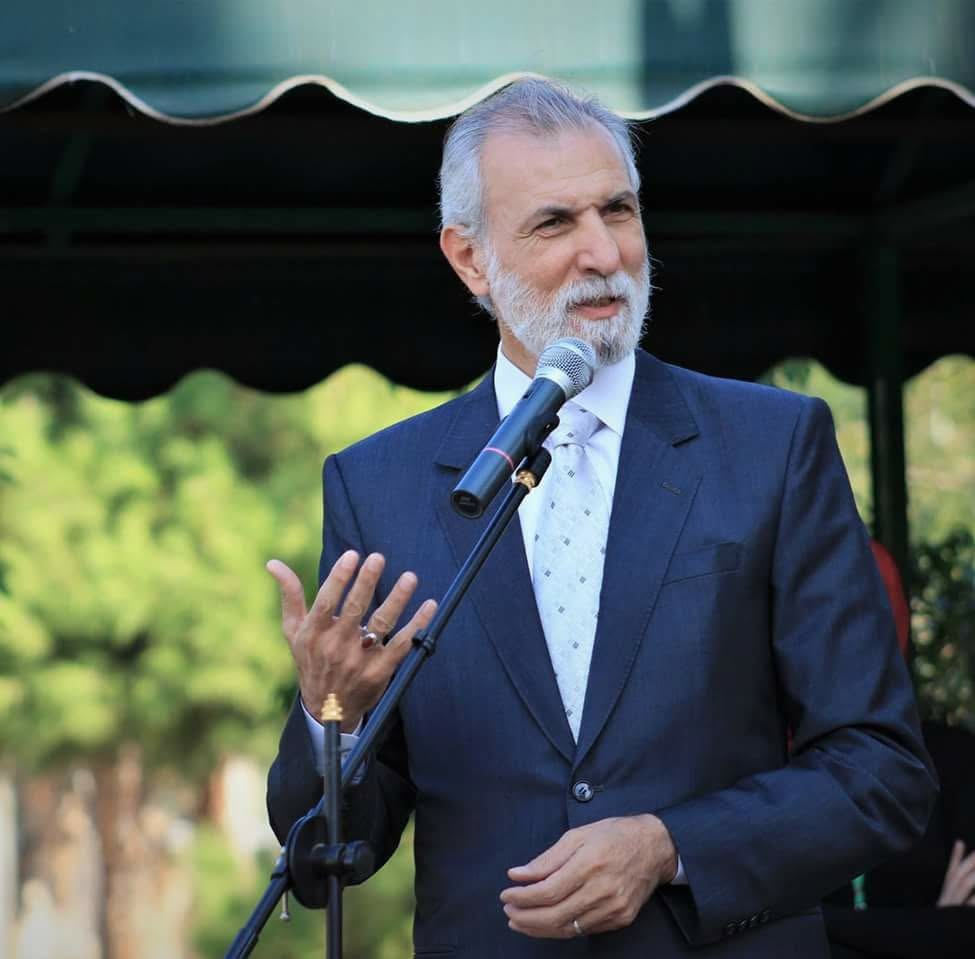
Among my distinguished colleagues gathered at this podium dedicated to the Lebanese Constitution, I am nothing but a novice in the company of experts; yet I am also a Lebanese citizen in a democratic and constitutional republic, sincerely and earnestly attached to his citizenship. I know my constitutional rights, hold fast to them, and refuse to surrender them to any confessional community or zaamat. For over the course of a hundred years, the one constant need expressed by the Lebanese citizen as an individual has been his need for the State, not for the sect, not for the zaim.
The Blessed Patriarch Elias Howayek, who, together with his companions, kindled the flame of Greater Lebanon, gazes upon us now from a century's distance. His gaze carries within it what he sees: disappointment, bitterness, and sorrow. And with good reason: we celebrate the founder… while destroying what he and his companions built.
No democratic state can be built without a constitution or a constitutional order, and if that constitution is not respected, the state collapses.
Those who wrote the Constitution in 1926 and developed it in 1990 were neither incompetent nor ignorant nor half-educated. Their patriotism was neither deficient nor suspect, and they were not those courtiers who compose ornate and pedantic missives.
The Lebanese Constitution is a rigorous text, drafted according to the principles and rules of constitutional science; it is the covenant of the Lebanese among themselves, not a favour bestowed by some upon others, and it is binding upon all without exception. As an expression of the Taif Agreement, it does not constitute a conjunctural necessity rendered obsolete by the passage of time; it has become, on the contrary, an essential component of Lebanon’s integrity and unity, and the Lebanese Republic built upon it is a homeland erected through consensus and consent, not through coercion, domination, or compulsion.
The Taif Agreement has not failed for it to be set aside and abandoned. It simply has never been applied. I repeat constantly that the current formula concerning the completion of the implementation of the Taif Agreement is inaccurate, since it was quite simply never applied for its completion to be possible.
We need neither a new Taif, nor a new constituent assembly, nor a vice-president of the Republic, nor enlargements and administrative additions to the Lebanese state.
We need only to apply the Constitution in its entirety, to respect it, to revere it, and to rely upon it; and in cases of ambiguity, to call upon a solid Constitutional Council whose members are not politicians in search of an occupation.
This Constitution, as a covenant, is the legal edifice that has embodied Lebanon’s subtle composition and the vital equilibrium that runs through it, for it regards the communities for what they are in themselves and not for their demographic weight and their number. It is from there that the balance between Muslims and Christians derives, and the balance within each of them as well, giving us a political regime that is, on one hand, civil in nature (that is to say, a civil state) and, on the other, preserves the balance between communities and within each of them.
Consequently, this Constitution is the certain reference text for building the state and its institutions on sound foundations. It represents simultaneously the permanent and faithful roadmap for consolidating the political regime, stabilising it, and enabling its development.
This Constitution needs to be applied in its entirety, in observance of the succession of legal timeframes its application requires. I am aware that there are, here and there among the Lebanese, those who sincerely wish to see the Constitution applied and call for it, while at the same time expressing reservations, equivocating, or fearing the activation of all its articles, sustained by a vague and obscure illusion that full application would not be in their favour.
A partial constitution, a fragment of a constitution, builds no state and safeguards no homeland. I would not wish us to be among those whom the Quran reprimanded: “…Do you then believe in part of the Scripture and disbelieve in part?…”, those very ones whom the righteous James, in his epistle in the New Testament, urged to observe the law in its entirety: “For whoever keeps the whole law and yet stumbles at just one point is guilty of breaking all of it.”
It is time, after a hundred years, for us to take our destiny in hand, we the Lebanese, and to build a single unified state, resting on a single constitution, with a single reference authority and a single president — not three.
It is the sincere and complete application of the Constitution, with the uncompromising resolve in that direction from truly honourable statesmen, that is capable of bringing arms under control before prohibiting them, of protecting the state from systematic pillage, and of shielding it from being reduced to a temple turned den of thieves.
I return to the famous formula of Georges Naccache: “Two negations do not make a nation.” I depart from it partially, for the consensus on “neither East nor West” did indeed make a nation, or, more precisely, did indeed consecrate a nation. But I also endorse it broadly, for those two negations proved incapable, on their own, of preserving a homeland or of building a state that would endure and last: the state collapsed in internal wars, and those wars came close to sweeping away the homeland — and risk doing so still.
The first Lebanese knew what they did not want from one another, without being certain of what they truly wanted from one another.
We now know what we want from all Lebanese and what we ourselves are bound to as Lebanese, for the benefit of all Lebanese: to respect and apply Taif as it is embodied in the Constitution; to acknowledge that we are all Lebanese in a definitive homeland; that our shared and unified coexistence is our way of being in the world and our way of being Lebanese; that we have a just state as the embodiment of that coexistence; and that we are free within it, in a genuine and complete democracy.
The Taif Agreement, as it has been embodied in the Constitution, has introduced us to two great positive virtues: the virtue of the democratic regime, and the virtue of the sincere participation of communities. It has also preserved us from two great vices: the vice of the despotic grip of communities over the state, and the vice of the monopolisation of power by a faction of a single community. Our failure to apply and respect it has plunged us into the first of these vices and nearly dragged us toward the second.
Our Constitution belongs to all of us.
It belongs to all our children.
Let us not barter it away.
*Speech delivered during a panel discussion on the centenary of the Lebanese Constitution at the Holy Spirit University of Kaslik on Wednesday, June 3, 2026, on the sidelines of the exhibition organized by the university for the occasion.
From the Clash of Civilizations to the Security of Humanity
Who, then, claimed the annexed Golan?
Lebanon: Is Neutrality the Next Project?
But Who Are These Houthis Threatening Freedom of Navigation?
We Do Not Want a Lebanese Hashd al-Shaabi
Mais em Opinion
Ver tudo


O mais recente do Levant Time
Ver tudo


