

Trump's calculated tactic to increase pressure on Tehran


And here we go again. Tensions are rising in the region with a new wave of strikes on Iran, announced for this evening by U.S. President Donald Trump, who also threatened to seize control of the strategic island of Kharg — the linchpin of Iran's oil economy.
However, in yet another reversal, Trump later posted on his Truth Social platform that he had decided to call off the strikes he had been threatening against Iran, asserting that "discussions with the Islamic Republic have been seen and approved by Iran's highest authorities."
And, as is often the case, the news was quickly denied by Iran's Fars news agency. But according to Axios, senior Iranian officials confirmed that a "framework agreement" had been reached, but that they were "awaiting the approval of Supreme Leader Mojtaba Khamenei."
Having exhausted all diplomatic avenues, Washington is now banking on a military approach to ramp up pressure on the Islamic Republic and force it to negotiate a deal that would neutralize the nuclear threat it poses, curb its destabilizing regional influence through its proxies, and resolve the dispute over the strategically vital Strait of Hormuz.
The strategy, then, remains the same. It is the tactics that have changed — and hardened, as evidenced by the increasingly aggressive tone of President Trump's threats. "The war will only end with Iran's surrender," he said during a Fox News interview, shortly after posting on his Truth Social account: "The United States will strike Iran very hard tonight (Thursday). The Navy, Air Force, radar systems, air defenses, and all other forms of defense (belonging to Tehran), along with most of its offensive capabilities, will cease to exist."
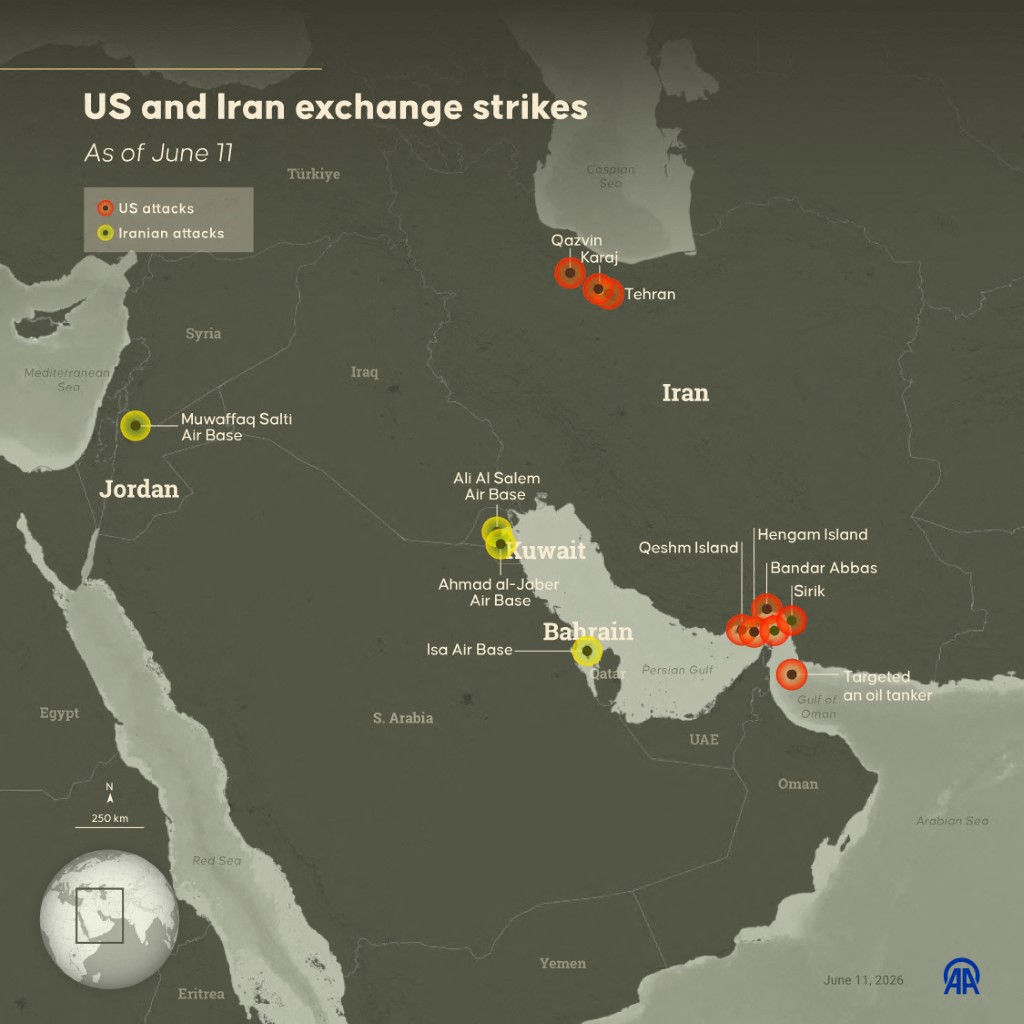
Overnight from Wednesday to Thursday, the U.S. military primarily targeted southern Iran as well as sites near the capital, including in Karaj, Nazarabad, and Pishva, according to the Islamic Revolutionary Guard Corps.
Donald Trump coupled his threats with others of an economic nature — far more significant for Iran: "At some point, in the not-too-distant future, we may take Kharg Island and other oil infrastructure locations. We will assume full control of their oil and gas markets, just as we did with Venezuela, which is working brilliantly for both Venezuela and the United States of America," he wrote, in what appears to be a blueprint for bringing an already economically battered Iran to its knees — a country further squeezed by the American blockade on its ports.
He repeated the same threat on Fox News but expressed reservations about the American public's appetite for an escalation of the conflict. "You know, my preference has always been to take Kharg Island. I'm not sure America has the stomach for it," he said.
Donald Trump also indicated that he does not intend to strike civilian infrastructure, so as not to harm the Iranian people, who are largely opposed to the mullahs' regime.
All of these threats are putting the ceasefire in place since April 8 under severe strain, even as Tehran responds forcefully to U.S. hammer blows.
Overnight from Wednesday to Thursday, the Iranian military targeted U.S. bases in Kuwait, Bahrain, and Jordan. It spared the United Arab Emirates, which, according to Bloomberg, recently held its first security meeting with Iran since the war began. The aim of that meeting: to ensure the UAE's economic stability, according to the outlet.
Tehran has also completely blocked the Strait of Hormuz, through which, until Wednesday, it had been allowing passage — albeit for a fee — to vessels from countries it considered friendly or neutral, while the US military announced on Wednesday that it had neutralized a third tanker that had attempted to breach the blockade of Iranian ports within the span of a week.
A fool's game vs. diplomacy
For now, this escalation in violence still appears contained — even calculated — though the risk of a spiral remains. Tehran and Washington remain locked in a kind of dangerous game of bluff, in which each side tries to maneuver with the leverage at its disposal to impose its terms within the framework of ongoing mediation efforts. The question is who will blink first.
One telling sign that the violence we have witnessed over the past few days is measured and purposeful is the absence of Israeli involvement.
The day Donald Trump asks his Israeli ally to join in strikes against Iran will mark the official return to the military option in pursuit of defined war objectives — at the risk of igniting a regional conflagration.
Washington is thus continuing to bet on the diplomatic process. Donald Trump reaffirmed yesterday that this process remains his "preferred option," while Islamabad and Doha were working overtime to hammer out an acceptable formula for a statement of intent that would allow Iran and the United States to resume negotiations.
Qatari negotiators left Tehran on Thursday, having arrived the previous day in an attempt to bridge the gaps between the United States and Iran, a diplomat familiar with the Qatari mission told AFP. The talks with Iranian officials were conducted in coordination with Washington, the diplomat confirmed, adding that they lasted "into the early hours of the morning."
In Islamabad, Pakistani foreign ministry spokesman Tahir Andrabi indirectly acknowledged that conciliation efforts have reached a deadlock, but stressed that his country has not yet given up. "It is difficult to remain optimistic in the face of renewed hostilities, but let us not draw the curtain on Pakistan's approach in favor of mediation," he said.
He noted that Islamabad had conveyed a message to that effect to both parties. "We remain committed" to mediation, Mr. Andrabi insisted.
Saudi Arabia also called for the continuation of Pakistan's mediation efforts and praised Qatar's role in supporting the negotiations. A similar appeal was issued by the Kremlin.
Mediation is now proceeding in step with American strikes and threats — both military and economic.
In this context, it is worth noting that US Treasury Secretary Scott Bessent announced that funds will be drawn from frozen Iranian accounts to compensate for damages caused by Iranian missile strikes against Washington's allies in the Gulf.
"All tolls paid to the Persian Gulf Strait Authority will also be offset by funds drawn from their accounts. Every attack launched by Iran will only worsen the economic and financial consequences it faces," he announced — even as one of the main sticking points in the indirect Tehran-Washington dialogue concerns frozen Iranian assets. The Islamic Republic is demanding that these be unfrozen as a condition for agreeing, among other things, to return to negotiations.
Could this high-wire strategy pressure Tehran into accepting American conditions for a "deal," or could it instead push it to escalate militarily, knowing that Trump is opposed to a full-scale war? The coming days should provide some answers.
Lebanese exports to Saudi Arabia resume
In Lebanon, the main news is of a political and economic nature, with the resumption of Lebanese exports to Saudi Arabia. Riyadh had suspended its imports from Lebanon in late 2021 due to the crisis triggered by the remarks made by then-Information Minister Georges Cordahi regarding Saudi Arabia's intervention in Yemen and the trafficking of Captagon into its territory.
On the ground, exchanges of fire continue between the Israeli army, which is pressing forward around the perimeter of Beaufort Castle, and Hezbollah militants, of whom "10,000 are said to have been eliminated during the war," according to Tel Aviv. On the Lebanese side, the death toll is approaching 4,000.
In what Israel has deemed a violation of the May ceasefire, the pro-Iranian group launched drones toward northern Israel on Thursday morning. The devices were intercepted before entering Israeli airspace, according to the Israeli military.
Is this a message to the Americans and Israelis signaling Hezbollah's readiness to reopen the Lebanese front should the new standoff between Tehran and Washington escalate? The question is worth asking.
France Avoids a State of Emergency but Prepares for the Worst
A Nobel Peace Prize to Save International Law in Peril
A Lebanese-Iranian Meeting in New York, but Several Political Messages
“No State Can Have Two Armies and Two Decision-Making Authorities,” Salam Says in New York
Trump Pulls Back at the Last Minute From Strikes on the Houthis
المزيد من LevantTime .
عرض الكل


المزيد في Today's Essential
عرض الكل


الأحدث من Levant Time
عرض الكل


