

The Lebanese-Israeli agreement: the government takes back control…

The diplomatic act of June 26, in Washington, undeniably reflects, in and of itself and regardless of what follows, tremendous political courage on the Lebanese side.
The substance of the framework agreement signed by Lebanon and Israel at the conclusion of five rounds and two months of direct negotiations held in Washington, under the supervision of Secretary of State Marco Rubio, is historic in every sense of the word.
The terms of this document represent a genuine turning point in the evolution of the deep existential crisis that has relentlessly undermined the very foundations of the country, its political system, its stability, and its prosperity for decades.
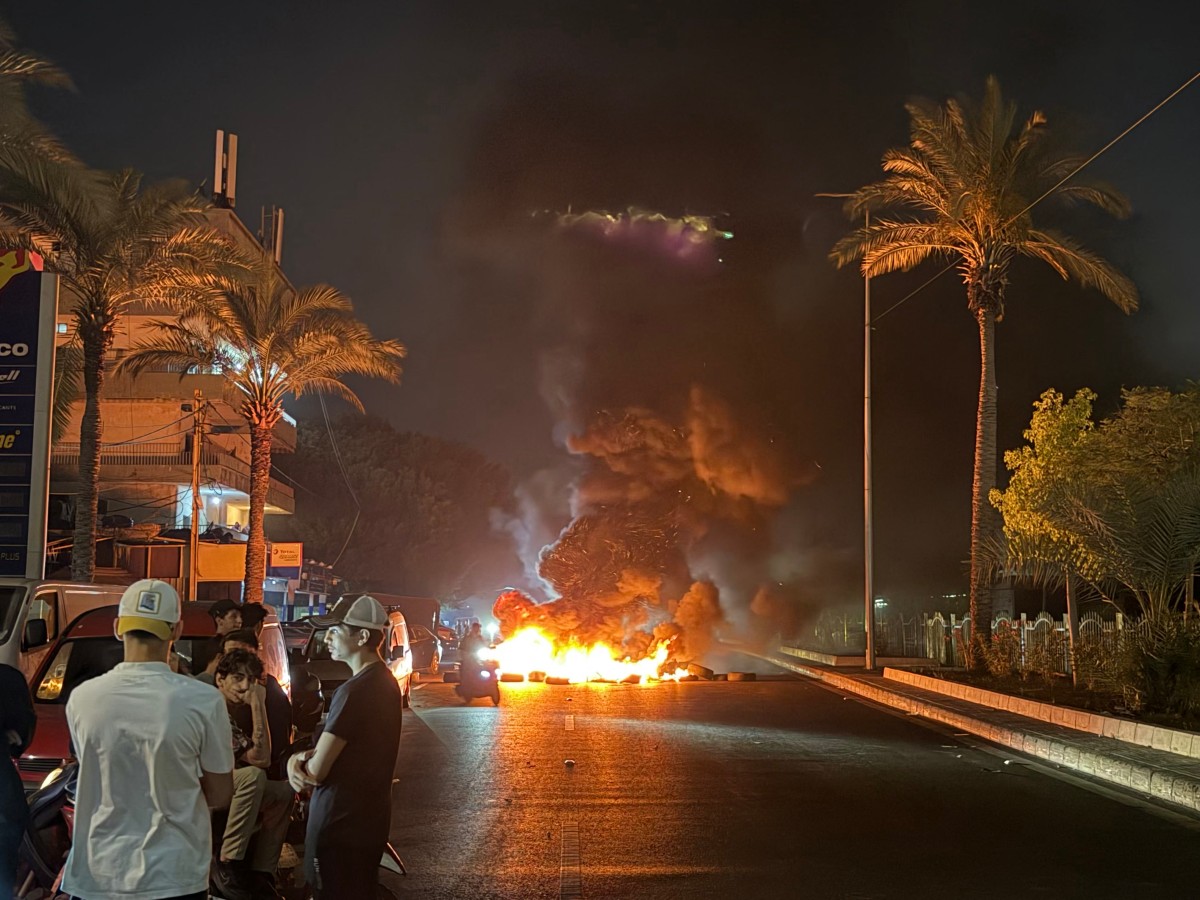
Hezbollah chose to express its disapproval following the signing of the framework agreement, but its reaction was limited to a few demonstrations and a brief blockade of the old airport road. (AFP)
From the outset, it is essential to exercise discernment.
The June 26 agreement is not meant to swiftly resolve, within a matter of days or weeks, the heavy disputes facing the Lebanese people, and more specifically the residents of the South.
Its significance lies in its geopolitical scope, in that it very clearly defines a roadmap — a process that will admittedly be long, difficult, and winding, but which has the great advantage of finally placing Lebanon on the right path: the path toward restoring state sovereignty and ending the fait accompli of de facto militia mini-states that have been undermining the authority of the central government since the late 1960s.
The geopolitical dimension of the June 26 document lies in its ultimate purpose: on one hand, the implementation of the principle of the state's monopoly on legitimate force and on arms; and on the other hand, ultimately — and this is the crux of the matter — the achievement of a lasting peace with Israel and the establishment of good-neighborly relations between the two countries.
Joseph Aoun's Premises
President Joseph Aoun aptly summed up the situation by laying out four premises to clearly define the direction his administration has taken: no more occupation; no more foreign interference; no more guardianship; decisions must henceforth rest exclusively with the state and the Lebanese people.
These are, admittedly, commonplace principles, and this is by no means the first official document of its kind to articulate such positions. True enough…
But the difference this time is that the path being charted is unfolding against a backdrop of a balance of power — locally, regionally, and internationally — that is largely favorable…
For the first time since the 1980s, the country benefits from the combined and concurrent action of a President of the Republic, a Prime Minister, and a government — as a whole — that have, from the very start, defined unambiguously sovereigntist orientations.
The latest gesture, highly symbolic, of replacing the signs along the airport road bearing the inscription 'Thank you Iran' with others in Lebanese colors bearing the slogan 'Lebanon First' is far from trivial.
This symbolic gesture schematically and succinctly illustrates the choice Lebanon faced today: either accept the fait accompli of direct Iranian involvement on the ground in efforts to reach a settlement in South Lebanon, as had been agreed upon during the American-Iranian talks in Switzerland under the leadership of US Vice President JD Vance; or hold firm to the government's resolve to reclaim control and engage in the Washington process — one that would allow Lebanon to decide, on its own, free from any outside tutelage, on the course of action needed to achieve an Israeli withdrawal, the disarmament of Hezbollah, and the restoration of sovereignty.
The authorities have clearly chosen the second path, which in practice keeps Iran out of the solution process — contrary to the option agreed upon during the Switzerland talks, which, under Mr. Vance's supervision, placed the Revolutionary Guards at the heart of the ongoing dynamic.
This explains the sharp reaction from Hezbollah's Secretary-General, Sheikh Naim Qassem, who, in a speech delivered on Saturday, (unsurprisingly) lambasted the agreement signed with Israel, while emphasizing — a telling sign — that his party (and therefore its patron) supported the Iranian-American framework agreement… One quickly forgets about the 'Great Satan' and the 'Death to America' slogan…
A favorable climate
At the regional and international level, the process set in motion in Washington is unfolding, without a doubt, at a time when the Iranian destabilizing camp — often called the 'obstructionist' camp — is emerging significantly weakened by the developments of the past three years.
Taking a broader view and looking at the current geopolitical context as a whole, one cannot help but note that the mullahs' regime — the true cornerstone and driving force behind anti-Western subversion — has lost many strategic assets since 2023: the elimination of Hezbollah's top political and military leadership; the fall of the Assad regime; the elimination of the Islamic Republic's political and security leadership; the enormous military, economic, and logistical losses suffered by Tehran following the two wars of June 2025 and March-April 2026, which have further aggravated an already unprecedented and deep socio-economic-financial crisis; and the widespread weakening of Iran's proxies in Lebanon, Iraq, Gaza, and Yemen…
All of these factors undeniably create a favorable environment for the implementation of the June 26 framework agreement, especially since the strategic option taken by the Lebanese authorities in this regard has received clear support from the Gulf Cooperation Council states, as evidenced by the joint communiqué published last Thursday by the GCC ministerial conference and Secretary of State Marco Rubio.
This document, made public on the eve of the framework agreement's signing, clearly endorses Lebanon's positions regarding the restoration of state sovereignty, the monopoly on arms, and the dismantling of Hezbollah's military and security apparatus…
On top of this GCC support, Saturday also brought clear backing from the European Union for the Lebanese state's positions. And to top it all off, President Trump reached out late Saturday evening to President Aoun, warmly congratulating him on the signing of the June 26 agreement and indicating that they would conduct a joint assessment of the ongoing process at an upcoming meeting to be held soon at the White House.
Iran's capacity for disruption
This favorable climate does not by any means suggest that the outcome is a foregone conclusion or that setbacks should not be expected.
The real test facing the Lebanese state in the coming days will hinge on the question of how much the Iranian Revolutionary Guards can still — or are willing to — give free rein to their full capacity for disruption, which continues to manifest itself, as demonstrated by their attacks over the past 48 hours on vessels in the Strait of Hormuz, prompting fresh American airstrikes on Iran overnight.
At the same time, to what extent can Hezbollah — or does it want to — do everything in its power to sabotage the process launched on June 26?
Two developments could temper the leading position taken by the pro-Iranian party on this front: the attitude of the army, which issued a firm-toned statement on Saturday evening affirming that it would not allow the call for protests — launched by Hezbollah early that same evening — to result in roads being blocked in the capital or attacks on public and private property; at the same time, Amal movement leader Nabih Berry called for calm and stressed the need to avoid any security-related excesses, while condemning the signing of the agreement with Israel and the direct negotiations with the Hebrew state.
These two factors would explain why Hezbollah's call for large-scale demonstrations on Saturday evening in Beirut and across the regions 'in order to bring down the government' did not immediately receive the broad response it had anticipated.
Nevertheless, the Iranian camp's capacity for disruption could still manifest itself on a large scale, despite the broad Arab support (from Gulf states), the European Union, and the United States that the June 26 process enjoys.
Revenge is a dish best served cold… The reaction of the Revolutionary Guards to the Washington agreement will undoubtedly serve, in the very near future, as a significant indicator of their real ability to turn such a saying into reality.
The Nobel Prizes and the Search for a Glimmer of Light in Human Behavior
Iran: Executions of young people, a favored tool of repression
A Chinese Perspective on Lebanon's Collapse
Dahr el-Baidar Explosives: Toward the End of Complacency?
Lebanese Moderation Needs a Project
Plus de Michel Touma
Voir tout


À lire aussi dans Analyze
Voir tout


Les derniers articles de Levant Time
Voir tout


