

Macron, in Damascus, seals Syria's rehabilitation in the post-Assad era
Dangerous escalation in the Strait of Hormuz; firm response from the US Administration


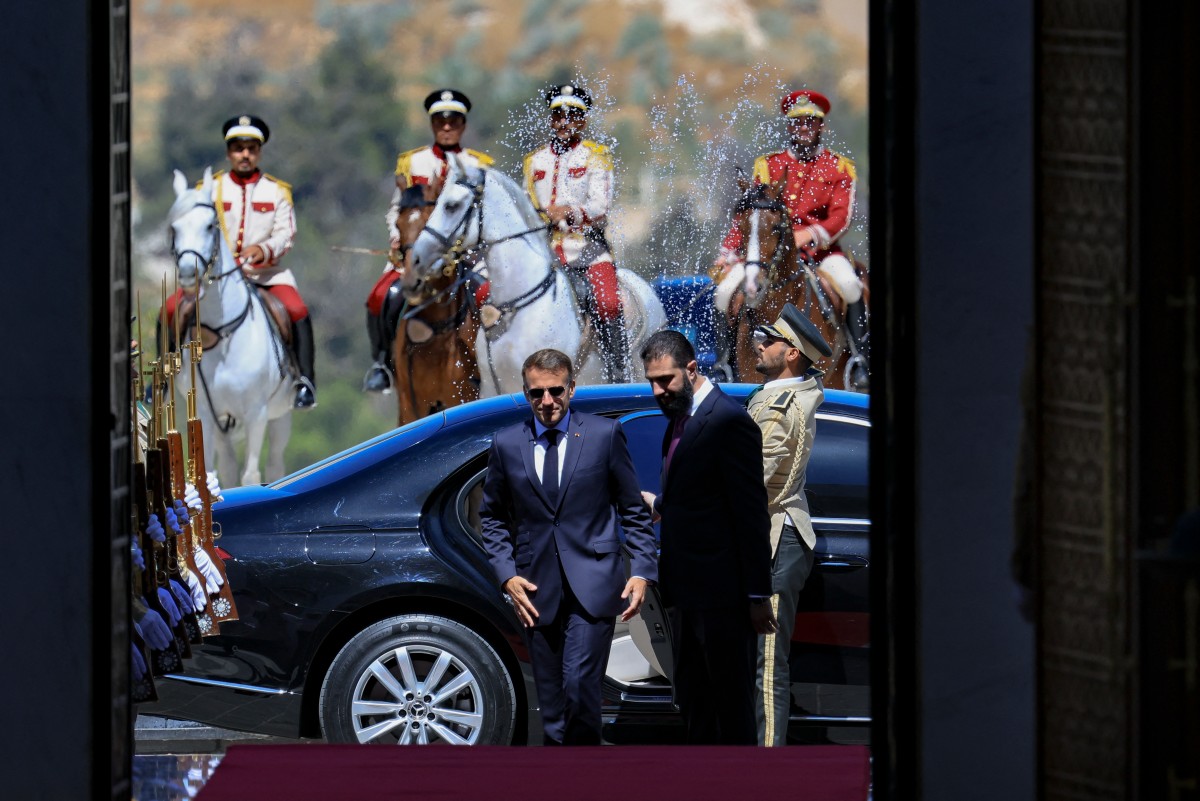
The visit that President Emmanuel Macron began on Monday evening in Damascus, accompanied by a large ministerial delegation and the heads of major French companies, took on particular significance in the current context — one that goes well beyond the conventional scope of routine official visits. However, it was overshadowed by a serious security incident…
On the political front, Mr. Macron's talks with Syrian President Ahmed al-Sharaa marked Syria's return to the international community in the post-Assad era.
A comeback that is both political and economic in nature.
The two heads of state announced the restoration of diplomatic relations between the two countries, which had been severed following the massacres carried out by the Baathist regime against its own population during the civil war that erupted in 2011.
The economic significance of this visit cannot be overlooked either, especially as it reflects a clear convergence of interests between the two countries.
France is positioning itself prominently within the enormous reconstruction and development process that Syria urgently needs after decades of destructive state control.
President al-Sharaa demonstrated full awareness of this, advocating for an "economic partnership with France" which he sees as a precursor or model for a broader partnership with the European Union.
In this context, both heads of state emphasized the need for Syria to once again become an "energy hub" in light of current international circumstances.
On his personal X account, President Macron summarized the essence of his visit in these words: "A new partnership between Syria and France, for a new era."
Syria's return to the community of nations — anchored in the need for socio-economic development and, above all, the establishment of a central state that stands as the antithesis of militia rule beholden to a regional hegemonic power — does not appear to sit well with those seeking to keep the entire Levant region mired in chronic instability and endless, open-ended conflict.
This desire to cause harm materialized in the form of a double bomb attack in the immediate vicinity of President Macron's residence.
The Élysée chief had left the area to head to the Syrian presidential palace, where President al-Sharaa was awaiting him, about fifteen minutes before the two explosions occurred.
According to the latest toll, the blasts killed one person and wounded around thirty others, including four Syrian gendarmerie officers and the deputy minister of Tourism.
The attack, condemned by President Joseph Aoun (who is expected in Washington on July 21) and by Saudi Arabia, did not disrupt the French delegation's schedule in any way.
Escalation at Hormuz
Pure coincidence, or carefully orchestrated timing? The double bombing in Damascus coincided with a resumption of attacks by the Islamic Revolutionary Guard Corps against vessels transiting the Strait of Hormuz without complying with the Pasdaran's conditions.
Iranian forces targeted three ships along this vital waterway within twenty-four hours on Tuesday, including a Qatari liquefied natural gas tanker and a Saudi oil tanker.
Qatar reacted sharply, strongly condemning what it described as an "unacceptable Iranian aggression" and calling on the Islamic Republic to immediately halt its "aggressive actions that endanger security in the Gulf."
The Qatari Ministry of Foreign Affairs summoned the Iranian chargé d'affaires to protest the attack on the LNG tanker, which, according to some reports, is at risk of exploding as a result of the assault.
Late in the evening, the Iranian Foreign Ministry described Qatar's reaction as "bewildering" and "contrary to the principle of good neighborliness"!
A senior American official stressed on his part that Iran had violated the terms of the memorandum of understanding signed between the United States and the Islamic Republic, noting that the Revolutionary Guards attacked a third merchant vessel late Tuesday afternoon.
The official indicated in this context that American forces shot down several Iranian drones over the Strait of Hormuz.
The question remains whether, in response to the violation of the memorandum of understanding, the United States will or will not launch airstrikes against Iranian military positions and infrastructure, and what the scale and scope of such strikes might be…
Late in the evening, Reuters reported remarks from an American official who stated that 'the United States in no way accepts Iran's behavior in the Strait of Hormuz, and there will be consequences'…
Consequences that were duly announced shortly thereafter: the Treasury Department announced the reinstatement of economic sanctions on Iranian oil, and around midnight (Levant time), CENTCOM declared it had launched 'powerful strikes' against the Islamic Republic in response to the attacks on vessels in the Strait of Hormuz.
Against this backdrop of mounting tension, two further developments in recent days have highlighted the escalatory climate that the Revolutionary Guards and the hardline wing of the Iranian regime appear intent on pursuing: the renewed belligerence of the pro-Iranian Houthi militia in Yemen toward Saudi Arabia; and the fierce hostility — accompanied by insulting remarks — publicly displayed by demonstrators at Ali Khamenei's funeral toward Iran's president and foreign minister, who were accused of adopting positions that are too accommodating toward the United States.
The so-called hardline current within the regime is increasingly staking out aggressive positions in the ongoing standoff with the Trump administration. Does its behavior reflect a deliberate attempt to torpedo any potential deal with Washington? At the same time, will the head of state continue to maneuver and prioritize the 'diplomatic' path, despite the escalation being driven by the Revolutionary Guards and an attitude that is all too often arrogant — bordering on insolent — toward the United States and its leadership?
The Nobel Prizes and the Search for a Glimmer of Light in Human Behavior
Iran: Executions of young people, a favored tool of repression
A Chinese Perspective on Lebanon's Collapse
Dahr el-Baidar Explosives: Toward the End of Complacency?
Lebanese Moderation Needs a Project
المزيد من Michel Touma
عرض الكل


المزيد في Analyze
عرض الكل


الأحدث من Levant Time
عرض الكل


