


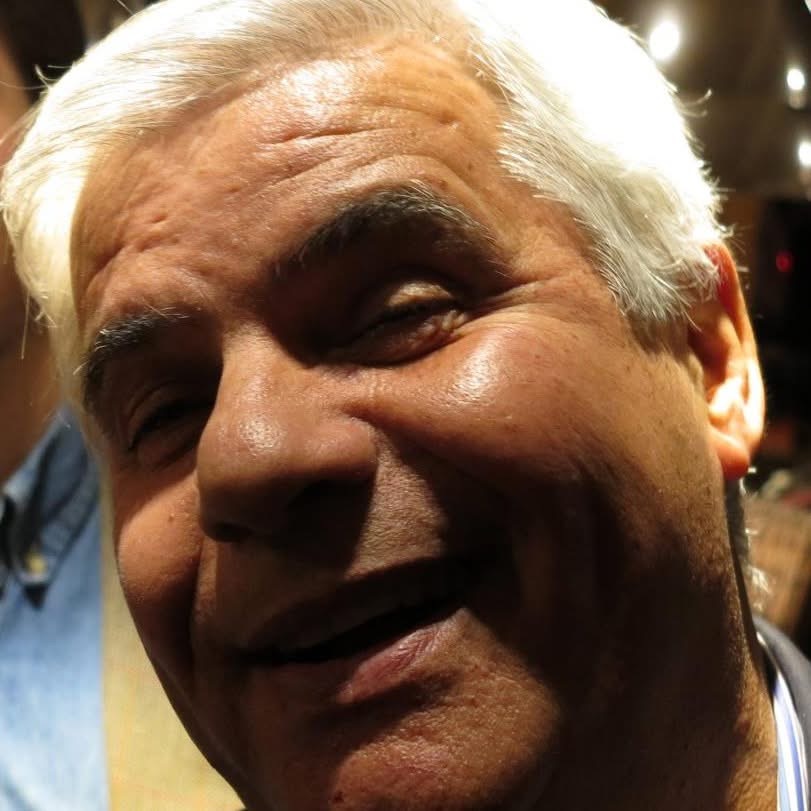
We could have mourned her passing as one mourns a beloved friend, and suffered as one suffers when death severs a part of a shared life: a friendship, a brotherhood, a family. She might also — and perhaps it would have been the easier path — have spent her life in sheltered comfort, protected from the hardships of origin and the harshness of destiny. She was the daughter of a noble and prosperous household, heir to a legacy that allowed her to lean upon inherited security and remain beneath the shade of a family untouched by either disgrace or deprivation.
But she was not “just any woman.” She was Leila Shahid.
With her passing a few days ago, sorrow thickens into a wound both heavy and deep. For what has been lost is not merely a friend; it is a life that resisted the easy temptation — the temptation to save oneself and leave one’s homeland to its fate.
Our story with her begins when she was still an infant… yes, at that threshold History rarely opens in the biographies of the great, though it is the very source of the narrative. Her mother, Sirine, nursed my sister Hayat alongside Leila, and my mother, Salma, nursed Leila together with Hayat. In our home, Leila was the daughter of Kamel and Salma; in theirs, we were the children of Mounib and Sirine. Thus were we introduced to the world: without borders between houses, without distance between bloodlines.
From those early days, Leila was a force in motion — driven by curiosity, by the hunger for discovery, by the urge to raise questions endlessly. She was a whirlwind of energy, as if she had been created to unsettle stillness, challenge inertia, and set even stone into motion.
Armed with the knowledge she acquired at the American University of Beirut, she rushed into the field — not as one who “visits” camps, but as one who returns to her own. She went to the Palestinian refugee camps in Lebanon as one goes back to one’s own children. She left the comfort of her life for the heart of tragedy, not to write and testify from afar, but to encounter reality from within and earn the right to speak of it because she had carried its weight.
She then immersed herself in journalism when the magazine Monday Morning was founded alongside Fawaz Najieh, a journalist and publisher of stature. There, on the demanding ground of rational thought rather than easy rhetoric, her diplomatic gifts began to unfold: articles, interviews, research were developed and written with seriousness, rigor, and scholarship. This approach was not cultural ornamentation; it was a set of instruments forged for struggle. Major media outlets quoted her, for her voice was not the “clamor of a cause,” but a discourse of knowledge and responsibility.
Then came the diplomatic path: her appointment as representative of the Palestine Liberation Organization, chosen by Yasser Arafat. Leila served her homeland because she believed — with early political intuition — that a homeland belongs to all its citizens, and that a leader is “mandated,” not “crowned.” Even with Abu Ammar, she perceived him as entrusted with a mission, not enthroned for eternity. This was not severity toward him; it was mercy toward the cause. For causes that transform into the worship of individuals are sacrificed upon the altar of individuals.
During her diplomatic mission, Europe — yes, Europe — was often more severe toward the Palestinian cause than America. The Old Continent was shaken by terrorism carried out in the name of resistance: airplane hijackings, the tragedy of Munich. Palestinian representation operated within a context marked by the Cold War and Soviet alignments that led the West to see the Palestinian not as the bearer of a right, but as a potential threat. Added to this was the wave of assassinations carried out by the Israelis against Palestinian representatives; this other kind of war emptied the political stage of men and figures of great stature.
During that phase, Leila was, in many respects, alone.
She was the political representative; she left her imprint on the media, on research centers, on cultural life, on university lectures, on meetings in policy circles… she embodied the “Palestinian face,” all with an endurance rarely demanded of a single human being.
Leila Shahid had succeeded. More than that, she triumphed — in the way justice is permitted to triumph in the great capitals: through argument, through reason, through intellectual and linguistic eloquence that does not descend to the level of the crowd and does not solicit demagoguery. She debated with a ferocity of mind — the ferocity of an eagle protecting her young… her Palestinians. She confronted her adversaries in France, in the media and in public, not through invective, but by transforming the cause into a narrative that could be understood… then accepted… then progressively freed from conditions. She moved the wall, stone after stone, pushing Europe from instinctive rejection toward conditional acceptance, and then working to dismantle the conditions.
Until she was awarded the French Legion of Honour at the rank of Officer — not as an ornament upon her chest, but as evidence that she had wrested recognition of dignity in the midst of a fierce struggle.
Yes, it is natural to grieve the loss of Leila Shahid, because we have lost a friend. But our sorrow today weighs heavier than the absence of friendship. We are living through a “new Nakba,” and Palestine more than ever needs a civilized leadership, clean-handed and clear-minded, one that resembles its people and does not treat them as bargaining currency.
Leila Shahid was — had destiny been just — the closest thing to a “President of Palestine,” in the moral rather than protocol sense: culture, experience, commitment to the Palestinian citizen — wounded, expelled, scattered to the four corners of the earth. She had moved Palestine from the state of bargaining and corruption toward an upright patriotism that forced even the malicious to confront their own shame.
That is why we weep: because we have bid farewell to a woman who was light in a time of darkness, and because we have been deprived, once more, of a model of leadership that does not demand ovations but seeks to fulfill its mission.
It is almost a sacrilege that Palestine should lose women like Leila… and it is deeply lamentable that our age remains orphaned of women like her.
In Search of Lebanon, from Beirut to the Vatican
UN: Paris Wants to Replace UNIFIL With a 'Different Type' of Presence
The Abolition of the Death Penalty: Ibrahim Najjar and Élie Keyrouz’s Long Fight
The Testament of Hassan Rifai
A ceasefire... yes, but what happens next?
المزيد من Jamil Kamel Mroue
عرض الكل
المزيد في Politics
عرض الكل



Mexico: after the Elimination of El Mencho, the Calm Before the Storm?
«Remaining»: Rekindle the Memory of the Victims of Political Assassinations Since 2005
Revolutionary Guards, Supreme Organ of Repression
Tropic Thunder: Understanding US Interventionism in the Caribbean
Tropic Thunder: Understanding US Interventionism in the Caribbean
الأحدث من Levant Time
عرض الكل


