

Lebanon-Israel: Rubio seeks to secure a statement of intent


On the third day of the fifth round of Lebanese-Israeli talks in Washington, what were described as difficult discussions between the two Lebanese and Israeli politico-military delegations were expected to yield a statement of intent outlining the framework for more substantive negotiations and future cooperation between Lebanon, Israel, and the United States.
The statement of intent was set to be announced and signed by Lebanon and Israel at 11 p.m. Beirut time, but the announcement was delayed as discussions between the two sides continued. According to several consistent sources, U.S. Secretary of State Marco Rubio is throwing his full weight behind efforts to bring Lebanon and Israel to sign the statement.
Meanwhile, a number of isolated incidents were reported throughout Thursday's day and evening between the Israeli army and Hezbollah militants. Shortly before midnight, Israeli aircraft carried out a strike on the village of Beit Yahoun, in the Bint Jbeil district.
The debates on this final day of the fifth round of talks unsurprisingly centered on the Israeli withdrawal and the future of Hezbollah's military arsenal.
These are two issues on which the two sides were struggling to reach agreement, even as the U.S. Secretary of State, currently touring the Gulf, spoke of progress in the talks.
For Israel, under heavy American pressure to pull back at least to the Blue Line, the equation is straightforward: no withdrawal as long as the pro-Iranian group retains its weapons and poses a threat to the country's north.
Lebanon, for its part, reaffirms its determination to extend its sovereignty over its entire territory and argues that the continued presence of the Israeli army in the South would complicate that effort.
Beirut is therefore demanding a full Israeli withdrawal as a precondition, while Tel Aviv wants the Lebanese army to deploy in the South before its forces pull back.
The two sides were also struggling to reach agreement on the 'pilot zones,' which would serve as the starting point for an Israeli withdrawal whose timeline has yet to be established.
According to Yediot Aharonot, Israeli Prime Minister Benjamin Netanyahu reportedly succeeded in convincing Donald Trump to stop calling for a withdrawal, on the condition that Washington is brought into the 'pilot zones' project in the South, from which Israel would gradually withdraw in exchange for a strengthened deployment of the Lebanese army.
Netanyahu also reaffirmed, in a speech late in the day, that his troops would maintain a presence in 'the security zones in Gaza and Lebanon' and that 'missions have yet to be carried out against Iran, Hezbollah, and Hamas.'
Tel Aviv has admittedly scaled back its operations in the southern part of the country significantly, but its army continues to eliminate Hezbollah fighters. Three people were killed in a drone strike that targeted a vehicle near Mayfadoune, in the Nabatiyeh district.
The Lebanese file is, as is well known, embedded in the talks between Washington and Tehran, at the insistence of the Islamic Republic, which seeks to retain its grip over any process affecting the country's fate and has appointed itself Lebanon's spokesperson—despite Lebanon's official rejection of any Iranian interference in its affairs.
Dismissing the criticism leveled by President Joseph Aoun and Prime Minister Nawaf Salam at Tehran's behavior, the commander of the Islamic Revolutionary Guard Corps' Quds Force, Esmail Qaani, once again declared that Israel must leave 'the entirety of Lebanese territory' of its own accord, or else be 'forced to flee in defeat.'
Tehran continues to make an unconditional Israeli withdrawal from southern Lebanon a condition for the continuation of its negotiations with Washington.
For their part, the United States and Gulf countries reaffirmed, in a joint statement issued at the close of the Gulf Cooperation Council ministerial conference held in Manama, the need to keep the two diplomatic processes underway in Washington and Switzerland separate.
Hezbollah's parliamentary bloc echoed the IRGC's position, urging the Lebanese state to 'take advantage of Iranian support' and warning it against 'making concessions to Tel Aviv.' Israel responded immediately through Defense Minister Israel Katz, who announced that his country 'will strike Iran hard if it attacks us because of our operations in Lebanon.'
Standoff over the Strait of Hormuz
At the regional level, the standoff over the Strait of Hormuz intensified sharply on Thursday, as the Islamic Revolutionary Guard Corps rejected an Omani initiative — backed by Washington and the Gulf states — aimed at securing navigation through this strategically vital waterway.
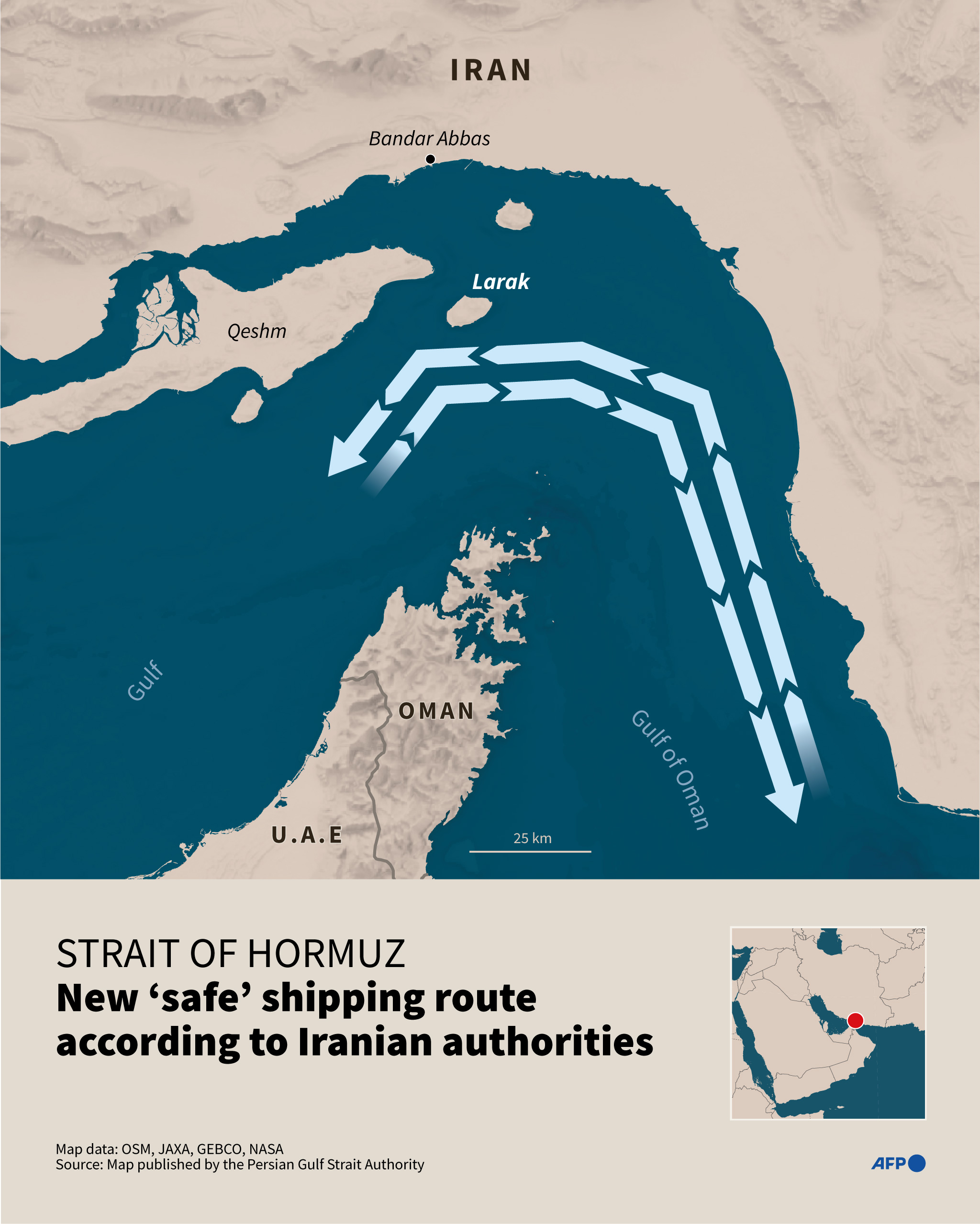
This development threatens to complicate the ongoing diplomatic efforts toward regional peace, particularly as Iran — which is proclaiming itself the victor in its confrontation with the United States and Israel, while grappling with serious financial and economic difficulties — is seeking to maximize gains of this kind.
According to the Wall Street Journal, transit tolls could earn Tehran up to $40 billion per year — enough to bail out the regime, especially if its assets remain frozen by Washington.
In a sign of an emerging crisis, a tanker was 'struck by an explosive device of undetermined origin southeast of an Omani port,' the British Navy announced late in the day. Three other cargo vessels, including a tanker, passing through the same corridor were forced to turn back, according to the same source.
Tehran had counted on Oman to help it sidestep international pressure and impose a toll on the Strait of Hormuz, but the sultanate quickly distanced itself from that position, announcing two new temporary shipping lanes established along its coastline in coordination with the International Maritime Organization (IMO).
Oman's Foreign Minister, Badr al-Busaidi, assured that no 'transit fees' would be imposed, while clarifying that Muscat was continuing discussions with Tehran regarding costs related to certain administrative and maritime security services.
While this decision was broadly welcomed by the Gulf states, the Revolutionary Guards — who are intent on maintaining control over one of the world's key energy transit points — immediately rejected it. In a counter-statement, they declared that 'the only authorized routes for transiting the Strait of Hormuz are those announced by the Islamic Republic of Iran.'
Accusing Muscat of failing to consult them, they warned that any vessel taking an alternative route would face 'sanctions,' without specifying their nature.
The American response was swift. In Bahrain, where he was attending the GCC ministerial conference, Marco Rubio flatly rejected any notion of tolls or fees in the strait, stating that 'no country can claim ownership of an international waterway.'
For Washington, the issue goes far beyond the Gulf. American officials fear that a precedent set at Hormuz could embolden other powers to monetize passage through strategic straits around the world, which would cause 'total chaos,' Rubio warned.
It remains to be seen what impact this episode will have on US-Iran negotiations.
On one hand, the Revolutionary Guards believe that any concession regarding Hormuz would be tantamount to a loss of regional influence.
On the other hand, while the United States is eager to reach a deal with Iran, it is not willing to do so 'at any price,' Marco Rubio reaffirmed in Manama.
The U.S. Secretary of State reiterated that no provision of a future agreement with Iran should jeopardize the "security, stability, or prosperity" of Gulf states, in an obvious attempt to reassure these monarchies, as a new round of technical talks between American and Iranian experts is scheduled to take place in Switzerland later this month.
This commitment was reflected in the final communiqué of the Manama ministerial conference.
The issue of ballistic missiles was included in the statement, even though it does not appear in the U.S.-Iran memorandum of understanding and Tehran refuses, on the grounds of regional balance of power, to have this matter made subject to negotiations.
The Gulf states' foreign ministers called on Washington to include the issue of Iranian missiles and Tehran-backed armed groups in the talks aimed at bringing a lasting end to the war in the Middle East. "Sustainable regional peace and security require addressing the full range of Iranian threats, including its ballistic missiles, drones, and support for armed groups in the region," the GCC ministers stated.
France Avoids a State of Emergency but Prepares for the Worst
A Nobel Peace Prize to Save International Law in Peril
A Lebanese-Iranian Meeting in New York, but Several Political Messages
“No State Can Have Two Armies and Two Decision-Making Authorities,” Salam Says in New York
Trump Pulls Back at the Last Minute From Strikes on the Houthis
More from LevantTime .
View All


More in Today's Essential
View All


Latest from Levant Time
View All


