

Is Iran signing its own death warrant?


Iran responded Monday to a new U.S. proposal aimed at breaking the diplomatic deadlock and bringing a lasting end to the war in the Middle East, its Foreign Ministry said, adding that exchanges with Washington were continuing "through the Pakistani mediator".
Iran reiterated its demands on Monday, particularly calling for the release of frozen Iranian assets abroad and the lifting of international sanctions suffocating its economy.
The spokesman also insisted on the payment of reparations for the war, which he described as "illegal and baseless".
On Sunday, Iranian media denounced the "excessive conditions" imposed by the United States in its latest offer. According to the Fars agency, they demand that Iran maintain only a single active nuclear site and transfer its stockpile of highly enriched uranium to the United States.
A Risky Gamble
In this context, Iran formally established Monday a new body, the Persian Gulf Strait Authority, to manage this passage.
The exact prerogatives of this new structure were not immediately revealed. But according to the specialized journal Lloyd's List, it is "responsible for approving ship transits and collecting passage fees in the Strait of Hormuz".
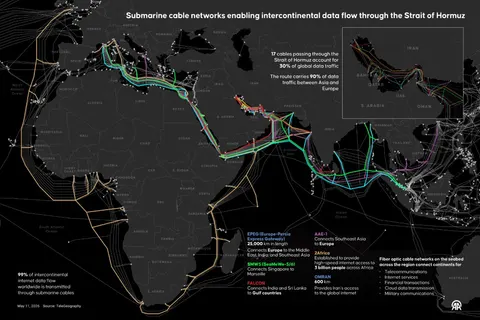
Indeed, the Islamic Republic believes that controlling this chokepoint would be a magic weapon to force the United States to back down. The Revolutionary Guards even threatened Monday to charge for the use of submarine fiber optic cables crossing the Strait of Hormuz, noting that any disruption to this equipment would cost the global economy up to "hundreds of millions of dollars per day".
In a message on Telegram, the ideological army of the Islamic Republic stated that in the name of Iran's "absolute sovereignty" over its territorial waters, the country "could declare that all fiber optic cables crossing the maritime route are subject to permits, monitoring and tolls"…
Without question, this radical position comes from the hardline faction of the regime, namely the Revolutionary Guards. But this risky posture could trigger a resumption of military confrontation.
For the Pasdaran and hardliners in the regime, this is nothing less than an existential war that they seek to perpetuate.
While Iran has lost many leaders, its infrastructure has been severely damaged by bombardments, and its economy is depleted, the ruling class refuses to capitulate—and is even demanding concessions.
Tehran believes that Donald Trump will lose patience over rising gas prices before the midterm elections in November.
The near-paralysis of the Strait of Hormuz, through which one-fifth of global hydrocarbon production normally transits, has lasted since the war began on February 28, to which Washington responded by imposing a blockade on Iranian ports. The blockade of this passage drove oil prices soaring.
But what Iranian leaders forget is that the circumstances are not ideal, as the population is very hostile to this standoff, especially following the large protests in January, suppressed with bloodshed (nearly 40,000 deaths in two days, January 8 and 9), and because of the war's impact on the economy and infrastructure.
A Grim Record
It is on this point that Iran was singled out in Amnesty International's annual report released Monday, which states that the number of executions recorded worldwide rose in 2025 and reached its highest level since 1981, a surge mainly due to Iran, where executions more than doubled last year.
Alone, the Islamic Republic accounts for 80% of executions recorded in 2025 by Amnesty. Some 2,159 people were executed by hanging in the country last year, compared to 972 in 2024.
"Iranian authorities have intensified their use of capital punishment as a tool of political repression and control, driving an unprecedented surge in the number of executions," the NGO notes in its report.
The resort to executions was particularly pronounced after the 12-Day War between Iran, Israel and the United States in June: 654 executions were recorded before this conflict, compared to 1,505 between July and December.
Death sentences and executions in Iran following the protest movement in the country in January and the start of the Middle Eastern conflict on February 28 are not included in Amnesty's report. But according to NGOs based in certain European countries, no fewer than 600 Iranian teenagers and young people, many of them university students, have been hanged since January.
On the Ground…
A drone strike caused a fire Sunday near the Barakah nuclear power plant in western United Arab Emirates, with no injuries or increase in radioactivity, authorities denouncing a "terrorist attack".
Air defense systems detected "three drones that had entered from the western border," two of which were successfully intercepted, while the other "struck an electrical generator" near the site, according to the UAE Defense Ministry.
The ministry denounced a "terrorist" attack, seemingly suggesting Iranian involvement. The attack, "whether carried out by the principal actor or by one of its agents, represents a dangerous escalation," it said on X.
Abu Dhabi has repeatedly accused Iran of carrying out strikes since the ceasefire of April 8, which ended hostilities between the Islamic Republic, Israel and the United States.
Moreover, Saudi Arabia indicated Monday that it had intercepted three drones over its territory, specifying that they had apparently been fired from Iraqi territory.
It should be noted in this context that Qatar and the UN Secretary-General strongly condemned the drone strike on the Barakah nuclear power plant sector.
In Lebanon…
On the Lebanese front, despite the (theoretical) entry into force Sunday at midnight of the extension of the ceasefire between Israel and Hezbollah for a period of 45 days, Israel continued its strikes Monday against positions and infrastructure of the pro-Iranian party in several localities in South Lebanon and the Bekaa. The Israeli military called for the evacuation of three localities in the Tyre and Nabatiyeh regions in anticipation of bombardments.
On Sunday, an Israeli strike near Baalbek in the town of Douriss killed the Islamic Jihad commander in the Bekaa.
France Avoids a State of Emergency but Prepares for the Worst
A Nobel Peace Prize to Save International Law in Peril
A Lebanese-Iranian Meeting in New York, but Several Political Messages
“No State Can Have Two Armies and Two Decision-Making Authorities,” Salam Says in New York
Trump Pulls Back at the Last Minute From Strikes on the Houthis
More from LevantTime .
View All


More in Today's Essential
View All


Latest from Levant Time
View All


