

Iran-USA: Towards a Return of The Yemeni Front?


On Monday, July 13, Yemen is dominating the regional news agenda as the fragile truce reached in April 2022 is coming under intense strain following an Iranian power play that has reignited the Yemeni front. This military gambit is attribuable to the continuing escalation in the conflict between Tehran and Washington, after the United States decided to reinstate the blockade it had previously imposed on Iranian ports.
Specifically, the Yemeni government carried out strikes on the runways of Sanaa International Airport, which is under Houthi control, in an attempt to prevent an Iranian aircraft carrying a delegation from the Iran-backed Shiite group from landing. The delegation was returning from Tehran, where it had attended the funeral of Supreme Leader Ali Khamenei. Despite repeated warnings from Yemeni authorities, who had instructed the group to return aboard a flight operated by Yemenia, the country’s national carrier, the delegation insisted on flying back on the Iranian aircraft, even though Yemeni airspace is closed to Iranian aviation. The aircraft nonetheless continued its flight despite the government’s objections, but reportedly landed in Hodeidah, the Houthi-controlled Red Sea port city in western Yemen.
The tone quickly hardened. Yemen’s Ministry of Defense said the strikes were prompted by the Houthis’ insistence on returning aboard an Iranian aircraft. According to the government, the flight not only violated Yemeni airspace but also represented “a new act of interference by the Islamic Republic.”
The Houthis immediately threatened retaliation after explicitly accusing Saudi Arabia of carrying out the strikes, raising the prospect of renewed hostilities with Riyadh for the first time since the U.N. brokered truce reached in 2022.
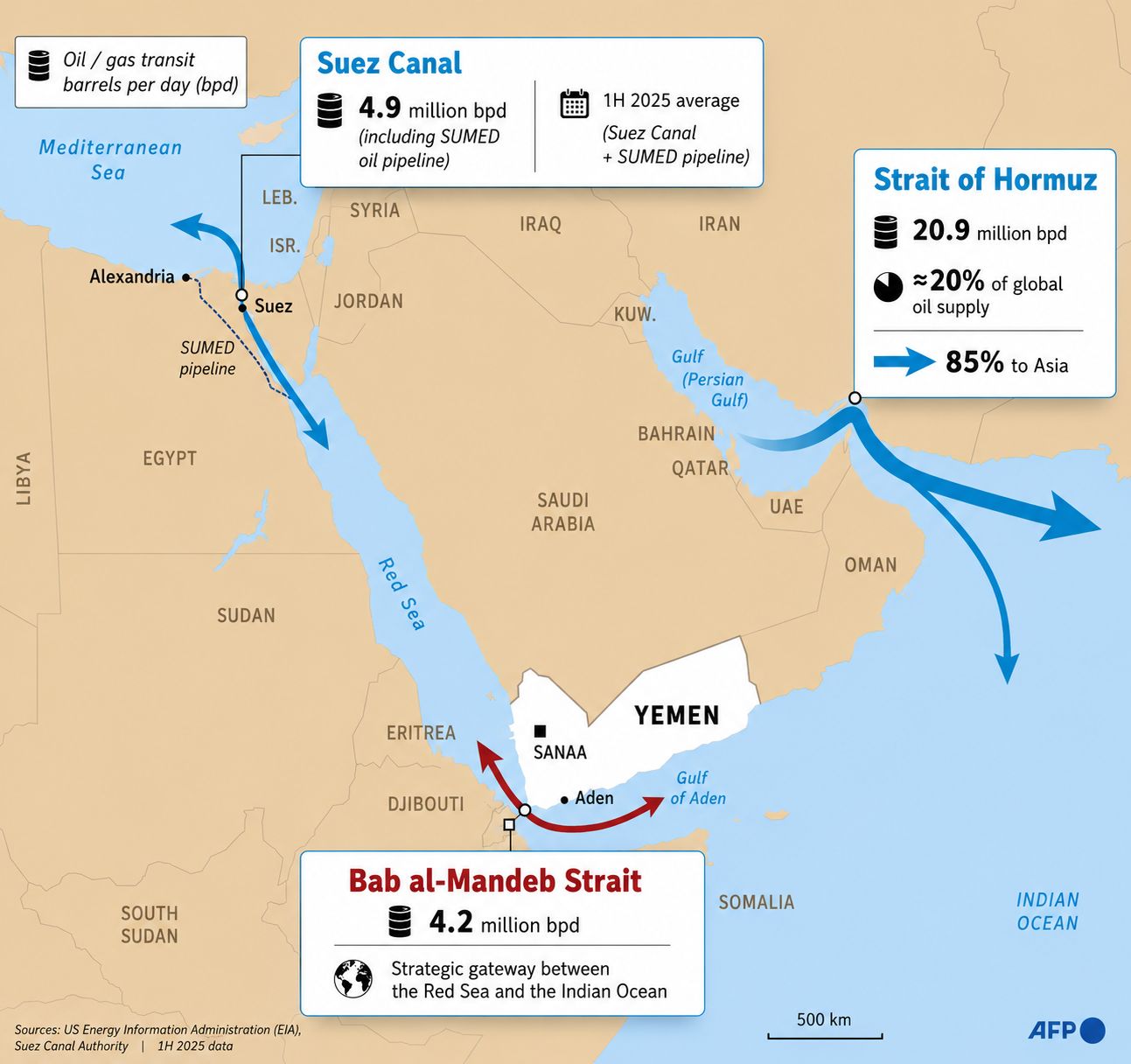
The Straits of Hormuz and Bab el-Mandeb
Amid steadily rising regional tensions, the Sanaa incident can only be seen as another chapter in the standoff between Tehran and Washington, largely centered on the Strait of Hormuz.
The incident followed another night of intense U.S. strikes against Iranian military and logistical targets, and Iranian retaliatory attacks against American positions in Kuwait, Jordan, Bahrain, Qatar and even Oman – a country that had until then been spared by Tehran, which had sought to reach a cooperation agreement with the sultanate for the management of Hormuz.
The architect of a network of allied groups, each more nefarious than the last, Tehran appears to have chosen the Houthis this time to take center stage. By doing so, it is giving its main regional ally, Hezbollah, room to breathe after being decapitated and weakened by Israel during the two disastrous wars referred to as wars of support for Hamas and then for the mullahs’ regime. At the same time, it is avoiding the involvement of another regional actor, Israel, whose territory has been spared Iranian strikes despite hosting U.S. bases. Activating the Lebanese front could have given Tel Aviv the pretext it has been seeking to resume its attacks against Iran.
Whatever the case, the central question is whether the Sanaa incident is merely a warning to Washington, with which Tehran is engaged in an open confrontation, or whether it marks a new phase in that confrontation. The seriousness of the incident will therefore be assessed based on what happens next.
This is because the geostrategic stakes involved in bringing the Houthis into the ongoing conflict are considerable. The main one concerns the Bab el-Mandeb Strait. The Houthis, who control the port of Hodeidah along this strategic waterway, have the ability to block access to the Red Sea and the Suez Canal, thereby significantly disrupting international trade.
Tehran, which again announced on Monday the closure of the Strait of Hormuz, has thus shifted the conflict to another equally strategic geographic area, at the risk of seriously disrupting global trade. In this devious game it is playing, Iran is seeking to show the Americans that it still holds several cards it will not hesitate to play in order to secure concessions in its negotiations with Washington.
Those negotiations have not been broken off. They have merely been suspended, with Iranian Foreign Ministry spokesman Esmail Baghaei confirming on Monday that diplomatic efforts were continuing with Qatar, Pakistan and Oman to “prevent an escalation of tensions.” According to him, Tehran had been in contact “in recent days” with Qatar and Oman, despite both having been targeted by Iranian strikes, as well as with Pakistan. The events from Sunday night into Monday, and throughout the day on Monday, clearly show that these efforts have fallen far short of being conclusive. Could they lead to a complete breakdown? Only the next developments will tell.
Esmail Baghaei also warned that Tehran would no longer consider itself bound by the memorandum of understanding reached with the Americans in June if they failed to honor their commitments. A way of responding to Donald Trump, who had effectively sounded the death knell for the ceasefire the previous week.
Houthi Strikes on Southern Saudi Arabia
While exchanges of threats are common during sensitive negotiations that could determine the fate of the entire region, developments on the ground take on a far more significant – and potentially dangerous – dimension.
The Houthis were quick to carry out their direct threats against Saudi Arabia, which they accused of striking Sanaa airport. Early in the evening, they launched ballistic missiles at Abha airport in the southwestern part of the kingdom, near the border with Yemen. At least six missiles targeted the facility, according to media outlets affiliated with the Iran-backed group. The Saudi Ministry of Defense confirmed the attack, saying that the missiles had been intercepted.
The strikes follow the same logic as the Iranian attacks against Gulf countries, which were carried out in retaliation for U.S. strikes. Through its Yemeni ally, Tehran appears to be seeking to drag Riyadh into a conflict from which it had kept its distance from the outset. The objective is the same as that pursued in the strikes against Gulf countries: to pressure Arab monarchies into reconsidering their alliance with the United States. An objective the Islamic Republic has never sought to hide, but one it has so far failed to achieve.
“A 20% Fee”
Washington, for its part, is pursuing a strategy largely inspired by Iran’s own tactics. In response to Iranian provocations, the Americans are responding with counter-provocations. U.S. President Donald Trump announced bluntly on Truth Social that the naval blockade that had helped severely cripple the mullahs’ regime’s economy would be reinstated, along with U.S. control over the Strait of Hormuz. Just as Tehran seeks to impose service fees, Trump said he wanted to collect “a fee equivalent to 20% of the value of cargoes” transiting the maritime route, despite the fact that the waterway is governed by international law, which is supposed to guarantee freedom of navigation without obstruction.
Iran responded by saying that it would “under no circumstances allow” Washington to interfere in the management of the strait, which Tehran wants to place under its strict control.
President Trump also announced that he would address the nation on Thursday evening.
According to The New York Times, Trump notified Congress of the resumption of hostilities with Iran. In his message to Congress, he said that U.S. forces had carried out defensive military operations on July 7, the newspaper reported.
Blockade or not, Tehran is holding on to its regional influence through its allies. According to several analysts, the Houthis possess numerous “disruptive assets” that prompted Sanaa’s forceful response. By striking the city’s airport themselves to prevent an Iranian aircraft from landing, Yemeni authorities are sending Tehran a direct political message: it is not permitted to use Yemeni facilities under the current circumstances.
This is because the Iranian aircraft incident carries another message, one that was quickly understood by the Americans and may have contributed to Donald Trump’s decision to reinstate the naval blockade. Tehran sought to show that it still retains freedom of movement and the ability to take the initiative despite the sustained strikes, and that its allies still have the ability to disrupt its adversaries’ plans.
The Iranian flight shows that, in the event of a blockade, the Islamic Republic could still have an air corridor to its Yemeni allies. This corridor would allow it to deliver the equipment and personnel (members of the IRGC) needed should it decide to block the Bab el-Mandeb Strait and reactivate the Yemeni front. It is, however, too early to speak of a genuine reactivation of that front.
Western Pressure
On the diplomatic front, Western pressure on Iran continues to intensify. London has announced a ban on the Islamic Revolutionary Guard Corps on its territory, while French Foreign Minister Jean-Noël Barrot has ruled out any lifting of European sanctions as long as Tehran continues its nuclear program, ballistic development and destabilizing actions in the region.
France Avoids a State of Emergency but Prepares for the Worst
A Nobel Peace Prize to Save International Law in Peril
A Lebanese-Iranian Meeting in New York, but Several Political Messages
“No State Can Have Two Armies and Two Decision-Making Authorities,” Salam Says in New York
Trump Pulls Back at the Last Minute From Strikes on the Houthis
المزيد من LevantTime .
عرض الكل


المزيد في Today's Essential
عرض الكل


الأحدث من Levant Time
عرض الكل


