

Hormuz, enriched uranium… Iran hardens its stance


The diplomatic maneuvering aimed at ending the war between the United States and Iran continues with the visit to Tehran of a new senior Pakistani official, mediator of the discussions.
Between statements from U.S. Secretary of State Marco Rubio, who claimed that "progress had been made," and those from Iran's Foreign Ministry, according to which "negotiations currently focus on ending the war on all fronts, including in Lebanon," a certain optimism seemed to be emerging after a series of explosive messages exchanged by both sides.
But information published Thursday by the Reuters agency concerning Iranian nuclear matters, as well as a hardening of the Revolutionary Guards' position on the Strait of Hormuz, came to sweep away this diplomatic lull.
According to Reuters, Iran's Supreme Leader, Ayatollah Mojtaba Khamenei, has issued a directive that Iranian uranium enriched to a level close to that necessary for nuclear weapon production should not be transferred abroad.
"The Supreme Leader's directive, as well as consensus within the establishment, is that the enriched uranium stockpile must not leave the country," said one of two Iranian sources cited by Reuters, speaking on condition of anonymity.
According to these sources, Iran's highest officials believe that a transfer of this material abroad would make the country more vulnerable to future American or Israeli attacks.
The two Iranian officials also stated that deep mistrust prevails in Tehran regarding the current ceasefire, perceived as a possible tactical maneuver by Washington intended to create a false sense of security before a resumption of airstrikes.
According to the sources, the two parties have begun to narrow certain gaps, but major disagreements persist concerning Iran's nuclear program—notably the fate of enriched uranium stockpiles and Tehran's demand to have its right to enrichment recognized.
One of the sources nevertheless stated that there were "workable formulas" to resolve this dispute.
"There are solutions, such as dilution of the stockpile under the supervision of the International Atomic Energy Agency," said one of the Iranian officials, cited by the London-based agency.
The International Atomic Energy Agency (IAEA) estimates that Iran possessed 440.9 kilograms of uranium enriched to 60% when Israel and the United States struck Iranian nuclear facilities in June 2025. The amount of material that survived these strikes remains unknown.
This decision hardens Tehran's position on one of the main American demands in the peace talks.
Ayatollah Khamenei's order could heighten tensions with U.S. President Donald Trump and further complicate discussions aimed at ending the war between the United States, Israel, and Iran.
Donald Trump stated Thursday that the United States would not allow Iran to keep its highly enriched uranium stockpile. "We're going to get it. We don't need it, we don't want it. We'll probably destroy it once we have it, but we won't let them keep it," Trump told journalists at the White House.
Hormuz: Iran expands its claims
Concerning a second sensitive point in negotiations with the United States, Iran's new strait of Hormuz management authority claimed Thursday a control zone extending to waters south of the Emirati port of Fujairah, drawing the ire of its Gulf neighbor.
Tehran has controlled navigation in this strategic maritime corridor for global hydrocarbon commerce since the start of the war in the Middle East.
Although a ceasefire came into effect on April 8, authorities are requiring vessels transiting the strait to obtain permits from Iranian armed forces.
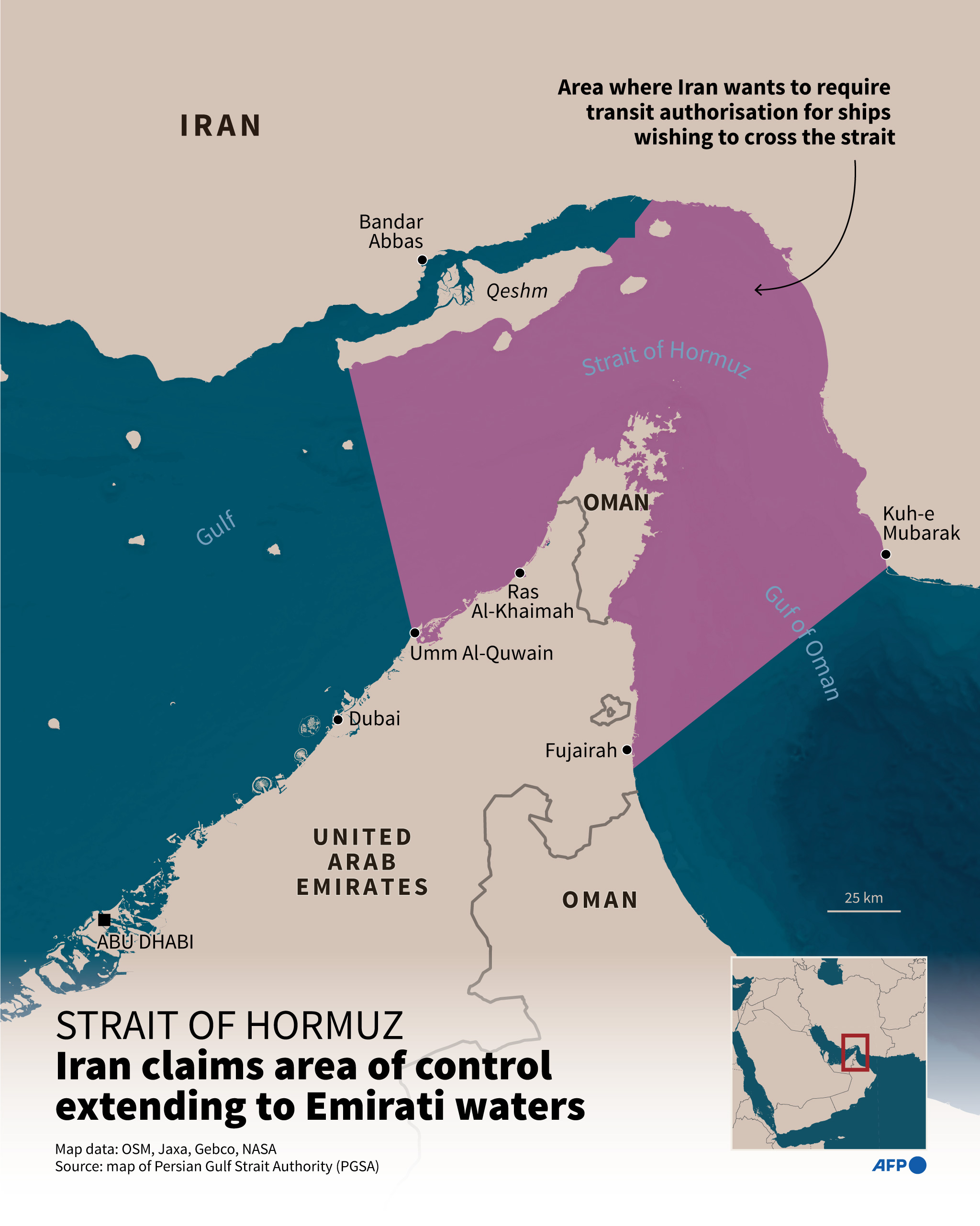
The brand-new "Persian Gulf Strait Authority," which now has an official account on X, published a message on Wednesday accompanied by a map, claiming to have delineated "the zone of regulatory jurisdiction for managing" the strait.
It states that this zone extends "from Kuh-e Mubarak in Iran to south of Fujairah in the United Arab Emirates" regarding the strait's eastern entrance, and on the western side "from Qeshm Island to Umm Al-Quwain," one of the seven emirates comprising the UAE.
"Transit through this zone for the purpose of crossing the Strait of Hormuz requires coordination with the Persian Gulf Strait Authority and its authorization," it specifies.
This is likely to anger Abu Dhabi, as the port of Fujairah is central to its strategy for bypassing the strait blockade.
"The (Iranian) regime is attempting to impose a new reality (...), but attempts to control the Strait of Hormuz or undermine the maritime sovereignty of the Emirates are nothing but fantasy," responded Anwar Gargash, advisor to the Emirati president, on X.
U.S. Sanctions Against Amal and Hezbollah
On another front, Washington announced Thursday that it was placing nine individuals on its sanctions list, accused of being close to or members of Hezbollah's leadership and of "obstructing peace and disarmament" of the Iranian-backed Lebanese group.
Among the targets of the U.S. Treasury Department's sanctions are Iran's designated ambassador to Lebanon, Mohammad Reza Raouf Sheibani, Lebanese intelligence officials, political allies of Hezbollah, and four group officials.
One of them is Hezbollah deputy Hassan Fadlallah, who also headed the movement's radio station (Al-Nour) and television network (Al-Manar).
The Lebanese government rejected the Iranian ambassador's credentials in mid-March and ordered him to leave the country, but Sheibani refused to depart Beirut.
The Treasury Department's measures also target Ahmad Baalbeki and Ali Safawi, two officials of the Amal movement, headed by Parliament Speaker Nabih Berri.
In its statement, Treasury Secretary Scott Bessent declared that "Hezbollah is a terrorist organization that must be completely disarmed. The Treasury Department will continue to target officials who have infiltrated the Lebanese government and enabled Hezbollah to conduct its senseless campaign of violence against the Lebanese people and obstruct peace."
The sanctions involve freezing all assets held directly and indirectly by the targeted individuals and prohibiting U.S. citizens and companies from conducting transactions with them.
This prohibition also applies to foreign companies if they have operations in the United States or conduct any part of their transactions in dollars.
On the ground, a hospital in southern Lebanon was damaged Thursday by an Israeli strike, according to the Health Ministry, with the Israeli military continuing raids despite a fragile ceasefire with the Iranian-backed Hezbollah.
"Two Israeli strikes targeted the locality of Tebnine, near the government hospital," in the Bint Jbeil region, reported the National News Agency.
The ministry further stated that the strike wounded "nine people, including seven hospital staff members, five of whom are women."
The ministry had indicated Wednesday that three hospitals in the south had been closed and 16 others damaged since the start of the war between Israel and the Iranian-backed Hezbollah on March 2.
France Avoids a State of Emergency but Prepares for the Worst
A Nobel Peace Prize to Save International Law in Peril
A Lebanese-Iranian Meeting in New York, but Several Political Messages
“No State Can Have Two Armies and Two Decision-Making Authorities,” Salam Says in New York
Trump Pulls Back at the Last Minute From Strikes on the Houthis
Plus de LevantTime .
Voir tout


À lire aussi dans Today's Essential
Voir tout


Les derniers articles de Levant Time
Voir tout


