

Harassment, Bullying: Women Are the Prime Targets of AI

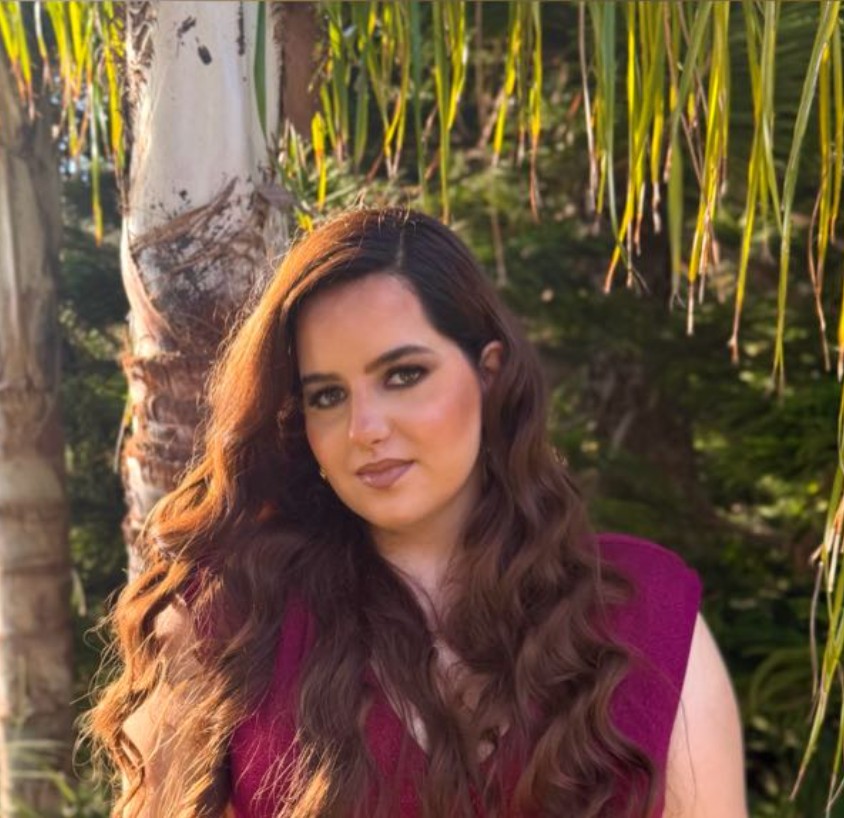
Doctored images, sexualization, smear campaigns, and accusations of treason: in Lebanon, artificial intelligence is providing new tools for harassment targeting women who are visible in the public sphere. The case of a government minister and the testimonies of two journalists shed light on a global phenomenon that is outpacing the legal and technical measures designed to contain it.
A red devil with horns, holding a trident — but with a familiar face: glasses, short bleached hair, and hoop earrings. This was no ordinary caricature, but one of dozens of AI-generated images that flooded social media platforms targeting Education and Higher Education Minister Rima Karamé. Her publicly stated insistence on going ahead with official exams despite the tense security situation surrounding the war had sparked a widespread wave of anger.
Those who were angry did not engage with the educational decision using pedagogical arguments. Instead, accounts appeared under a distorted, mocking version of her name, alongside hate pages created specifically against the minister. Images portraying her as a demon, a witch, or a "villain" proliferated.
One of them superimposed her face onto the body of Gargamel, the iconic villain from the cartoon The Smurfs. When run through the detection toolHive Moderation, both images were assessed as having a 99.9% probability of being AI-generated. The tool estimated, with a considerably lower degree of certainty — 75.7% — that the model used may have been Gemini 3.
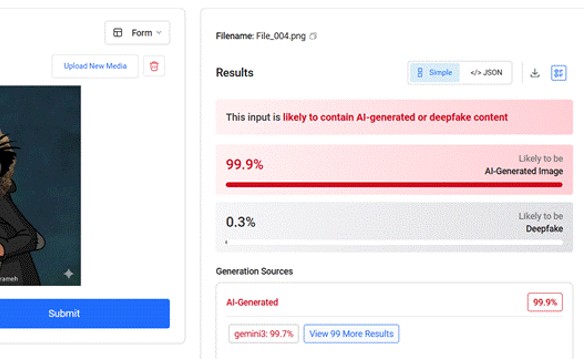
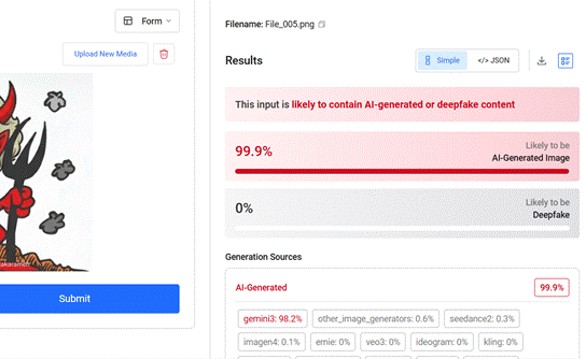
Second image circulated: Hive Moderation's analysis placed the probability of it being AI-generated at 99.9%. It is worth noting that AI-generated content detectors are probabilistic tools capable of producing both false positives and false negatives.
The same pattern played out with women who have far less protection than a government minister. Maya*, a young Lebanese journalist, posted a video filmed in the field during the war that went widely viral.
According to her account to the author of this investigation, her only "reward" was seeing an anonymous account appear and circulate fake sexually explicit AI-generated images of her, accompanied by phrases such as "Israel loves Maya" — a dual attempt to violate her body and cast doubt on her loyalty. This incident has not, however, been independently corroborated to date.
Journalist Lynn*, meanwhile, discovered that a photograph of her taken while reporting in the field had been manipulated to show her standing between two Israeli soldiers pointing their weapons at her. The image had been posted by a foreign account followed by tens of thousands of people.
After being physically assaulted while filming in Beirut, she personally counted 148 comments beneath a post about the attack: criticism of her appearance, sexual insinuations, and accusations of collaborating with the enemy.
"The comments hurt me far more than the assault itself. With the person who attacked me, we had a confrontation and that was the end of it. But the things I was reading, written by people hiding behind fake accounts, were much harder to take," she says.
The ministry's version: an orchestrated campaign, not an educational debate
A source close to the Education Minister says that she and her ministry were aware of the campaign from the moment it launched, and that it gradually escalated from spreading misinformation to personal attacks, before becoming a full-blown "trend" on social media.
According to this source, the ministry simultaneously attempted to explain its position and publish studies and figures on the number of students, displaced persons, and the school curriculum. "But these messages weren't getting through, or had far less reach than the campaign being waged against her."
The source describes a "violent campaign in which every means possible was used," combining personal attacks and insults. On some days, the minister's phone received between 700 and 1,000 messages within short periods of time, coming from what she describes as "organized electronic trolls" using fictitious numbers and sometimes real ones, some of which belonged to students.
According to this source, the campaign also became a vehicle for gaining visibility: "Everyone who wanted to be seen, drum up sympathy, or put themselves forward started posting content about the minister, until the debate about exams and education faded away and was replaced by attacks on her person — her hair one day, her accessories the next, the color of her skirt after that."
Despite all this, the minister filed no legal complaints — a stance the source attributes to her desire to "not make it personal." "She was speaking on the basis of science and data; she therefore did not personally take anyone to court."
On the question of solutions, the source mentions a "social cohesion" plan that the ministry is developing as part of school curricula, in coordination with the ministries of Culture, Information, and Youth and Sports. The legal framework governing behavior on social media remains, for its part, under review at the Ministry of Information.
Beyond harassment: a systematic form of cyberbullying
What the minister's case has in common with those of the two journalists goes beyond simple "digital harassment" in the narrow sense. This is systematic cyberbullying targeting specifically women in the public sphere: the distortion of their image, demonization, ridicule, and the questioning of their competence — all without a single one of their decisions or ideas being genuinely discussed.
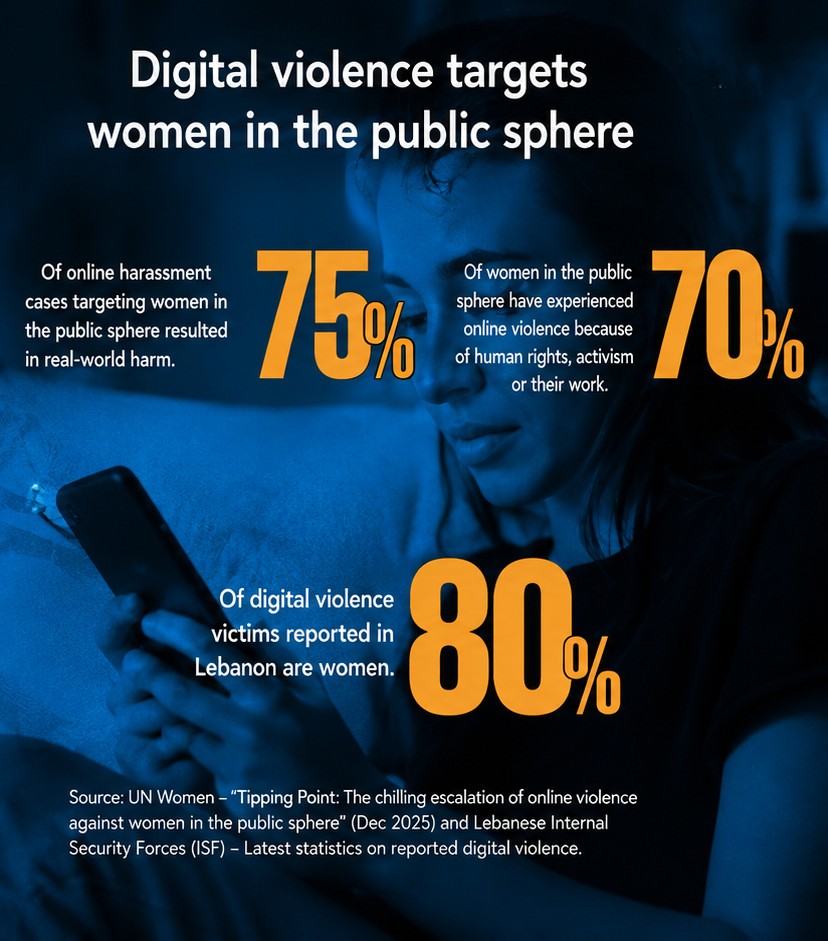
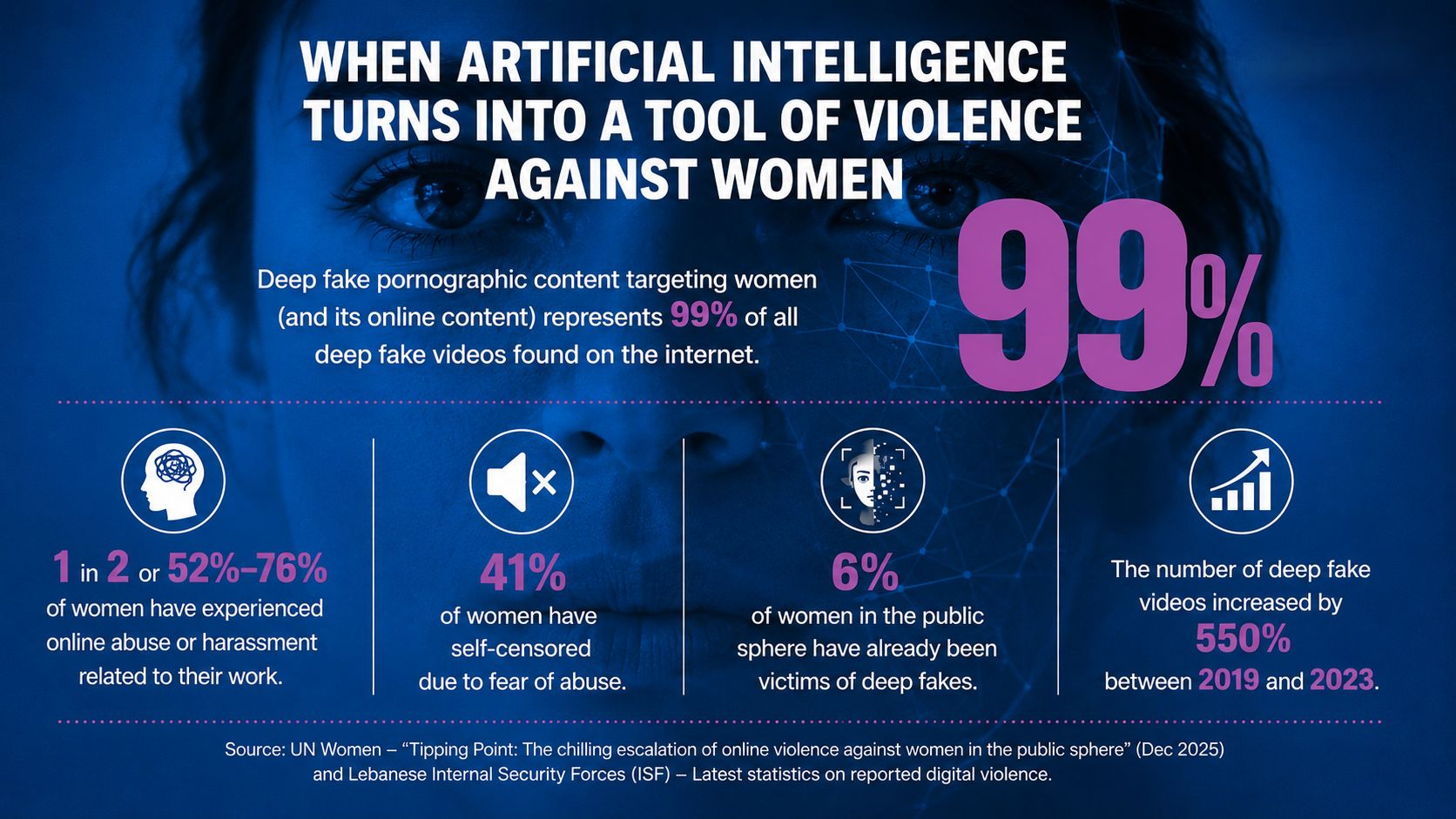
International figures show that what is happening in Lebanon is part of a global phenomenon that is rapidly worsening. According to the "Tipping Point" survey, published in December 2025 by UN Women and the European Commission, in cooperation with UNESCO and the ICFJ and with the participation of researchers from City St George's, University of London, across 119 countries, 70% of women working in the public sphere have experienced digital violence in the course of their work. 41% reported having also suffered real-world harm linked to that violence, while the figure rises to 75% among journalists.
In Lebanon, the latest statistics from the Internal Security Forces, cited by UN Women, indicate that 80% of reported victims of digital violence are women.
When artificial intelligence enters the picture, the figures become even more alarming. According to the "State of Deepfakes" study, published in 2023, 98% of deepfake videos available online are pornographic in nature, and 99% of their victims are women. The study also reported a 550% increase in the number of such videos between 2019 and 2023.
The second part of "Tipping Point", published in April 2026, further reveals that 6% of women in the public sphere have already been victims of deepfakes, while 12% have had intimate images shared without their consent. One in four women has been diagnosed with anxiety or depression linked to digital violence, while 41% practice some form of self-censorship in their posts in order to avoid attacks.
How is this content created, and how can it be detected?
Creating such content no longer requires any particular technical skills. A single publicly available photograph is enough to generate dozens of degrading versions in just a few minutes, using image generation models.
And, as Lynn points out, "ten seconds of your voice is all it takes to fabricate an entire conversation you never had."
Conversely, detection tools such as Hive can estimate the likelihood that content was artificially generated and attempt to identify the model used. This is the tool that was used in the course of this investigation to examine the images and videos targeting Minister Karamé.
But detection remains slower than spread. By the time the analysis results are available, the image may have already reached thousands of screens. And since this content is "professionally crafted," the journalist explains, "people will believe it, because almost no one is truly able to tell the difference anymore."
The problem lies in society before it lies in the tool
"With the rise of artificial intelligence, digital harassment has changed not only in intensity, but also in nature. We are now seeing disinformation fabricated from images and videos, and it is always more dangerous for women than for men," says Abed Qataya, Director of Digital Content at SMEX, an organization specializing in digital rights.
Qataya notes that these campaigns intensify during significant political moments — when a woman runs for office or makes a controversial decision, as in the case of Minister Karamé.
"Insults are often used against women who work in the public sphere, and they become personal; they don't even try to discuss policy or facts," he explains.
He adds: "The danger comes not only from the AI tools now available, but also from the way society thinks about and regards women."
On the legal front, Lebanon appears to be lagging behind the pace at which the threat is evolving. Qataya explains: "In Lebanon, we have no laws directly dedicated to the digital sphere. We have the Penal Code, the 2018 law on electronic transactions and personal data, and the 2020 law criminalizing harassment" — but no legislation specifically addresses fabricated content or gender-based digital violence.
"We have no national plan, nor even a national committee dedicated to this issue," he adds.
Lynn echoes this from her own experience: "The first thing we need is real laws that actually allow us to hold people accountable. Who am I going to file a complaint against? Against X?"
She also believes that the authorities themselves do not take digital violence seriously enough: "They think it's not real violence. For them, real violence is when someone comes and hits you."
From legislation to platforms: four levels of action
The three cases examined in this investigation — a minister demonized over an education policy decision, a journalist whose fake sexual images were fabricated, and a third who was digitally placed between the weapons of two Israeli soldiers — demand action on four levels that can no longer be deferred.
Legislators must adopt a legal framework that explicitly criminalizes the production and distribution of malicious fabricated content, strengthen penalties for sexual and financial blackmail, and establish the national committee called for by digital rights advocates.
Media outlets and public institutions must adopt clear protection protocols — ranging from managing abusive comments to providing legal and psychological support — rather than leaving targeted women to face hundreds of messages on their own.
Digital platforms must speed up the processing of reports and improve their ability to detect AI-generated content. As for women in the public sphere and their teams, Qataya recommends investing in digital security skills, both technical and psychological.
In the meantime, the first line of defense remains in the hands of the public itself: before sharing a 'compromising' or 'shocking' image of a woman in public life, one question should come before all others — who made it, and why?
* 'Maya' and 'Lynn' are pseudonyms used, at their request, to protect the identities of the two journalists.
This report was produced with the support of the European Union and the Dutch government, as part of the grant dedicated to artificial intelligence in the media for the Middle East and North Africa region. Its content does not necessarily reflect the views of the European Union or the Dutch government.
Generative AI tools — Anthropic's Claude and OpenAI's ChatGPT — were used for source research and restructuring during the preparation of this work. The Hive tool was used exclusively to verify content suspected of being AI-generated, and not to produce content. All content was reviewed and the accuracy of every piece of information and every source cited was verified prior to publication. Every possible effort was also made to eliminate any potential bias from the results, whether related to language, the presentation of events, or the selection of sources. Full editorial responsibility for this work rests with its author.
Collège de Nazareth at Risk of Closure
The Philippe Chebaya Center for Children with Special Needs: A Beacon Above the Holy Valley
World Cup: Collective Emotions and Identifications in Lebanon
Training, Digital Development, AI: La Francophonie's Work in the Middle East
Studying in a State of Limbo: When Instability Becomes the Norm
Más de Vanessa Kallas
Ver todo
Más en Society
Ver todo



Nazareth's Extended “Family” Stands United Against the Proposed Sale

The Dragon’s Hiccup: The War Through The Eyes of a Child
Habemus: Peru, at the heart of Leo XIV's life
Lo último de Levant Time
Ver todo


