



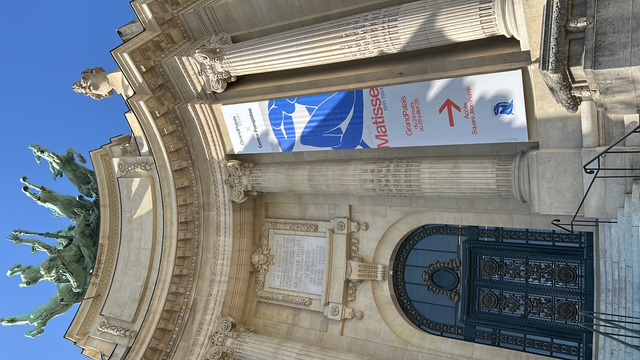
At the Grand Palais, a rare exhibition of exceptional scope, bringing together more than three hundred works from international collections, explores until 26 July the final thirteen years of Henri Matisse. Far from an epilogue, it reveals a moment of intensity in which, constrained by illness, the artist entirely reinvents his language. Paintings, drawings, books, textiles, stained glass and cut gouaches compose a journey conceived as a living studio: that of a man who, at the edge of the end, chooses to open himself still further.
There are exhibitions that open like doors, and then there are those that impose themselves more slowly, almost quietly, until they displace something older than the gaze itself: a manner of holding time, a dense and profound way of standing upright before it, in its slowness as in its light.
At the Grand Palais, this journey devoted to Matisse stands in precisely that fragile interval where life narrows and yet the work expands. In 1941, following an operation that left him lastingly weakened, the artist came close to death. He would later speak of a “second life,” as of a stolen space where everything begins again differently — not through rupture, but through a silent intensification of the gaze.
Holding the world
The first rooms still carry, in undertone, the weight of the world. The war moves through the era without ever settling there openly. Yet it circulates in absences, in restraints, in the very gestures of Matisse, who remained in France and refused any direct representation of violence.
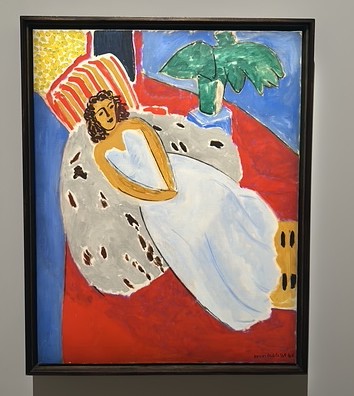
In the drawings of Themes and Variations (1941–1942), the line advances like a held breath. Figures appear, fade, return elsewhere, as if form were less intent on fixing itself than on remaining alive. Nothing truly stabilises, and yet nothing is lost.
This is not a withdrawal from the world, but another way of inhabiting it — slower, perhaps more fragile, yet of a rare exigency. And in this economy of near-nothingness, something already settles: a peace that rests on nothing acquired, but on a continuous attention.
Light does not console
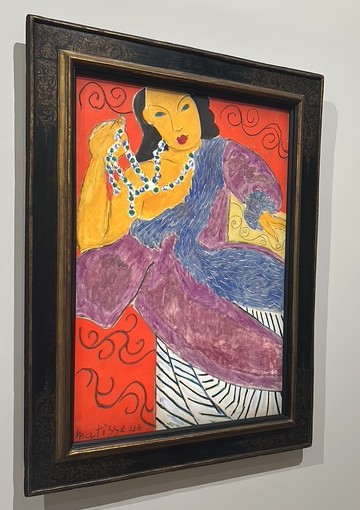
Then colour opens, gently, without spectacular gesture. In The Romanian Blouse (1940), the clear ground breathes like a linen cloth exposed to open air, while the reds, blues and yellows assert themselves with an almost carnal intensity. Light softens nothing. Rather, it traverses, insists, holds.
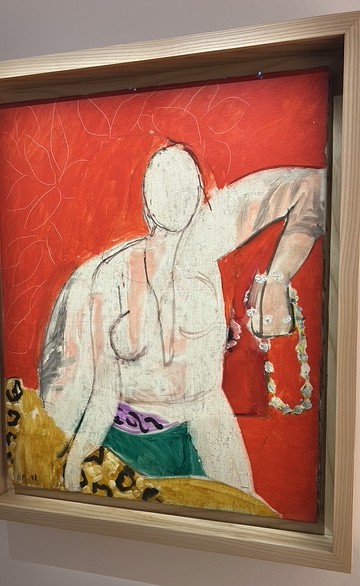
In Matisse, it is never decoration. Light is decision, almost an interior position: a way of remaining on the side of what persists.
Vence, time slowed
At Vence, time changes its density.
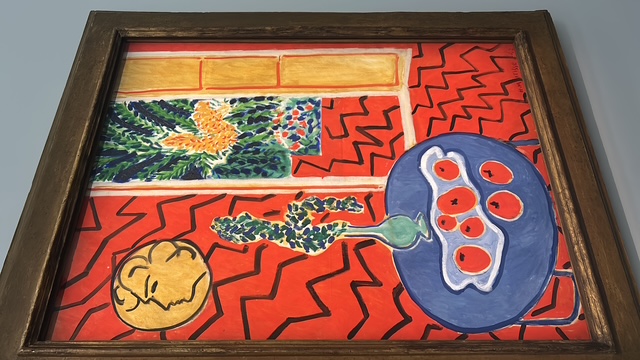
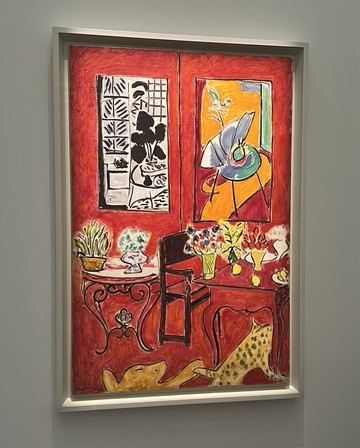
In the Vence Interiors (1947–1948), including Large Red Interior (1948), colour no longer covers space: it permeates it. The red becomes matter, warmth, continuous presence. The objects — table, plant, window — are no more than points of equilibrium within a vaster vibration.
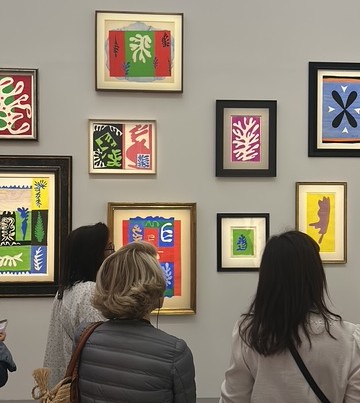
One no longer truly looks at these works; one enters them. And gradually, something undoes itself within perception itself, as though the world were willing to weigh a little less than before.
Cutting into light
With Jazz (1943–1947) and then the cut gouaches, a shift occurs, more radical still than it first appears.
In Icarus (1947), the black figure seems to float amid coloured flashes beating around it, between fall and suspension.
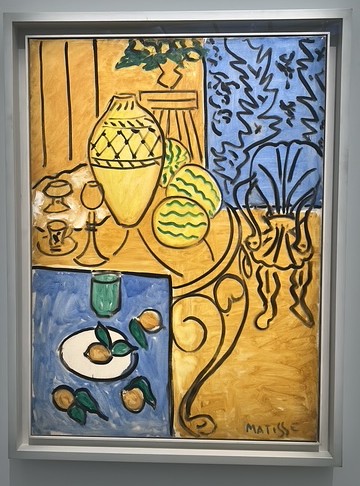
In the Blue Nudes (1952), blue becomes density, almost solid silence, yet traversed by a surprisingly carnal presence.
In The Sadness of the King (1952), forms respond to one another like slow music, each colour seeming to carry a contained emotion, never overflowing.
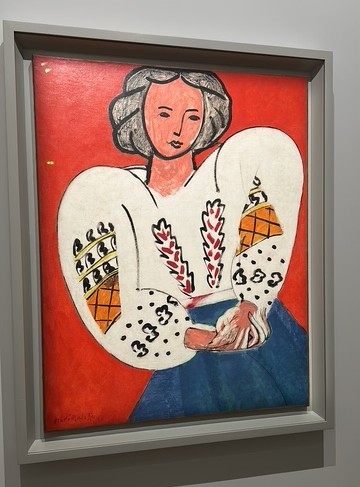
With The Sheaf (1953), plant forms rise in an almost organic movement, as if painting were recovering an ancient sap, a thrust of life without narrative.
Here, everything seems to have been brought back to the essential — not through reduction but through intensification.
A habitable space
The Chapel of the Rosary at Vence (1947–1951) marks a total displacement.
Matisse is no longer composing works but a place. A space in which everything participates: walls, stained glass, ceramics, vestments. The lines reduce themselves to a few precise signs, almost breathed, and the colours — blue, green and yellow — are conceived to be traversed by the light of day.
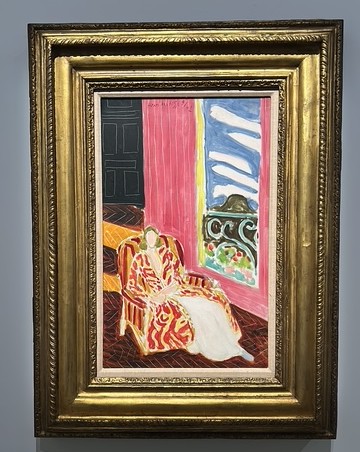
In the morning, they appear fresh, almost translucent. At noon, they thicken, vibrate more intensely. In the evening, they settle, as though the light itself were calming.
Everything here rests on an attentiveness to the passage of time, to its finest nuances.
The final gesture
Towards the end of the exhibition’s journey, painting almost entirely fades away.
Matisse, weakened, continues to cut coloured papers which he moves around him like a garden held in suspension. The forms are no longer painted; they are adjusted, displaced, re-tuned, as if the image were born directly from gesture and breath.
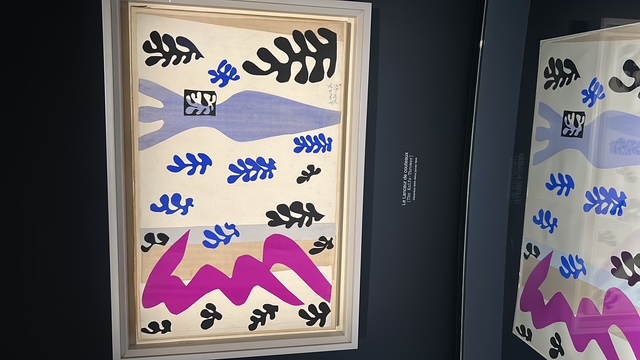
Nothing appears to be a completion. Everything seems, on the contrary, to grow lighter still, until it touches a form of bare necessity.
In a note from 1950, a sentence moves through this period like a quiet murmur, almost a confidence addressed to time: “I hope that however old we live to be, we shall die young.”
Not in the sense of the body, but in that capacity to remain traversed, still, by what is coming.
What light leaves behind
What this exhibition offers to see goes far beyond the chronology of a late work.
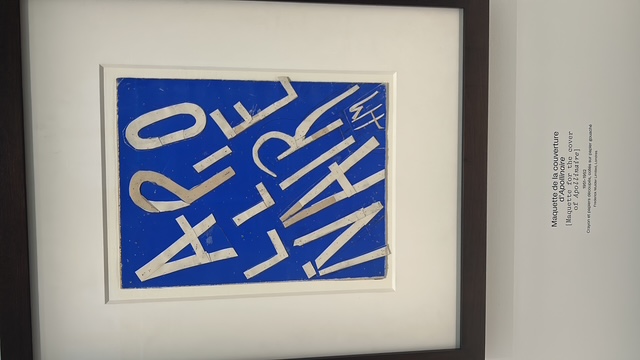
It reveals a manner of moving through time, illness and constraint without ever closing in on oneself. Faced with what narrows, Matisse responds neither with drama nor with rupture, but with an inverse movement: a continuous opening, almost instinctive, where simplification becomes intensity.
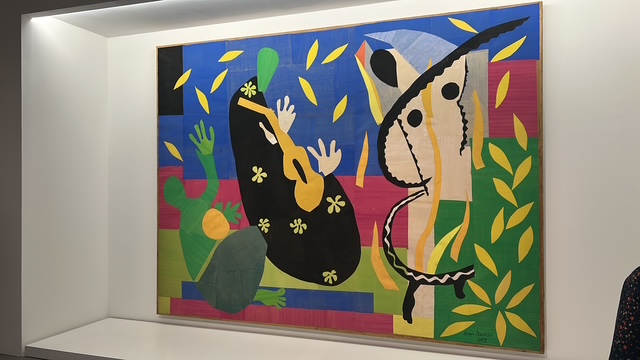
The images do not impose themselves durably. They persist otherwise — as a slow, diffuse sensation that continues to work upon the gaze long after the exit.
And what remains is this impression, discreet but persistent: that art, when it attains this rightness, does not hold the world back. It lets the world colour itself until it becomes luminous.
With the OIF, Francophone Literature Breaks Down Borders
Eva Gonzalès: Subtle Freedom Through the Brush
September News: The Battle of Lebanon
The Samir Kassir Festival, or the Lebanon Yet to Be Born
Why Habermas Remains Urgently Relevant
Más de Yasmina Comair
Ver todo


Más en Culture
Ver todo



'Byblos' at the IMA: a cultural resistance in the face of war
Lo último de Levant Time
Ver todo


