

The Future of Sunni Political Islam
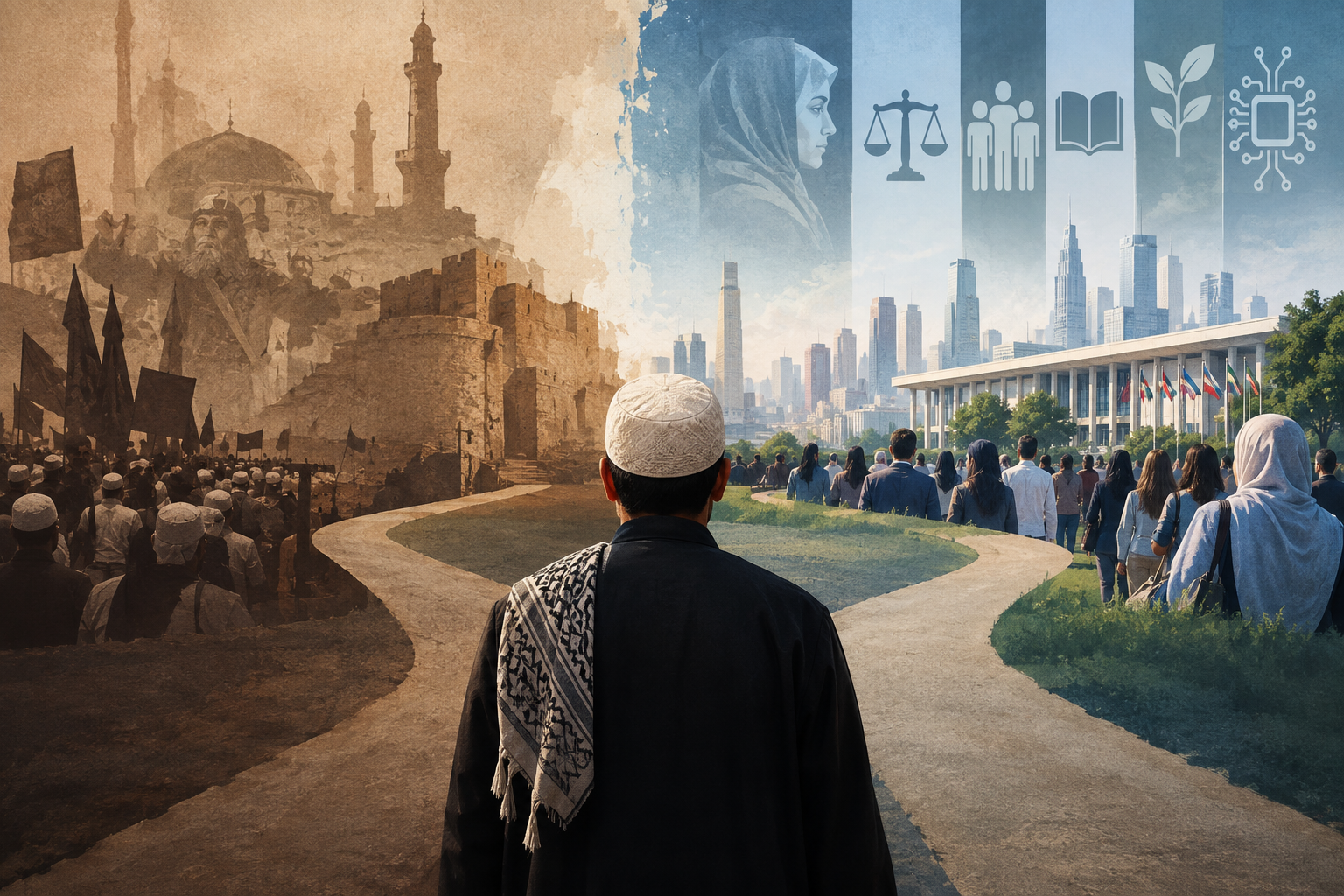
For more than a century, political Islam has been one of the major intellectual and political currents in the Arab and Muslim world. It has taken many forms, encompassing a wide range of organizations, movements and approaches, from those that have opted for elections and peaceful political action to revolutionary movements and, ultimately, extremist jihadist organizations. Despite their profound differences, a central idea has remained common to a significant number of these movements: the belief that the crisis facing Arab and Muslim societies can be overcome by returning to an Islamic political model capable of restoring the nation’s unity, strength and standing.
After long and often costly experiences, a difficult question now arises:
Is this project still capable of offering a vision for the future?
The Failure of the Single-State Project
The dream of unity has been one of the strongest aspirations in modern Arab political history.
Arab nationalists championed it in the form of a single Arab state. Political Islam movements, for their part, framed it within the project of the Islamic umma, through the restoration of the caliphate or the creation of a unified Islamic state.
But in both cases, the project ran up against essentially the same reality.
The single Arab state never came into being, nor did a unified Islamic state. On the contrary, nation-states became increasingly consolidated, borders were reinforced, and distinct national identities and interests gradually emerged.
After nearly a century of attempts, the idea of erasing this reality in order to reunite the region within a state founded on a single ideology now seems increasingly difficult to defend as a realistic political project.
But the crisis of political Islam is not limited to the failure of the unity project.
It also concerns its relationship with time.
When the Past Becomes a Project for the Future
Islamic civilization emerged in a particular historical context and, at different points in its history, made major contributions to thought, science, philosophy, medicine, administration and trade. This is not about denying that heritage or diminishing its value.
The problem begins when history ceases to be a source of identity and experience and becomes an established political program to be applied to the future.
Much of the political Islam discourse continues to seek the legitimacy of the future in a political and social model that is more than fourteen centuries old.
This is where the fundamental contradiction lies.
While the world is advancing at a pace perhaps unprecedented in human history, some of those who advocate political Islam continue to ask how society can be rebuilt on the model of Islam’s early days.
Today, the world is debating artificial intelligence, genetic engineering, quantum computing, robotics, the future of work, climate change, the digital economy and the future of democracy in the age of algorithms.
Meanwhile, part of our political discourse continues to debate questions that arose in societies that knew neither the modern state nor an industrial economy, modern citizenship nor international human rights – and certainly not the internet or artificial intelligence.
This is not a conflict between religion and science.
It is a conflict between two ways of understanding time.
You Cannot Enter the Future with Political Thinking Rooted in the Past
This is where we come to the most difficult question.
Political Islam cannot enter the new Middle East while holding on to systems of thought and social models shaped by historical contexts radically different from our own.
Modern society has profoundly reshaped the relationship between the individual and the state, between men and women, between rulers and the ruled, between majorities and minorities, and between religion and the public sphere.
Individual freedom, equality before the law, human rights, women’s rights, freedom of belief and expression, minority rights, political participation, the peaceful transfer of power and accountability now lie at the heart of the modern conception of the state.
No contemporary political project, Islamic or otherwise, can therefore regard these principles as secondary, or dismiss them as imported ideas from which those in power can pick and choose according to their own interests.
The question is no longer simply whether political Islam accepts elections.
It goes much further.
Does it accept freedom, even when it produces choices with which it disagrees?
Does it accept that women should have the same rights as men, as full citizens, rather than reducing them to their role within the family or treating them as sexual objects?
Does it accept that non-Muslim citizens should enjoy the same political rights as Muslims?
Does it accept freedom of thought, belief and conscience?
Does it accept the peaceful transfer of power when it loses elections, just as it does when it wins them?
Does it accept an independent judiciary, a free press, civil society and the separation of powers?
And does it accept that human rights are not a favor granted by the majority to the minority, but rights inherent to every human being – rights that political power has no authority to take away?
These are not details of a political program.
What is at stake is political Islam’s very relationship with political modernity.
Women: The Most Difficult Test
Women’s status in society is undoubtedly one of the most revealing tests.
Women’s place in society has changed profoundly. Today, women are scientists, doctors, judges, ministers, heads of government, business leaders, university professors, astronauts and artificial intelligence engineers.
It is difficult to imagine a vision for the future that continues to define women’s place through social categories shaped in economic and social contexts radically different from our own.
It is not enough to say that Islam has honored women.
The political question is what rights women actually enjoy today.
Do they enjoy full and equal citizenship? Has it been recognized that they are not inferior to men, that their bodies are neither something to be concealed nor sexual objects, that there can be no distinction between an enslaved woman and a free woman, and that all women are equal? Has it been recognized that women are equal to men in thought, intelligence and political participation, that their testimony carries the same weight as that of men, and that they are entitled to an equal share of the inheritance, given that the modern woman is the equal of man in knowledge and intellectual ability and is capable of managing her own affairs?
Do they have the same rights when it comes to making decisions that affect their lives?
Are they subject to the same laws?
Can they hold all positions of decision-making power?
This is where the renewal of political thought becomes a necessity, not a luxury.
From Literal Adherence to the Search for Underlying Principles
Contemporary Islamic thought may need to undergo a profound shift: rather than seeking to reproduce rules inherited from the past, it should focus on the purposes and values that lie behind them.
Justice, human dignity, mercy, the fight against injustice, the protection of the most vulnerable, responsibility, consultation and respect for human beings can provide a strong ethical foundation for a contemporary society inspired by Islamic values. As we have seen above, the ultimate purpose of noble virtues is to free human beings from the grip of their instincts – the desire for power, money and sexual gratification – and to prevent them from reducing others to commodities or mere means to an end. Instead, they should help build a society that recognizes the humanity of every individual and guarantees equality for all.
The question then takes on a different dimension.
Instead of asking what models Muslims used a thousand years ago to organize their societies socially, economically and politically, we should ask:
How can justice be achieved today?
How can human dignity be guaranteed?
How can people be protected from the power of the state?
How can equality among citizens be ensured?
How can society be protected from discrimination?
How can each person’s freedom and conscience be safeguarded?
And how can we address questions that classical Islamic jurisprudence simply never had to confront – from artificial intelligence and genetic engineering to data ownership and digital privacy?
Ijtihad then ceases to be an attempt to reproduce the past and becomes a tool for shaping the future.
Artificial Intelligence Changes the Question
We are on the threshold of a transformation that could prove even more profound than the Industrial Revolution.
Artificial intelligence will not merely change the tools we use. It could fundamentally reshape the economy, work, education, government, warfare, the media and social relations – and perhaps even our understanding of political power.
The question now facing political movements across the region is therefore radically different.
It is no longer about how the state should have been governed fourteen centuries ago, but about asking:
How should the state be governed twenty years from now?
How can human beings be protected in the age of artificial intelligence?
Who owns the data and the algorithms?
How can freedom and privacy be protected?
How can wealth be redistributed if production becomes increasingly less dependent on human labor?
How can we prevent technology from becoming an instrument of oppression?
Any political movement – Islamist, nationalist, left-wing or liberal – that is unable to answer these questions will gradually find itself left behind by history.
The Problem Is Not Islam
A distinction needs to be made here.
Speaking of a crisis of political Islam does not mean speaking of a crisis of Islam.
Islam is a religion, a civilization, a culture and an identity for hundreds of millions of people. It will remain one of the fundamental components of the societies of the region. But religious texts must remain subject to continuous reflection in order to keep pace with the course of history and with the intellectual needs and realities of each era.
Every religion is ultimately concerned with promoting noble virtues. Their highest expression lies in freeing human beings from the grip of their instincts and their desires for power, money and pleasure; in refusing to reduce human beings to commodities or mere means; and in upholding the equality and dignity of all.
Islamic civilization itself did not experience its great periods of flourishing by closing itself off from the world. On the contrary, it flourished by opening itself to the world, translating its knowledge and philosophies, and then enriching and advancing them.
That is why, if Islam is to continue to play a role in civilization, the goal should not be to bring Muslims back to the seventh century, but to enable them to be active participants in the twenty-first century.
What Remains of Political Islam?
This does not necessarily mean the disappearance of Islamist movements.
It could also mean their transformation.
We may see the emergence of political parties grounded in Islamic ethical values, operating within the framework of the nation-state and democracy, accepting the peaceful transfer of power, equal citizenship, human rights, equality between women and men, freedom of belief and pluralism, and offering realistic, workable economic, social and technological programs.
The Islamic reference would then serve as a source of values and ethical principles, rather than as a pre-established model of the state.
The difference between the two models is substantial.
In the first case, the question is:
How can we rebuild the state of the past?
In the second:
How can our values help us build the state of tomorrow? A state built on justice, freedom and political participation, rather than on force, coercion, discrimination and repression.
Political Islam at a Historic Crossroads
The new Middle East will not wait for anyone.
The world is entering the age of artificial intelligence. As it does, our very notions of work, production, knowledge, power, sovereignty and even what it means to be human are changing.
In this new world, it is no longer enough for a political movement to have answers to the questions of the past.
It must first be able to ask the questions of the future.
Political Islam therefore faces a historic choice.
Either it remains a project seeking to reproduce a bygone society, moving ever further away from the course of history.
Or it accepts the need to fundamentally rethink its own political thought – its conception of the state, power, citizenship, the place of women, freedoms and human rights – and to reopen the door to ijtihad and interpretation, so that Islamic thought can engage with the transformations of its time.
This does not mean abandoning Islam.
It may even mean the opposite: freeing Islam from the grip of a single historical interpretation.
The fourteen centuries of Islamic history are not a problem. On the contrary, they represent an immense civilizational heritage.
The problem begins when we believe we must live in the 15th century of the Hijri calendar with the same answers developed during the early centuries of Islam.
The real challenge facing political Islam is not to restore the past, but to show that the Islamic reference can give rise to a political vision for human beings living in the age of artificial intelligence.
The decisive question is therefore not:
How can we recreate history?
But:
How can we reread our heritage in the course of history so that we can help shape the future?
Civilizations do not die because they have a past.
They begin to decline when the past becomes the only horizon from which they can imagine their future.