

The Mecca Agreement and the Emergence of a Fourth Regional Balance?
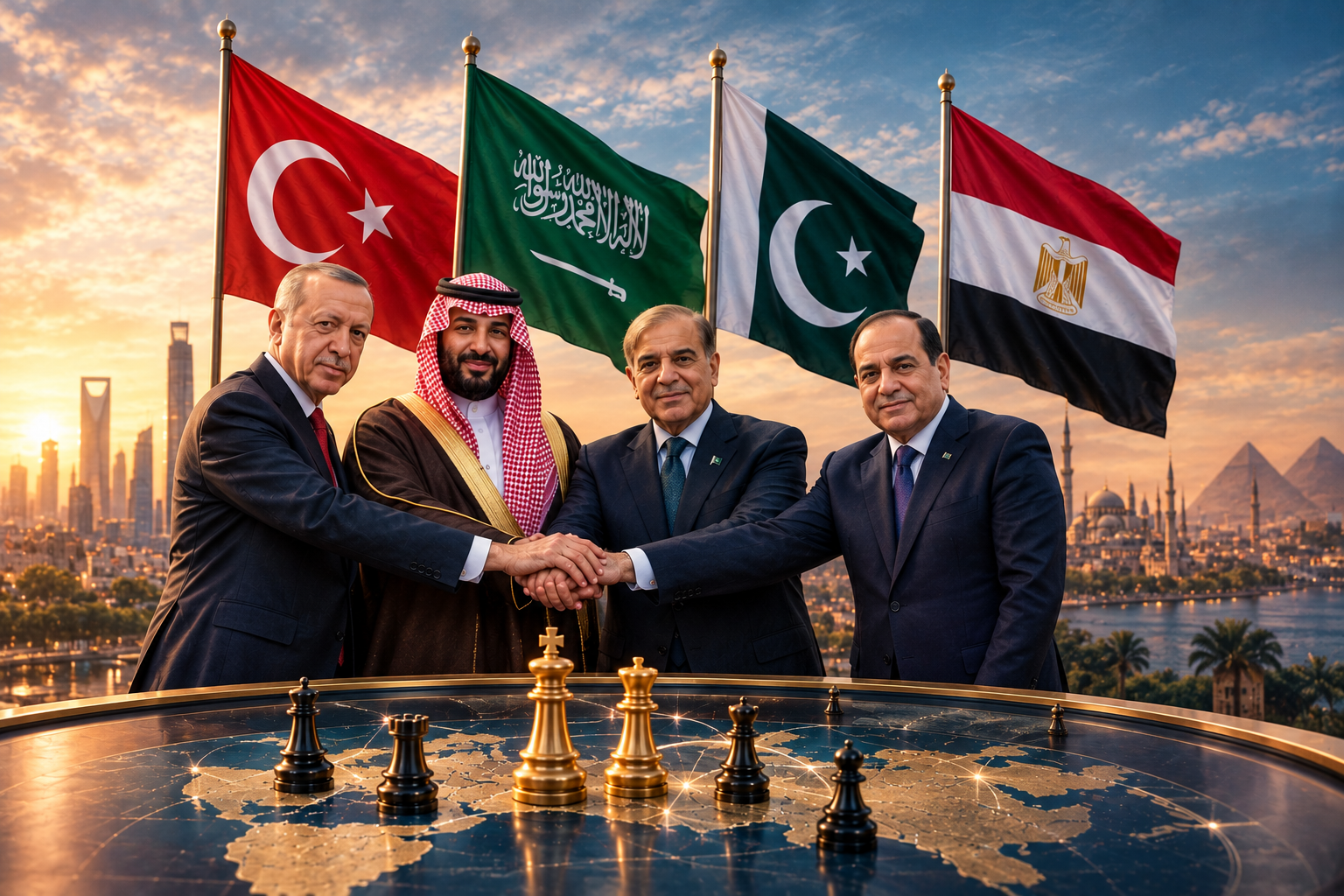

If the Middle East is now the scene of a confrontation between Israeli, Turkish and Iranian projects, the Mecca agreement on joint defense between Saudi Arabia, Turkey and Pakistan could signal the emergence of something different: not necessarily a fourth hegemonic project, but a new project for regional balance.
The significance of the agreement lies in the fact that the three countries bring together remarkably complementary sources of power.
Turkey has a powerful military, is a member of NATO, and has a rapidly expanding military and technology industry, as well as advanced capabilities in drones and electronic warfare.
Pakistan is a major military power. It is the only Muslim state to possess nuclear weapons. It also has extensive military and strategic experience.
Saudi Arabia, for its part, has economic and financial power, as well as energy resources, alongside its central position in the Arab and Muslim worlds and its growing political weight on the international stage.
The combination of Saudi financial power, Turkish military and industrial power, and Pakistani military and nuclear capabilities thus creates, for the first time in decades, the possibility of a regional power center emerging that would not be entirely under the American umbrella.
This does not mean that the three countries have decided to break with the United States. Turkey remains a member of NATO, while Saudi Arabia and Pakistan maintain important ties with Washington. But the new element is that these states are now making clear, in practice, that regional security can no longer remain exclusively dependent on the guarantees of an outside power.
The agreement is thus part of a broader international transformation.
The order that emerged after the end of the Cold War, in which the United States was the virtually sole power capable of setting the rules of the game in the Middle East, is beginning to evolve toward a more multipolar system.
China is present both economically and strategically.
Russia, despite the decline of some of its influence, remains an international power.
India is emerging as an increasingly important global power.
And Turkey, Saudi Arabia and Pakistan no longer want to be mere states operating within an order shaped by others; they now seek to participate in shaping it.
Beyond an Alliance Against Iran
It would be wrong to view the Mecca agreement as a simple Sunni alliance directed against Iran.
The three countries themselves have stressed the defensive nature of the agreement, emphasizing that it is directed against no particular state.
More importantly, their strategic interests extend far beyond the confrontation with Tehran.
To be sure, they want to prevent the return of Iranian hegemony, but they do not want the collapse of Iranian power to automatically lead the region toward Israeli hegemony.
The agreement thus becomes an instrument of balance with a dual purpose:
Containing Iran, on the one hand, and preventing Israel from becoming the sole regional power capable of imposing the rules of the system, on the other.
The distinction is fundamental.
If, in previous decades, the Iranian project sought to build an axis stretching from Tehran to Baghdad, Damascus and Beirut, and if the current Israeli project seeks to establish a strategic supremacy that would make Israel the power no one could challenge, the Mecca agreement could usher in a third logic:
Neither Iranian hegemony nor Israeli hegemony, but a regional balance among several powers.
What If Egypt Joined the Agreement?
The question then takes on an entirely different significance.
The agreement is open to other countries joining, and Egypt has already been mentioned as a natural potential candidate.
If that were to happen, the very nature of the alliance would be radically transformed.
The grouping would then bring together Saudi Arabia, Egypt, Turkey and Pakistan.
In other words, the Gulf’s economic power would be combined with the Arab world’s most populous country, one of the Middle East’s largest military powers, and the Muslim world’s sole nuclear power.
At that point, we would no longer be looking at a simple tripartite defense agreement, but at a potential nucleus of a new regional security order.
That order could subsequently take various forms and extend to other Arab and Muslim countries.
From a Joint-Stock Company to a New Board of Directors
And it is at this point that we can return to the image I put forward in 1988.
I said then that the Middle East would be transformed into a joint-stock company, with the United States at the head of its board of directors, and that the struggle would henceforth be over who would take charge of running it.
Perhaps it is time to revisit that image.
The company still exists, but the chairman of the board is no longer in a position to make decisions on his own.
Israel wants to become the most powerful regional executive.
Turkey wants to be an indispensable partner in running the company.
Iran is trying to preserve the share it holds, even as that share continues to erode.
As for Saudi Arabia, together with Pakistan and perhaps Egypt and other countries, it appears to have begun asking a different question:
Why should a single actor have to run the region?
This is where the Mecca agreement’s potential historical significance lies.
For if it evolves from a simple joint-defense agreement into a broader political, economic and security system, it could form the nucleus of a regional order based on a balance of power rather than the hegemony of a single power.
From Regional Balance to International Balance
But the most interesting aspect of this shift is that this grouping does not need to fully align itself with any of the major international blocs.
Turkey is a member of NATO but maintains relations with Russia and China.
Saudi Arabia is a longstanding partner of the United States, but in recent years has deepened its relations with China, Russia and other Asian powers.
Pakistan, for its part, has a deep strategic relationship with China, while maintaining important channels with the United States and the West.
This means that, collectively, these three countries have a network of relations stretching from Washington to Beijing, via Moscow, Europe and the Muslim world.
The true value of this axis would therefore lie precisely in the fact that it is not a subordinate component of any international bloc, but is capable of moving between the different poles.
And this may be the defining feature of the international order to come:
Power will not belong solely to those who align themselves with the strongest camp, but to those capable of dealing with all camps without ever becoming subordinate to any of them.
If Saudi Arabia, Turkey and Pakistan succeed in doing so, the Mecca agreement could go far beyond the question of joint defense.
It could become one of the first building blocks of a regional balance within a multipolar world order.
The Middle East would then have begun, for the first time in a long while, to move from a stage where others compete for influence to a region where some of its own powers seek to participate in shaping the very rules of the international game.