

The Middle East as a Corporation: Who Will Take Charge?

In 1998, my students asked me a question that, at the time, seemed too broad to have a clear answer: What is the future of the Middle East?
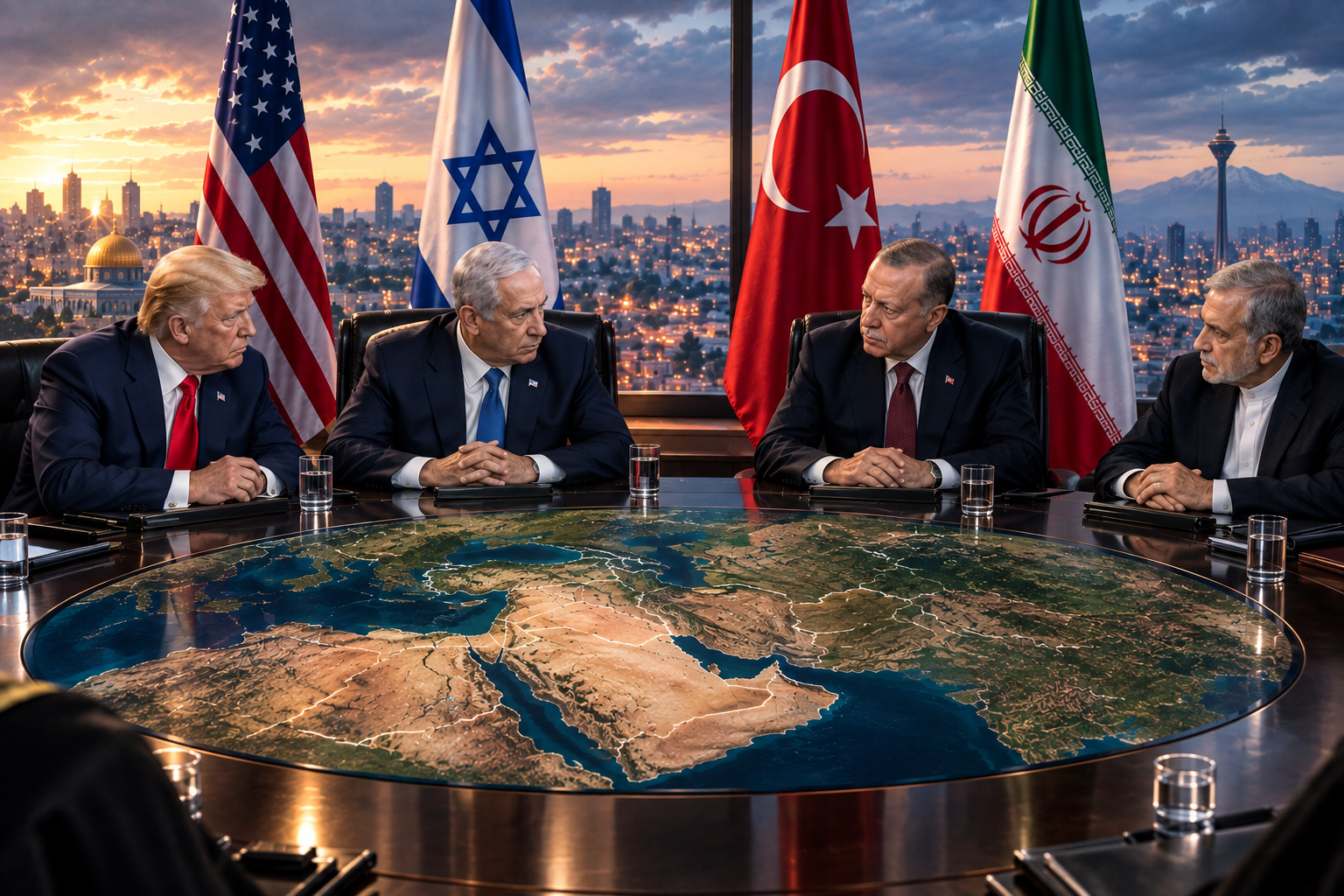
I told them that I believed the Middle East would evolve into something resembling a large corporation, with the United States as its board of directors, and that the fundamental conflict of the future would no longer be limited to the one between the Arabs and Israel, but would also revolve around the question of who would take over the executive leadership of this regional enterprise. I added that the main contenders in this struggle would essentially be Israel, Iran, and Turkey.
Nearly three decades later, it appears that we are at the heart of that struggle.
The central question in the Middle East is no longer simply who controls a territory, who wins a war, or even who possesses the greatest military power. The deeper question now is: Who will set the rules of the regional order? Who will define the limits of states’ influence? Who will decide the future of Syria, Iraq, Lebanon, the Gulf, and the Eastern Mediterranean? And who has the ability to influence Arab decision-making?
The region has gradually moved from a phase in which the Arab world, despite its weakness and divisions, was among the actors shaping the regional order to one in which much of that Arab world has become the arena for the struggle over that order.
That is where the real tragedy lies.
From the Arab-Israeli Conflict to the Struggle for the Arab World
During the second half of the 20th century, the region’s principal conflict was defined as the Arab-Israeli conflict. Several competing Arab projects – Nasserist, Baathist, monarchical, and Islamist – were at work. The Arab states themselves, whatever reservations one might have about their policies, were major actors in shaping the future of the region.
Today, the map has changed.
We are now confronted with three major regional projects: Israeli, Turkish, and Iranian, each with its own vision of its place, its role, and the limits of its influence. Amid these competing projects, Arab states are pursuing their own paths, sometimes according to their national interests, and at other times according to the interests of their regimes and their security concerns.
There is therefore no longer, strictly speaking, a single “Arab axis” facing the other axes. Some Arab states are drawing closer to the United States, while others are coordinating with Turkey. Still others have built strategic relations with Israel, while some are aligned with Iran. Others, finally, are seeking to maintain balanced relations with all of them.
Even the Gulf states no longer act as a unified political bloc: each now has its own calculations, its own relationships, and its own alliances. Developments underway in 2026 show that some countries in the region are already seeking new security arrangements and new alliances, after confidence in the traditional regional order’s ability to guarantee stability has been shaken.
The Israeli Project: From Control of Territory to Control of the System
When we speak of “Greater Israel,” it would be wrong to reduce the idea to a specific geographical map stretching from one point to another. Some Israeli religious and nationalist currents do indeed envision territorial expansion, but the concept of greatest strategic significance is Greater Israel as the leading hegemonic power in the Middle East.
In other words, Israel may not need to occupy every territory to achieve its project. The most effective form of domination could be to become the military, technological, and intelligence power that no major regional decision could afford to ignore.
Israel has considerable military and technological superiority, a deep strategic alliance with the United States, and intelligence and military capabilities that are unparalleled given its size and population.
From this perspective, weakening rival regional powers and preventing the emergence of a military power capable of counterbalancing Israel become essential elements of its security vision.
Over the past several decades, Iran has posed the main regional challenge to this vision. But Iran’s weakening does not necessarily mean the end of the struggle over the regional order. On the contrary, it could reveal the next challenger.
And that challenger is Turkey.
The Turkish Project: Influence Without Occupation
Turkey does not need to restore the Ottoman Empire to establish itself as the most influential power in its geographical sphere.
The modern Turkish project is far more complex and pragmatic.
Ankara wants to be the state whose interests must be taken into account before any decision concerning Syria, Iraq, the Eastern Mediterranean, the Caucasus, and perhaps a large part of the Arab world.
To build a broad sphere of influence, it draws on its economy, trade, energy, defense industry, military power, diplomacy, and cultural ties, as well as its position within NATO.
It would be wrong to simplistically describe this as “neo-Ottomanism.” Recent studies suggest that current Turkish policy is more about an attempt to build a regional order that serves Turkey’s security and interests, while preventing its adversaries from shaping the environment around it, than about seeking to recreate a historical empire.
But Turkey’s growing power is increasingly bringing Ankara into confrontation with the Israeli project.
The vital spheres of the two projects overlap in Syria and the Eastern Mediterranean, while extending toward the Red Sea, trade and energy routes, and the levers of influence within the regional political system. This is why Turkish-Israeli relations are beginning to shift from recurring political disputes toward an increasingly structural strategic rivalry.
The Iranian Project: Defending a Shrinking Sphere of Influence
Iran, for its part, has pursued its regional project according to an entirely different logic since the 1979 Islamic Revolution.
Tehran did not rely solely on conventional military power. It also built an extensive network of political, military, and non-state alliances stretching from Iraq and Syria to Lebanon and Yemen.
The Shiite component played a central role in many of these networks. Yet reducing the Iranian project to a mere “Shiite project” fails to capture its full logic. At its core, it is the project of a state seeking to build strategic depth that can prevent its adversaries from encircling it and give it sources of leverage beyond its borders.
That project, however, has suffered major setbacks in recent years, as the regional environment that enabled its expansion has changed.
Today, Iran appears to be engaged in a different battle from the one it has fought over the past two decades. Its objective is no longer simply to expand its sphere of influence, but to preserve, as far as possible, what remains of it.
With the direct clashes that marked 2026, the conflict between the United States and Israel on one side and Iran on the other has entered a new phase. The Strait of Hormuz crisis, meanwhile, has shown that Iran, even under military and economic pressure, still has the means to affect the global economy and security.
After Iran, Will Turkey Become Israel’s Main Rival?
This brings us to the question that, in my view, will be central to the next phase.
If Iran’s ability to compete at the regional level were to decline sharply, that would not necessarily lead to a stable Middle East dominated by Israel without a genuine rival.
Quite the contrary.
It could lead to a gradual shift in the center of regional rivalry, from a confrontation between Israel and Iran to a confrontation between Israel and Turkey.
Turkey possesses what Iran did not: a larger and more diversified economy, an advanced industrial base, a rapidly expanding defense industry, a substantial conventional military, NATO membership, a geographical position that gives it control over the gateways to Europe, Asia, and the Middle East, as well as extensive economic and political ties with the Arab world.
Israel, for its part, could see the rise of a Turkey wielding broad regional influence as a long-term challenge to its monopoly on strategic superiority in the region.
Once Iran is neutralized, Turkey could become the main obstacle to near-absolute Israeli dominance, just as Israel could become the main obstacle to a Turkish project aimed at building a broad regional sphere of influence.
This hypothesis is no longer merely a theoretical exercise. Analyses published in 2026 already point to Turkish-Israeli tensions evolving into a strategic rivalry stretching from Syria to the Eastern Mediterranean and the Red Sea corridors.
And the Arabs, Where Do They Stand?
At this point, we must ask the painful question.
Where, then, is the Arab project in all this?
To be sure, there are Arab states with considerable economic, financial, and military power, and some of them are already pursuing a more independent and more assertive foreign policy. It would therefore be wrong to regard the Arabs as mere puppets manipulated by foreign powers.
The real problem lies elsewhere. It is the absence of a collective Arab project for the regional order.
There is a Saudi policy, an Egyptian policy, an Emirati policy, a Qatari policy, an Iraqi policy, and the policies of every other country. But where is the common Arab vision of what the Middle East should look like ten or twenty years from now?
What are the acceptable limits of foreign interference?
What is our conception of regional security?
How can we protect smaller Arab states so that they do not become mere spheres of influence?
What will become of the Palestinian cause?
What kind of relationship should we have with Iran, Turkey, and Israel?
And what kind of relationship do the Arabs themselves want to have with the United States, China, Russia, and Europe?
It is precisely the absence of common answers to these questions that allows others to answer them on the Arabs’ behalf.
The Board’s American Chairman
That leaves the role of the United States.
When I used the image of a “corporation” in 1998, I said that the United States would be its chairman of the board.
Three decades later, the analogy still holds, but with one important qualification.
Washington is no longer able to manage every detail of the Middle East as it did after the collapse of the Soviet Union. China has emerged as a major economic power in the region, Russia has sought to build military and political influence there, and regional powers have gained greater autonomy.
But the United States retains an advantage that no other actor possesses: a network of bases, alliances, and military and economic relationships, as well as an unprecedented ability to influence the balance of power in the region.
The US-Iran military developments of 2026 confirm this: despite recurring talk of its withdrawal from the Middle East, Washington remains a direct actor in the region’s security and wars.
Perhaps today’s “corporation” is simply less disciplined than the one I imagined in 1998. The chairman of the board is still there, but he is no longer able to keep all the board members under control, while each regional director seeks to increase his share and influence.
The Real Danger
The greatest danger for the Arab world is not that Iran, Israel, or Turkey prevails.
The real danger is that the Arab world continues to accept being a playground for others instead of reclaiming its role as an actor.
For when collective Arab power is lacking, each state will choose the alliance it believes can protect it: one with the United States, another with Turkey, a third with Israel, a fourth with Iran, while a fifth will try to keep an equal distance from all of them.
But the sum of these individual policies does not amount to an Arab order.
It creates a vacuum.
And politics, like nature, abhors a vacuum. If the Arabs do not define their own vision for the future of their region, others will define it for them.
And so the question my students asked me in 1998 returns today with even greater urgency:
Who will govern the Middle East?
But perhaps the question we Arabs should be asking ourselves is even more important:
Do we want to remain minor shareholders in a company run by others on our behalf, or do we want to regain the ability to shape a regional order in which we are genuine partners in determining its rules and its future?