

Gibran Khalil Gibran: A Bridge of Light Between East and West (2/3)


In our previous article, we reviewed Gibran’s life. In this second installment, we explore several facets of the thinker: the influence of Friedrich Nietzsche, Gibran the rebel, and his role as a precursor of Lebanese nationalism.
“I am a son of earth and sky.
The forest is my church, the field my sanctuary,
and the stars my companions in meditation.”
Gibran Khalil Gibran
“Man is a rope stretched between the animal
and the Superman – a rope over an abyss.”
Friedrich Nietzsche
During his stay in Paris, Gibran discovered Nietzsche, a revelation that profoundly transformed both his thought and his style. He moved from a melancholic, nostalgic poet to a thundering prophetic voice. His writing became aphoristic, prophetic, and powerful.
Yet unlike Nietzsche – an atheistic, cynical, and deeply pessimistic thinker – Gibran remained profoundly faithful and filled with hope. In fact, Gibran reinterpreted Nietzsche’s concept of the Übermensch (Superman) through his Eastern sensibility as well as through his vision of Lebanese nationalism and the freedom of peoples.
Moreover, the very structure of The Prophet (Al-Mustafa addressing a crowd before the veils are lifted) strikingly echoes Nietzsche’s Thus Spoke Zarathustra.
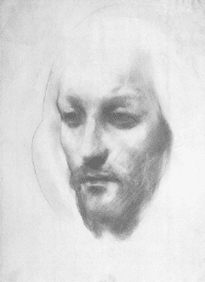
“The Wanderer, 1928.” Charcoal. (Gibran Khalil Gibran Museum)
The Relationship with the Church: A Rebellious Believer
“Your faith is within you;
and it is the beating of your heart.”
“Religion is a heart that opens,
not a doctrine that closes.”
Gibran Khalil Gibran
Gibran’s relationship with the Church was one of passionate “love and hate.” A Maronite Christian by birth and cultural upbringing, his childhood was steeped in the spirituality of Lebanon’s sacred Qadisha Valley, the historic refuge of Lebanese monks.
His style was directly shaped by the Bible, which he read repeatedly. In The Prophet, his central character speaks in parables, reminiscent of Scriptures. Yet Gibran would go on to become one of the fiercest critics of ecclesiastical institution.
His book Rebellious Spirits, published in 1908, caused a scandal. He denounced the alliance between feudal lords and the clergy, describing certain priests as “wolves in sheep’s clothing.” Upon publication, the book was deemed “heretical and revolutionary.” Yet, Gibran was not attacking faith itself, but the institution’s hypocrisy.
“You have your religion and I have mine,” he wrote. Although influenced by Sufism and Hinduism, Gibran remained fundamentally Christian. He was a Christian of the early origins, who reduced everything to Jesus, to whom he devoted absolute reverence.
Deeply influenced by European Romanticism and American Transcendentalism, he saw Christ not as a figure of suffering and submission, but as a fierce “lion,” a revolutionary who breaks the chains of organized religion.
Today, his relationship with the Church becomes more reconciled. He is widely welcomed in ecclesiastical circles. In the United States, some priests officiate weddings by reading passages from The Prophet. Academic theses by religious scholars have been devoted to him. Moreover, the first Arabic translation of The Prophet was carried out by an Orthodox priest.
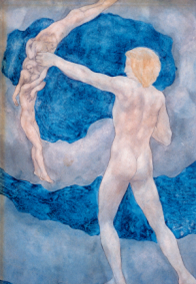
“The Archer, 1923.” Aquarelle. (Gibran Khalil Gibran Museum)
The Invention of an “Imaginary Lebanon”
“Lebanon is the soil of my soul
and the cradle of my dreams.
Your Lebanon is an octopus-like
government with many tentacles.”
Gibran Khalil Gibran
At a time when Lebanon was under Ottoman rule and later the French Mandate, Gibran played a key role in shaping modern Lebanese identity.
Yet he was not a political ideologue. From New York, where he founded the Pen League (al-Rabita al-qalamiyya), he revolutionized Arabic literature and gave new face to the creative genius of the Lebanese diaspora. He became a national symbol embodying an intellectual, free and spiritual Lebanon.
Influenced by Nietzsche, Gibran advocated for a Lebanese identity rooted in freedom, strength, and self-transcendence. He did not envision a Lebanese people defined by victimhood or submission, but a nation freed from corruption and intellectually open to the world: a Lebanon as a bridge between cultures, distinct from the Arab world through its spirituality, history, and openness.
During the great famine of 1914, Gibran actively supported Lebanon through his writings, but when President Ayoub Tabet offered him a ministerial post, he refused, convinced that politics was not his path.
Today, Gibran’s writings are regularly appropriated by Lebanese politicians and repurposed in the service of opportunistic nationalism.
Invoking Gibran allows some political figures to project an intellectual and moral stature while ignoring his sharp critiques of corruption and hypocrisy of those in power.
Gibran, an Unwitting Icon of Counterculture
In the United States, The Prophet, published in 1923, became something of a counterculture bible in the 1960s. It won over hippie’s circles with its universal spirituality and ecumenical tone. Students read it on campuses and held it up as a manifesto for a spiritual quest outside institutional frameworks. Yet this image is reductive. Gibran was neither a guru nor a New Age prophet. He is a Christian revolutionary, profoundly imbued with Christ.
Read more on this topic:
Gibran Khalil Gibran: A Bridge of Light Between East and West (1/3)
With the OIF, Francophone Literature Breaks Down Borders
Eva Gonzalès: Subtle Freedom Through the Brush
September News: The Battle of Lebanon
The Samir Kassir Festival, or the Lebanon Yet to Be Born
Why Habermas Remains Urgently Relevant
More from Micha Moussallem
View All


More in Culture
View All


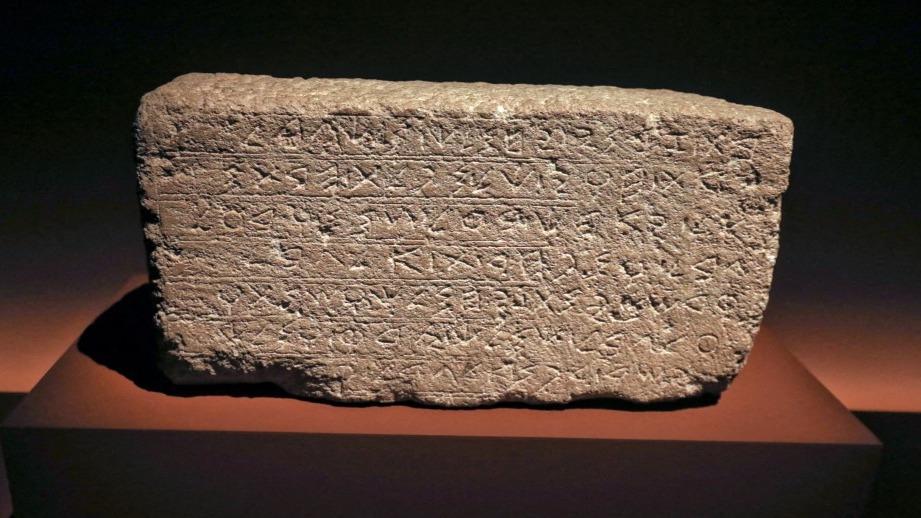

'Byblos' at the IMA: a cultural resistance in the face of war
Latest from Levant Time
View All


