

Marie Curie: Beyond Prejudice, Uranium and Two Nobel Prizes (4)

Some people spend their lives accepting their lot, while others take their destiny into their own hands. This is all the more difficult for a woman living in a man’s world. And yet… some women chose to fight, succeeding in breaking the taboos of their time. Whether they wielded a brush, a pen, scientific instruments, or their voices, they made their mark on their century with a boldness that at times bordered on scandal.
From Artemisia Gentileschi, defying Italian society and the courts five centuries ago, to George Sand, who traded the corset for the freedom to write; from Camille Claudel, the deeply wounded artist, to the rigor and genius of Marie Curie, and the universal voice of Oum Kalthoum… these women succeeded in overcoming social prejudice.
In a series of articles, we invite you on a journey through time to meet these rebellious women.
Marie Curie embodies the very essence of intellectual rebellion. She not only defied the political order of her country and the entrenched prejudices of her time; she also pushed back the very boundaries of human knowledge.
Marie was born Maria Salomea Skłodowska in Warsaw in 1867, when the city was under Russian rule. From an early age, Maria displayed exceptional intellectual abilities. Her parents gave her and her sisters the same education as their brother. Yet under Tsarist law, women were barred from attending university. She joined the “Flying University,” a clandestine institution that provided higher education to young Polish women under the very noses of the Tsarist authorities.
This act of defiance was the prelude to the life that lay ahead.
Realizing that her homeland could never satisfy her thirst for science, she decided to move to Paris with her sister Bronia, who wanted to study medicine. After years of grueling work as a governess to finance their respective studies, Marie finally arrived in Paris in 1891. She was 24, almost penniless, but driven by an insatiable thirst for knowledge.
The Sorbonne
Marie enrolled at the Sorbonne and studied with ascetic intensity, working twice as hard to make up for lost time. She lived in a freezing attic room and barely had enough to eat, but at last her mind was free to flourish. She graduated first in her class with a degree in physics and second with a degree in mathematics.
Amid this intellectual ferment, she met Pierre Curie, a scientist as independent-minded and passionate as she was. Their union was not merely romantic; it was also a meeting of two extraordinary minds.
Together, they set out to unravel the mystery of the invisible rays emitted by uranium.
In a poorly insulated shed, freezing in winter and stifling in summer, Marie spent endless hours stirring boiling vats of pitchblende, a uranium ore. Yet the male-dominated scientific establishment struggled to take her seriously. Marie persisted. The effort was immense, but the reward would transform modern physics: Marie and Pierre discovered two new chemical elements, polonium, named in honor of Marie’s homeland, and radium.
The age of radioactivity had begun.
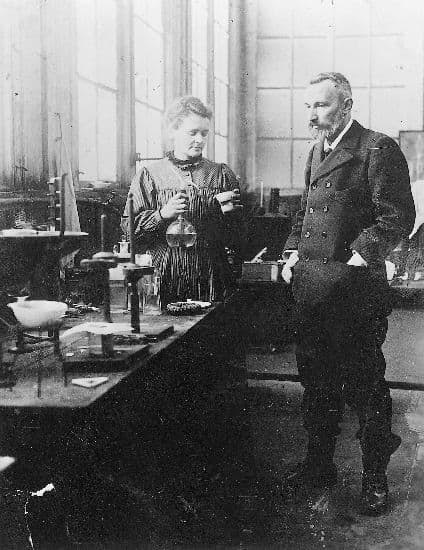
Marie et Pierre Curie in their laboratory.
Triumphs and Tragedies: Claiming Her Place
In 1903, the Nobel Prize in Physics recognized their groundbreaking work.
Initially, the Swedish Academy intended to honor only Pierre Curie and Henri Becquerel, deliberately overlooking Marie’s contribution. But Pierre threatened to refuse the prize unless she was included. Marie thus became the first woman ever to receive a Nobel Prize.
Yet fate, often cruel, soon intervened. In 1906, Pierre was killed after being struck by a horse-drawn carriage.
Devastated, Marie refused to retreat into the obscurity then expected of widows. She drew new strength from her grief and threw herself back into her work. She continued her research and took over her husband’s position at the Sorbonne, becoming the first woman to teach at the prestigious university.
Against the Mob: A Relentless Fight
In 1911, after her affair with the married physicist Paul Langevin was made public, Marie faced an extraordinarily vicious campaign of sexist and xenophobic attacks in the French press. Yet despite the media frenzy that threatened to destroy her career, she refused to back down. The same year, she traveled to Stockholm to receive her second Nobel Prize, this time in Chemistry.
To this day, she remains the only person to have been awarded Nobel Prizes in two different scientific disciplines.
When the First World War broke out, Marie, true to her convictions, devoted herself wholeheartedly to the war effort. She helped develop and deploy the “Little Curies,” mobile surgical units equipped with X-Ray machines that she herself drove to the front lines. In doing so, she helped save countless lives.
An Immortal Legacy
Until the very end, Marie continued her research. Though weakened by illness, she traveled the world, wrote books, and visited the United States, where she was given a hero’s welcome. She also attended scientific conferences alongside the leading scientists of her time, including the Solvay Conference, where she met Albert Einstein and other prominent scientists.
At last, her contribution to the advancement of science and medicine was recognized, particularly her role in the fight against cancer. Her eldest daughter, Irène, helped her with her work. Like her parents, she would go to marry a scientist and win a Nobel Prize of her own.
“To Great Men, the Grateful Nation”
Marie Curie died in 1934, worn down by decades of exposure to radiation. Her laboratory notebooks – and her own body – bore the marks of the science she had brought to light.
The woman once dismissed as “the foreigner, the homewrecker” now rests in the Panthéon, in a lead-lined coffin, among France’s greatest figures.
A quite rebel, Marie Curie defied the deepest prejudices of her time through her work and her actions. She did not merely accept the world as it was. She dissected it, sought to understood it, and ultimately changed it.
Oum Kalthoum, Architect of Her Own Myth (2/2)
Oum Kalthoum, Architect of Her Own Myth (1/2)
Rebels, inspiring and inspired: Camille Claudel (3)
George Sand: A Man’s Name to Establish Herself as a Prolific Writer (2)
When An Artist from Old Florence Takes Up Her Brush (1)
More from Micha Moussallem
View All


Latest from Levant Time
View All


