



Some people spend their lives accepting their lot, while others take their destiny into their own hands. This is all the more difficult for a woman living in a man’s world. And yet… some women chose to fight, succeeding in breaking the taboos of their time. Whether they wielded a brush, a pen, scientific instruments, or their voices, they made their mark on their century with a boldness that at times bordered on scandal.
From Artemisia Gentileschi, defying Italian society and the courts five centuries ago, to George Sand, who traded the corset for the freedom to write; from Camille Claudel, the deeply wounded artist, to the rigor and genius of Marie Curie, and the universal voice of Oum Kalthoum… these women succeeded in overcoming social prejudice.
In a series of articles, we invite you on a journey through time to meet these rebellious women.
In the pantheon of women who shaped the 20th century, Oum Kalthoum holds a prominent place. The “Star of the East” was not merely a singer with an inimitable voice. Above all, she was a true pioneer. In a stifling society, Fatima Ibrahim es-Sayyid el-Beltagi made her mark through exceptional talent, strategic intelligence, and unwavering determination.
Singing in Disguise as a Boy
Oum Kalthoum was born at the dawn of the 20th century in a modest village in the Nile Delta. At her birth, her father, Ibrahim, a religious man, gave her the name Oum Kalthoum, after one of the Prophet Muhammad’s daughters. The name refers to someone with a full, rounded face. From the age of six, she honed her extraordinary gift for singing by listening to her father chant verses from the Quran during ceremonies in nearby villages. To allow her to accompany him, her father came up with the idea of disguising her as a young Bedouin boy, as it was unthinkable at the time for a girl to perform in public.
This period provided her invaluable training. Quranic recitation (tajwid) is a spiritual and vocal discipline that helped her develop powerful breath control and exceptionally clear pronunciation of Classical Arabic, which would later become one of her greatest assets.
This first act of transgression was the first step in a lifetime spent pushing boundaries.
The Conquest of Cairo
When she arrived in Cairo in the early 1920s, Oum Kalthoum was just a young peasant (fellah) from the Nile Delta. Cairo’s elite looked down on her rustic manners, accent, and attire.
To overcome this snobbery, she embarked on a relentless program of self-education. She surrounded herself with intellectuals, devoured classical poetry, refined her vocabulary, and learned proper etiquette and French. Within a few years, she turned the tables: her flawless command of Classical Arabic became her chief weapon, winning the admiration of the elite and intellectuals alike.
Birth of “Kawkab es-Sharq”
In Cairo, Oum Kalthoum immersed herself in a vibrant artistic world, run exclusively by men.
At that time, the profession of female singer – the ‘awalim – was associated with loose morals and even prostitution. For a woman from a conservative religious family like hers, singing in Cairo’s theatres and cabarets was considered a disgrace.
Far from allowing others to dictate her choices, she decided to take complete control of her art and career and to set her own rules.
The Creation of a Persona
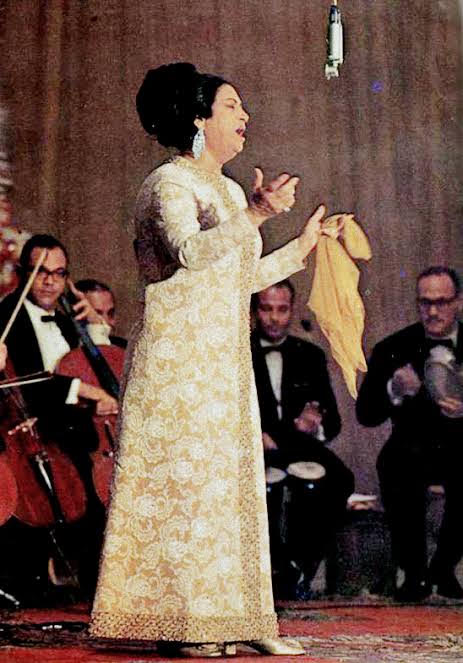
From an early stage, without marketing or image consultants, Oum Kalthoum invented the concept of the “untouchable star.” She built a fortress around her public image, imposed strict discipline on those around her, dressed with understated elegance, and refused to play the seduction games of the entertainment world.
On stage, she adopted a distinctive posture. She transformed her vulnerabilities into symbols. Suffering from an eye condition (Graves’ disease), she began wearing austere dark glasses that added to her air of mystery and authority.
The famous silk handkerchief that she would endlessly fidget with on stage, initially used to wipe her sweaty hands caused by stage fright, became her signature accessory. Even her severe bun was part of her persona, adding to her authority and aura.
A Visionary Ahead of Her Time
As early as 1934, she recognized the importance of modern media and became the first artist to sign a contract with the newly established Egyptian National Radio. Her concerts on the first Thursday of every month became veritable secular masses, emptying the streets from the Mashreq to the Maghreb.
She negotiated her own contracts with formidable resolve and quickly became the highest-paid and most respected artist in Egypt.
Absolute Artistic Excellence
She personally selected her lyrics from among the greatest poets of her time, such as Ahmed Shawqi or Ahmad Rami, who was reportedly secretly in love with her.
She pushed her composers, including the famous Riad al-Sunbati, to their limits. In 1964, she collaborated with her longtime rival, composer Mohamed Abdel Wahab, on the mythical song Enta Omri.
Thanks to her extraordinary gift of improvisation, a song could last more than an hour, depending on the audience.
She did not merely perform; she also directed her own musicians. She pushed them – event though they were the finest musicians in Egypt – to surpass themselves until they achieved perfect harmony. One of them is said to have remarked: “We do not play for Oum Kalthoum. She improvises, and we follow.”
She sang of love and became the undisputed icon of tarab, an emotional and musical trance reminiscent of the techniques of blues and jazz technics, while commanding her audience with a single gesture of her hand.
Oum Kalthoum, Architect of Her Own Myth (2/2)
Marie Curie: Beyond Prejudice, Uranium and Two Nobel Prizes (4)
Rebels, inspiring and inspired: Camille Claudel (3)
George Sand: A Man’s Name to Establish Herself as a Prolific Writer (2)
When An Artist from Old Florence Takes Up Her Brush (1)
More from Micha Moussallem
View All


Latest from Levant Time
View All


