

Farouk al-Sharaa and “The Missing Narrative”
Memoirs or the Discourse of Power?

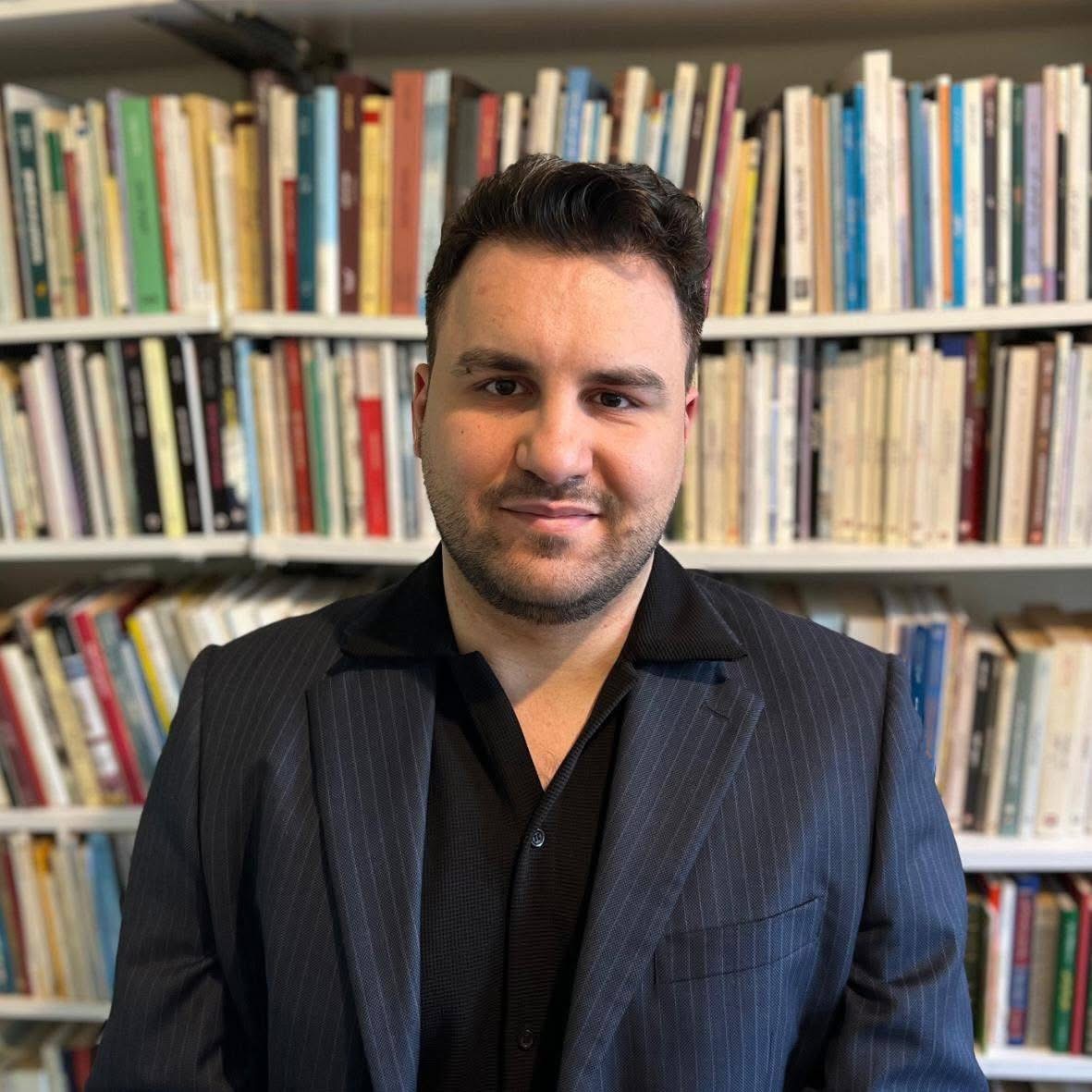
My experience with memoir literature has generally been unrewarding, and this holds particularly true for the first volume of the memoirs of former Syrian foreign minister Farouk al-Sharaa, entitled The Missing Narrative (Arab Center for Research and Policy Studies, 2015). From its lyrical, subjective, and impressionistic opening, the book appears to promise the reader a work of personal reflection, only to draw him into a reading of political history written with an unqualified bias toward the Assad regime and the figure of former Syrian president Hafez al-Assad.
Assad between Political Mythology and Image-Making
In al-Sharaa’s pages, Hafez al-Assad appears as a larger-than-life hero or a “Frankenstein of Damascus”: a man who hangs up on American president Ronald Reagan, forces Secretary of State James Baker to move the peace conference from Amsterdam to Madrid, while al-Sharaa himself is portrayed as the favored confidant, at the expense of former Syrian vice-president Abdel Halim Khaddam. This narrative construction offers no critical reading of power; it merely reproduces the official account.
The Great Absences: Pivotal Events Outside the Text
Major historical sequences, decisive for both Syrian and Lebanese history, are entirely absent from the memoirs, foremost among them:
· the disappearance of Imam Moussa Sadr and his two companions;
· the events of Hama in 1982;
· the assassination of Lebanese leader Kamal Jumblatt;
· the policy of “rural urbanization” through bureaucratic inflation of the public sector, a phenomenon analyzed in detail by academic Ziad Majed in his work Syria: The Orphaned Revolution.
These omissions bear little resemblance to oversights; they reflect rather a deliberate choice to pass over the most problematic episodes in silence.
The Obedient Minister Rather Than the Man of Experience
In these pages, al-Sharaa grants himself no role other than that of the president’s “obedient minister”: a minister who executes Assad’s political transactions, presents himself as accommodating toward Yasser Arafat and as a negotiator facing Saddam Hussein, without ever building an independent personal narrative or submitting his political career to any form of introspection.
Political Papers Rather Than Memoirs
What al-Sharaa has written is closer to a detailed political dossier than to memoirs in any literary or human sense. One is reminded here of what former Lebanese president Amine Gemayel did when he set out his political positions in a documentary volume, without restoring to the reader the living texture of personal experience.
A Comparison with the Traditions of Political Memoir
Unlike the memoirs of major world political figures such as Henry Kissinger, which combine documentation with the construction of inner experience, al-Sharaa practices a deliberate policy of leaping over events and narrative circumvention, producing ultimately a subjective political history rather than a living biography of its author.
Conclusion: Why Does the “Narrative” Remain Missing?
In sum, The Missing Narrative resembles less a memoir than a belated political apologia for an era and a regime. The first volume thus fully merits its title: a narrative genuinely lost, and one that will likely remain so, which provides little incentive to read the second volume as long as the same approach prevails, one that consists in suppressing difficult questions rather than confronting them.
The Nobel Prizes and the Search for a Glimmer of Light in Human Behavior
Iran: Executions of young people, a favored tool of repression
A Chinese Perspective on Lebanon's Collapse
Dahr el-Baidar Explosives: Toward the End of Complacency?
Lebanese Moderation Needs a Project
Más en Analyze
Ver todo


Lo último de Levant Time
Ver todo


