

The Illusion of a “Post-Militia” Era in the Middle East
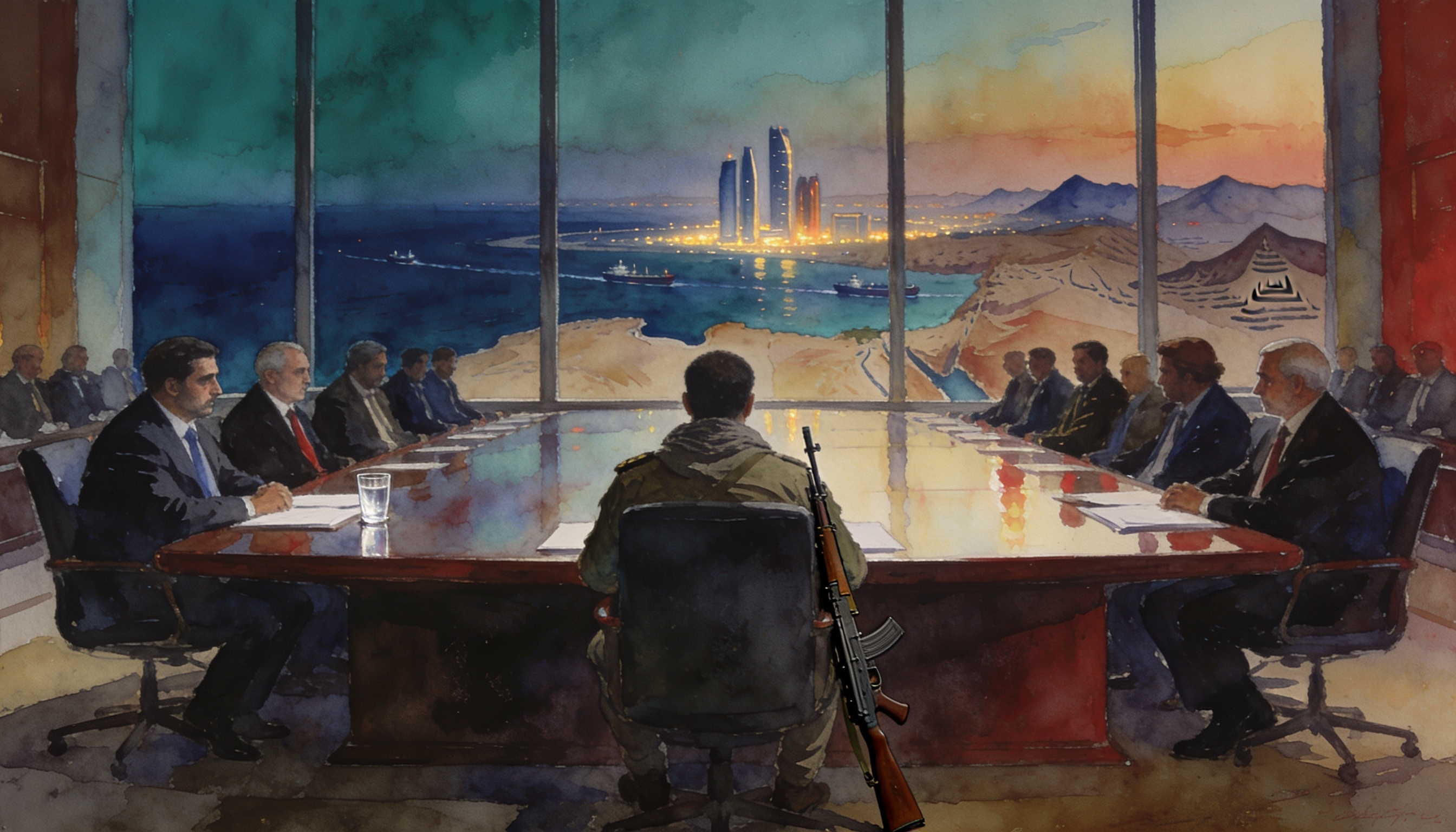

The ongoing conflict between the United States and Iran, along with the struggle over the Gulf’s strategic waterways, has once again brought to the fore the question of militias as actors operating in the Middle East outside the framework of the state and international relations. The world had expected the war against Iran to mark a turning point: striking the center of regional patronage was supposed to weaken the “militia” model, pave the way for the return of the state and political settlements, and perhaps bring an entire chapter in the region’s history to a close.
Yet what is happening so far appears to point in the opposite direction. The war has not ended the age of militias. It has brought them back into diplomatic calculations themselves.
What is particularly striking about the Trump administration’s approach is that the realism Washington professes does not necessarily mean moving beyond militias. At times, it means dealing with them as de facto powers. This can be seen, in different forms, in Lebanon, Yemen and Iraq.
This militia “bloc” operating outside the state is the product of successive historical phases that profoundly shaped the nature of Middle Eastern states, their formation, their structures and their modernization. In newly independent developing countries, armies did little to build the state or consolidate its cohesion before the process of state-building itself had been completed. Traditional Arab armies often confined themselves to repressive functions, protecting authoritarian regimes, their power and their privileges, while imposing unity from above, sometimes without genuinely integrating the societies’ various social and sectarian components.
The strategy of supporting militias dates back to the 1980s, when Iran sent the Islamic Revolutionary Guard Corps to train Hezbollah fighters in Lebanon. Tehran viewed such groups as a partial substitute for its conventional military and as a forward line of defense designed to keep conflict away from Iranian territory.
The Iranian regime, which Arab states have regarded as a serious threat to their national security since the 1979 Islamic Revolution, remains standing in part because of its active regional proxies. Despite the devastating cost of American and Israeli strikes, the regime and its allies in the “Axis of Resistance” continue to display considerable boldness.
This is where the clearest paradox lies.
Instead of the conflict with Iran leading to the neutralization of Ansar Allah, the Houthis have become an actor that cannot be ignored in the security of the Red Sea and the Gulf. The United States is maintaining contacts with the Houthis even as they escalate against Saudi Arabia, while Trump has so far refused to become directly militarily involved against them and communications continue through various channels.
It is as though Washington has moved from the logic of “eliminating the militia” to one of “managing the militia.”
Some of these organizations have become local and regional actors with interests and calculations of their own, capable of disrupting trade and energy routes while securing a place at the negotiating table.
Was the war against Iran therefore intended to dismantle the regional order created by militias, or has it turned into a war to redistribute influence within that very order?
The end of the militia era that many had expected may instead become an international recognition of militias as components of a new order, reshaping the Middle East at the expense of regional allies, particularly the Gulf societies that built their stability on the idea of the state rather than on multiple competing centers of power.
The region would then remain suspended between war and peace, grappling with the consequences of the violence unleashed by Israeli Prime Minister Benjamin Netanyahu.
For decades, Iranian officials have spoken of an “Axis of Resistance.” Yet when Iran itself came under attack twice, each component of that axis made a different decision about whether to enter the fight.
The Hamas-led operation of October 7, 2023, set off a series of wars that eventually culminated in attacks on Iran itself. Hezbollah and Hamas have been significantly weakened, Bashar al-Assad’s regime has fallen in Syria, and the Iraqi government has ordered militias to hand over their weapons by next month.
The Iranian regime’s adversaries hope that Tehran will be forced to scale back its support, eventually causing the militia axis to unravel. Tehran itself is financially strained, while several of its regional affiliates are poorly managed or weakened.
Some components may survive, but they are likely to drift apart or be deployed more sparingly. Others may emerge as “rogue” actors, while some could seek a new patron or strategic alignment.
Hezbollah was Iran’s closest proxy. Until 2023, Hassan Nasrallah, its charismatic leader who was assassinated by Israel in 2024, saw himself less as a mere proxy than as an equal partner within the Axis of Resistance. A true believer deeply immersed in Iran’s revolutionary ideology, he nevertheless sought to preserve a degree of autonomy.
That is no longer the case.
Naim Qassem, Nasrallah’s successor, is a mediocre and unpopular storyteller.
At the other end of the spectrum are the Houthis, the most autonomous of Iran’s allies. They began as a local insurgency in northern Yemen in the 1990s, and decades passed before Iran began providing substantial financial and military assistance.
When that assistance came, it dramatically enhanced their capabilities.
Once mocked as barefoot fighters, the Houthis now possess anti-ship missiles capable of harassing vessels in the Red Sea and air-defense systems capable of bringing down American Reaper drones.
Yet they are also more inclined to strike deals and continue to protect their own interests more than Tehran’s. They have built their own ties with Al-Shabaab, the Al-Qaeda-linked movement in Somalia. Houthi delegations have visited Russia, while others have held talks with China.
Between these two poles stand Iraq’s “rogue” Shiite militias, themselves a product of the 2003 US-led invasion.
Two decades later, their priorities have changed. Iran remains an ally, but their principal patron is now the Iraqi state, which has more than two hundred of them on its payroll.
The Revolutionary Guards are said to have sent advisers to Iraq to establish small cells tasked with attacking Gulf states, a sign that the larger militias were reluctant to undertake such operations themselves.
Hamas has always been something of an awkward fit within the axis: a Sunni organization within a predominantly Shiite bloc. It also clashed with Iran over Tehran’s support for the Assad regime in Syria.
Khalil al-Hayya, its newly appointed leader, is regarded as a loyal Iranian ally. Other officials, however, favor turning toward Sunni powers, particularly Türkiye and the Gulf states. Hamas recently urged Iran to halt its attacks on Gulf countries.
Even if Iran wished to rebuild all of its alliances, its resources are limited. In some respects, the fate of the axis may come to resemble that of the Soviet Union’s allied states in the 1980s, when Moscow could no longer afford to provide them with generous support.
The comparison is, of course, metaphorical and does not account for the religious and ideological dimension specific to the Middle East.
This brings us to the new paradox: if an actor that possesses weapons outside state authority can, after war and pressure, move to the negotiating table and obtain recognition of its role, what remains of the principle that the state alone should hold a monopoly over arms and sovereignty?
It would almost amount to rewarding those who have held stability hostage to weapons.
The danger is not that Washington might abandon its allies, but that it might continue supporting them on security matters while politically redefining the region in a way that grants their armed adversaries negotiating legitimacy.
Over the past several decades, the Gulf states have built a model entirely different from that of the militias: centralized states, open economies, investment, infrastructure and stable social life.
When an armed group becomes capable of influencing shipping, energy flows or regional security and then enters into direct negotiations with the United States, the implicit message to Washington’s allies can be unsettling, particularly when the US administration gives the unfortunate impression that it does not quite know where it stands.
The region’s states may therefore be forced to reassess their reliance on the United States as their principal security guarantor. At the same time, the scale of the conflict is fueling further concerns about Israel’s role as a destabilizing force.
The first signs of this trajectory appeared when Saudi Arabia, Türkiye and Pakistan recently agreed on a mutual defense pact. Yet it remains unlikely that Türkiye or Pakistan would rush into a war with Iran in order to defend Saudi Arabia.
Regional dynamics will remain highly volatile, especially as the consequences of the war begin to matter more than the war itself, and stable states find themselves compelled to adapt to transnational armed forces because the great powers have come to regard those forces as part of the equation through which the region is managed.