

Nabil Nahas at the 61st Venice Biennale, a Monumental Body of Work


Nabil Nahas, a leading figure in Lebanese-American contemporary art, is currently at the center of the international art scene. He has been officially selected to represent Lebanon at the upcoming Venice Biennale, which will take place from May 9 to November 22, 2026.
Nabil Nahas occupies a singular position within the contemporary art landscape. He is one of the few artists to have achieved a distinctive synthesis between radical American abstraction and an Eastern sensibility deeply rooted in nature and spirituality.
The exhibition, titled Don’t Get Me Wrong, is curated by Nada Ghandour, curator and commissioner, in collaboration with the Lebanese Visual Art Association (LVAA). It will take place at the Arsenale (Sala d’Armi), one of the most prestigious venues of the Venice Biennale.
With this exhibition, Nabil Nahas offers a monumental experience that redefines the relationship between the viewer and the painting.
The Artist’s Journey
Nabil Nahas was born in Beirut in 1949. He spent his first ten years in Cairo, where he absorbed the majesty of Egyptian landscapes and the rigor of Islamic art.
In 1973, he earned his MFA (Master of Fine Arts) from Yale University in the United States, where he encountered major figures of the art world and immersed himself in Abstract Expressionism. He then settled in New York and quickly became known as a “master of color and texture.”
After the civil war, his return to Lebanon marked a turning point in his practice. He began painting cedars, olive trees, and pines – not as simple landscapes, but as symbols of resilience.
Nabil Nahas’ Style
His style is marked by a dual influence: American Abstract Expressionism and a Mediterranean heritage.
What distinguishes Nahas from his contemporaries is his extreme materiality.
Nabil Nahas’s work draws on the complex geometries of the natural world (starfish, cedars, marine motifs) as well as Islamic art. He often uses pumice powder or volcanic rock mixed with paint to create rough, almost organic textures, transforming the canvas into a sculptural object resembling a lunar surface or a coral reef.
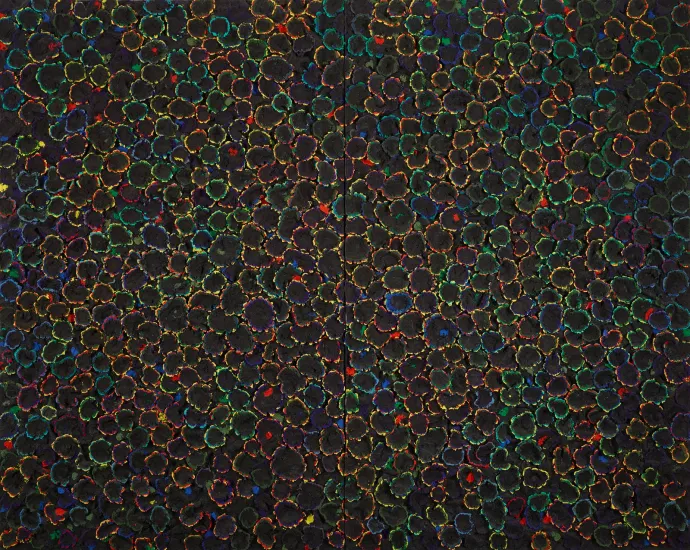
Untitled, acrylic and pumice on canvas. (Dalloul Art Foundation)
Starfish: One of his most well-known innovations consists in fixing real starfish (or casts) onto the canvas, then covering them with successive layers of paint, creating an organic relief that challenges the traditional flatness of painting.
The concept of fractals: Inspired by mathematician Benoît Mandelbrot, Nahas explores the concept of fractals, according to which the apparent chaos of nature contains its own geometric order. Like nature itself, his canvases appear capable of multiplying infinitely, without center or boundary.
International Recognition
Nabil Nahas is not only a “Lebanese painter,” but an established figure on the global art scene. His works are held in major international museums, including the Metropolitan Museum of Art (New York), the Tate Modern (London), the British Museum, and the Guggenheim Abu Dhabi.
In 2013, he received the National Order of the Cedar, a distinction rarely granted to visual artists in Lebanon, highlighting his role as a cultural ambassador.
His works are also highly sought after on the auction market (Sotheby’s, Christie’s), achieving record prices exceeding 240,000 dollars for his most monumental pieces.
The Exhibition “Don’t Get Me Wrong”
The exhibition is conceived as a total immersive work. It was specifically designed for the Arsenale space at the Venice Biennale.
Its scale is monumental. It consists of 26 acrylic-on-canvas panels, extending over an impressive length of 45 linear meters and reaching a height of 3 meters. The canvases are raised two meters above the ground, compelling visitors to look upward, recalling the way Renaissance church frescoes are traditionally contemplated.
In this exhibition, Nahas adopts the concept of fractals, inviting a meditative wandering in which forms appear to multiply infinitely.
Nada Ghandour, who is presenting her third curatorial direction of the Lebanese Pavilion, describes Nahas’ work as a reflection of Lebanese identity, which she characterizes as a “polyphonic choir” and compares to a weaving of multiple threads (history, spirituality, nature) through which he seeks to express Lebanon through its cultural complexity. For Ghandour, Nahas’ practice is a combination of art, culture, and spirituality, both symbolic and philosophical.
In a world where art is often divided between conceptual (intellectual) art and decorative art, Nahas proposes a third path: an abstraction with a soul.
He demonstrates that it is possible to belong to the “New York School” while remaining deeply connected to Mediterranean world.
At the 2026 Venice Biennale, his presence symbolizes the strength and creativity of a Lebanon that, despite ongoing crises, continues to address the world through a complex sense of beauty and a universal poetic vision.
With the OIF, Francophone Literature Breaks Down Borders
Eva Gonzalès: Subtle Freedom Through the Brush
September News: The Battle of Lebanon
The Samir Kassir Festival, or the Lebanon Yet to Be Born
Why Habermas Remains Urgently Relevant
More from Micha Moussallem
View All


More in Culture
View All



'Byblos' at the IMA: a cultural resistance in the face of war
Latest from Levant Time
View All


