

In Nicaea, the Pope Preaches the Creed of Christian Unity


The city of Iznik, ancient Nicaea, marked a key stop on Pope Leo XIV’s visit to Turkey, as the pontiff led a service dedicated to Christian unity on the shores of Lake Iznik, south of Istanbul. The ceremony brought together Orthodox and Protestant leaders for a prayer service among the ruins of a submerged 4th-century basilica.
The Mass commemorated the 1,700th anniversary of the First Ecumenical Council of Nicaea, convened in 325, twelve years after the Roman Empire legalized Christianity.
Standing beside Patriarch Bartholomew I of Constantinople and other church leaders, Pope Leo XIV recited the Nicene Creed — a statement of faith still recited by millions of Christians worldwide. The creed was first adopted at the very council that gathered in Nicaea almost 17 centuries ago.

“We are all called to overcome the scandal of the divisions that, unfortunately, still exist, and to nurture the desire for unity,” the Pope said in English, emphasizing “the pursuit of fraternity.”
The ceremony, presided over by Patriarch Bartholomew I, featured prayers in several languages as well as a cappella polyphonic and Byzantine chants. Representatives from the Coptic, Greek, Armenian, Syriac, and Anglican Churches attended, underscoring the event’s ecumenical character.
Non-acceptance to use religion to justify violence
The Patriarch urged participants to “follow the path of Christian unity laid out for us,” despite the “divisions” created over the centuries.
The Pope also called for “a forceful rejection” of attempts to use religion to justify war or violence, condemning “all forms of fundamentalism and fanaticism,” without naming specific leaders or conflicts.
Submerged for centuries, the Iznik Basilica continues to shed light on early Christianity and its martyrs. The ruins were discovered in 2014 by Turkish archaeologist Mustafa Sahin, head of the archaeology department at Uludag University in Bursa, using aerial photography. The remains lie about 50 meters from the shore and two meters below the lake’s surface.
“I realized it was an unknown church,” Sahin said. He explained that the Basilica of the Holy Fathers was built around 380 AD on the site where a 16-year-old martyr, Neophytus, was executed for his faith in 303, during the Roman persecution of Christians.
Due to climate change, the lake’s water level has gradually fallen, revealing large sections of the basilica, which collapsed after earthquakes in the 11th century and was submerged two centuries later.

Basilica of Martyrdom
An earlier church erected in Neophytus’s memory hosted the Council of Nicaea in 325 before being destroyed by a powerful earthquake in 358. The later Basilica of the Holy Fathers was named in honor of the 318 bishops who convened to draft the Nicene Creed.
The church once held a sarcophagus believed to contain the remains of Neophytus and other martyrs. Their bones now lie just beneath the lake bed.
“We have already found about 300 graves,” Sahin said, describing the site as “a cemetery of martyrs.” His team has unearthed evidence of violent deaths — broken limbs and skulls bearing holes and fractures. “These traces show that those buried here were tortured and executed,” he said.
Several smaller tile graves, believed to hold the remains of children, have yet to be opened. Each set of bones is excavated, analyzed, and reburied after documentation.
“This was not an ordinary cemetery,” Sahin explained. “It was a place of martyrdom, a church of great significance for Christians.”
The archaeologist emphasized Turkey’s central role in early Christian history. “Christianity emerged around Jerusalem,” he said, “but without Anatolia, there would be no Christianity,” referring to the missionary journeys of the Apostle Paul and other foundational figures of the faith.
Collège de Nazareth at Risk of Closure
Harassment, Bullying: Women Are the Prime Targets of AI
The Philippe Chebaya Center for Children with Special Needs: A Beacon Above the Holy Valley
World Cup: Collective Emotions and Identifications in Lebanon
Training, Digital Development, AI: La Francophonie's Work in the Middle East
More from LevantTime .
View All


More in Society
View All


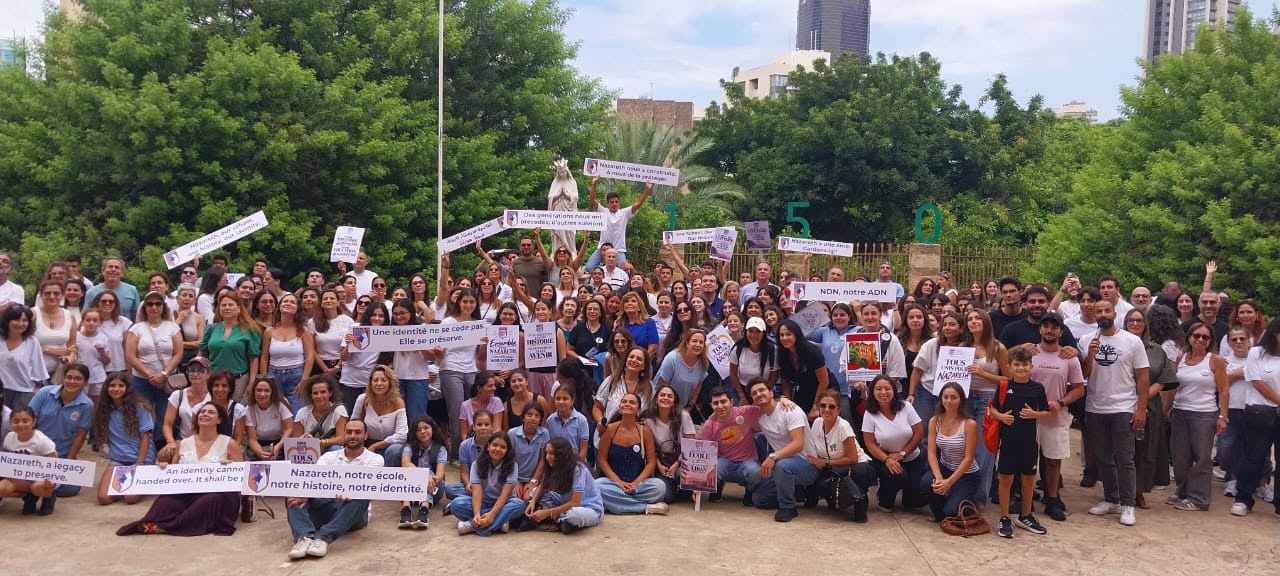

Nazareth's Extended “Family” Stands United Against the Proposed Sale

The Dragon’s Hiccup: The War Through The Eyes of a Child
Habemus: Peru, at the heart of Leo XIV's life
Latest from Levant Time
View All


