

George Sand: A Man’s Name to Establish Herself as a Prolific Writer (2)


Some people spend their lives accepting their lot, while others take their destiny into their own hands. This is all the more difficult for a woman living in a man’s world. And yet… some women chose to fight, succeeding in breaking the taboos of their time. Whether they wielded a brush, a pen, scientific instruments, or their voices, they made their mark on their century with a boldness that at times bordered on scandal.
From Artemisia Gentileschi, defying Italian society and the courts five centuries ago, to George Sand, who traded the corset for the freedom to write; from Camille Claudel, the deeply wounded artist, to the rigor and genius of Marie Curie, and the universal voice of Oum Kalthoum… these women succeeded in overcoming social prejudice.
In a series of articles, we invite you on a journey through time to meet these rebellious women.
We continue our series on famous yet rebellious women with George Sand. Nineteenth-century literature was largely dominated by men. Yet one woman refused to accept this state of affairs: Amantine Aurore Lucile Dupin, better known as George Sand. She would shake up conventions, customs, and laws of her time. A prolific writer, a courageous mother, and a woman who loved passionately, she swept through her era like a hurricane, refusing to be confined to the gilded cages of propriety and social convention.
Childhood
Aurore Dupin spent her childhood in Berry, at the Nohant estate, in the care of an aristocratic and cultured grandmother who gave her the education of a proper lady of society and enabled her to acquire an exceptional level of culture for a woman of her time. Having lost her father and been abandoned by her mother as part of a sordid arrangement, Aurore nevertheless enjoyed a happy childhood surrounded by nature and her grandmother’s books.
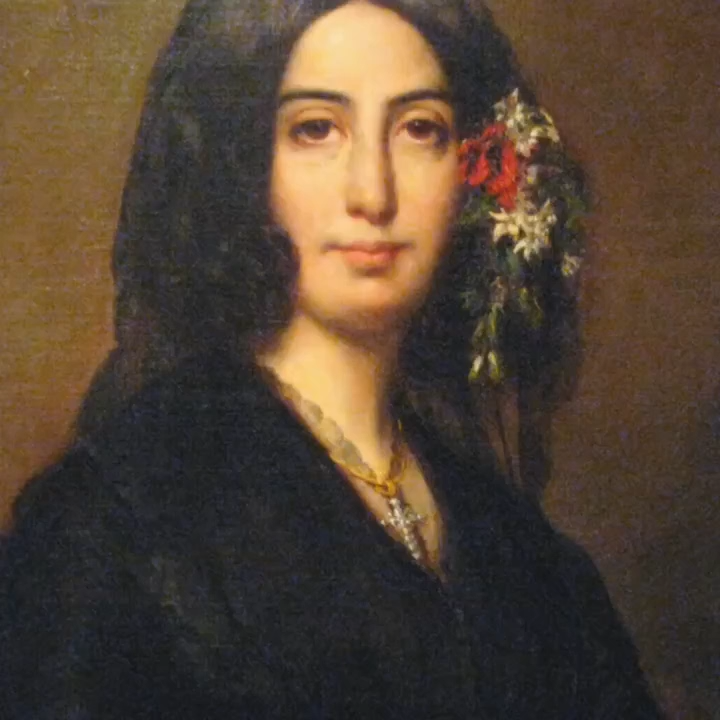
Portrait of George Sand, an oil painting by Auguste Charpentier, painted in 1838 and housed at the Musée de la Vie Romantique in Paris.
The Battle for Her Children and Her Land
“Men make the laws, women make the customs.”
George Sand’s life took a dramatic turn when she decided to flee her unhappy marriage to Baron Casimir Dudevant. At the time, the Napoleonic Code was uncompromising: a married woman was legally a minor. Her property, money, and even her children legally belonged to her husband. Yet Aurore refused to submit. In 1835, she launched a high-profile lawsuit seeking separation of property and separation from her husband. At the heart of this struggle were her greatest treasures: her children, Maurice and Solange, and her beloved Nohant estate.
In the 19th century, a woman seeking a divorce and claiming the family fortune caused an absolute scandal. Before the judges, Sand displayed fierce determination and remarkable legal acumen. She won her case, regaining both Nohant and custody of her children.
Making a Living by the Pen: A Groundbreaking Struggle
Free but financially suffocated by mounting legal expenses, she had to earn a living from her writing to support her family. In order to publish her books, move freely around Paris without an escort, attend plays, frequent newspaper offices, and so on, she decided to wear men’s clothing – her famous gray frock coat – smoke cigars, and adopt a male name. George Sand was born.
She wrote at night, sometimes for as many as fourteen hours a day, churning out page after page to pay for her children’s education and maintain her estate. In her novels, the subjects she tackled, including female desire, were sometimes provocative and unprecedented for the time. She became the first woman in France to make a living from her writing, holding her own as an equal among the literary giants of her day: Balzac, Flaubert, and Victor Hugo, much to their dismay. For her, writing was not a pastime but an act of faith: “Art for art’s sake is an empty phrase. Art for truth, art for beauty, art for goodness – that is the religion I seek.”
The Absolute Lover: The Idyll with Chopin
“There is only one happiness in life, to love and be loved.”
George Sand did nothing by halves, least of all when it came to love. She was a passionate lover who sought to elevate the soul through passion, even if it meant suffering and causing scandal. Following a tumultuous and destructive affair with the poet Alfred de Musset, that ended in a major scandal, and following numerous other relationships, she would experience with Chopin one of the most beautiful – and complex – love stories of the Romantic era.
When they first met, Chopin was ill and tormented. Sand, by contrast, was overflowing with vitality. It was love at first sight. They then spent a winter in exile in Majorca, at the Charterhouse of Valldemossa. In that wild, rain-soaked setting, while Chopin coughed up blood and composed his finest Préludes, Sand became his lover, muse, and devoted nurse. She watched over her beloved genius, took care of their daily affairs, and wrote her novels by candlelight while he improvised at the piano. Their relationship lasted nearly nine years, alternating between artistic fusion and painful ruptures.
Despite all her disappointments, love would always remain the great driving force of her life.
A Legacy of Shadows and Light”
“Disappointments do not kill, and hopes keep us alive.”
In the twilight of her life, Sand, affectionately known as the “Good Lady of Nohant”, retired to her beloved estate, where she took her final bow.
She left behind more than seventy novels, thousands of letters, and the memory of a woman who remained true to herself and knew how to transform her personal struggles into a body of work with universal resonance.
She died leaving behind one enduring certainty for all the women (and men) who would follow in her footsteps: freedom cannot be negotiated; it must be conquered!
Read also
Oum Kalthoum, Architect of Her Own Myth (2/2)
Oum Kalthoum, Architect of Her Own Myth (1/2)
Marie Curie: Beyond Prejudice, Uranium and Two Nobel Prizes (4)
Rebels, inspiring and inspired: Camille Claudel (3)
When An Artist from Old Florence Takes Up Her Brush (1)
More from Micha Moussallem
View All


Latest from Levant Time
View All


