

Who Has the Right to Write a Manifesto?
Who Has the Right to Declare? (1)


This is the first in a three-part series tracing the manifesto as a form of writing and a way of intervening in the world. The first article looks at the history of declaration and the authority it gives to those who make one. The second turns to the struggle over the pronoun “we.” The third asks a slightly different question: what does a manifesto become when it is less concerned with tearing the world down than with protecting something within it, or reminding us of what still deserves our care?
It began with a small book, Irene Vallejo’s Manifesto for Reading, and with a comment from a reader who felt the title had promised something the book did not deliver.
He had expected a theoretical reflection on reading, books, and libraries, perhaps something closer to the work we associate with Alberto Manguel. Instead, he found intimate, scene-driven pages returning to memories of reading, schools, libraries, and first books, at times articulating feelings many readers already share. His objection was, at heart, straightforward: Where is the theory? Where is the research? Where is the new argument that justifies placing a word as weighty as “manifesto” on the cover?
We can, of course, disagree about Vallejo’s book. We can find it beautiful or slight, and ask what it really adds to the vast library of writing about reading and our relationship with books. But the objection itself took me somewhere that seemed more interesting than the book that had provoked it. What, exactly, has the word “manifesto” promised us? When did we become so certain about what a text must contain in order to deserve the name? And where did this particular image of the manifesto come from, the one that makes us expect theory, a programme, rupture, or something radically new?
The word carries such cultural force that it is difficult to hear it without also hearing some noise around it. In the modern imagination, the manifesto is associated with a group announcing itself, with a programme intent on changing the world, with an enemy whose time has come to be named, or with a language that does not hesitate long before telling us what must fall and what should be born in its place. The Communist Manifesto may come to mind, or the clamour of the early twentieth-century avant-gardes, or that self-assured “we” entering a sentence the way someone enters a room already knowing they intend to rearrange everything in it. At times, it almost seems that a manifesto cannot fully convince us of its name unless, somewhere in its pages, we hear a fist strike the table.
Yet even a brief encounter with its history reveals a form of writing far more unruly than this image suggests. The word was not born in the hands of revolutionaries alone. It did not remain the property of politics for long, nor did it preserve a single form once artistic and avant-garde movements took hold of it, followed by feminist, anti-fascist, and other movements. Each time a new group adopts the manifesto, it seems to stretch the form slightly toward its own needs and add to it a function that may not have been visible in its earlier uses.
So before returning to Vallejo at the end of this series, it may be worth going back to a time when “manifesto” had not yet become synonymous with revolution. The question running through its history may begin less with “What is a manifesto?” than with another, more intimately tied to power: who has the right to declare?
In the Beginning, There Was the Declaration
The word manifesto comes from the Italian and from the verb manifestare. At its root lies the idea of making something manifest: making a position, an intention, or a matter visible and known. In early modern European usage, the term referred to a public declaration explaining the motives behind an action already taken or announcing the reasons for one still to come. When it entered English in the seventeenth century, it largely retained this meaning: the holder of a position brought an intention into public view and made it known to others.
Linguistically, the movement appears simple. Something exists first on the inside, as a decision, intention, or position, and is then pushed outward into a shared space where it becomes visible. Politics enters the moment we ask about the conditions of that visibility. Who, in the first place, could turn a private decision into a public matter? Who possessed the paper, the printing press, the platform, and the legitimacy that would make people receive a declaration as speech worth hearing?
In the earlier stages of this history, we encounter rulers, states, and religious and legal institutions. There are royal manifestos explaining the causes of wars or disputes, declaring one state’s position toward another, or giving a political decision a public form through which it could circulate. The Folger Library catalogue, for example, preserves a manifesto issued in the name of King Charles II in 1672 against the States General of the United Provinces. It bears little resemblance to the romantic image that would later emerge of the rebel printing a manifesto at night and distributing it among the people. It belongs to the world of sovereignty and diplomacy, to a moment when declaration was one of the means through which power made its decisions present before others.
This does not mean that the manifesto was once monarchic and then abruptly switched allegiance to revolution. Declarations, proclamations, and pamphlets circulated early on within religious, legal, and political disputes, while the European public sphere itself expanded with the spread of print, the growth of readership, and the increasing number of actors seeking to be heard. What matters most is that, with political modernity, the relationship between declaration and authority began to change. A form once used to make the will of the powerful visible also became available to those who wanted to contest their right to speak, name, and represent.
This shift changes the order of the relationship between speech and power. In the most direct model, the ruler declares because authority precedes the statement and gives it weight. The modern political manifesto begins to test another route. It speaks first, and through that act of speaking attempts to claim a position that was not guaranteed before it was declared.
We might see this as the beginning of the manifesto’s modern life, when declaration ceases to be merely the effect of an existing authority and becomes one of the means through which the authority of speech itself can be made.

1848, When a Collective Searches for Its Voice
It is difficult to move through the history of the manifesto without stopping, at least once, at the Communist Manifesto. Its importance lies not only in its status as perhaps the most famous political manifesto of the modern era, but also in the image it helped cement: a form in which an interpretation of the world meets an account of the forces struggling within it, while a collective comes to understand itself as bearing a historical interest to which the text gives clarity and political direction.
The first edition appeared in 1848, but the story began earlier. At the congress of the Communist League held in London in late 1847, Karl Marx and Friedrich Engels were commissioned to draft a theoretical and practical programme for the party. The text was then written in German and sent to press in London at the beginning of the following year. In this case, the source of legitimacy appears relatively clear. An organisation already exists, knows that it wants a text capable of declaring its vision, and chooses two people to write it.
At first glance, the relationship seems stable. There is a group, a political project, an interpretation of conflict, and then a text that gives these elements a form capable of facing the world. This may be one reason the Communist Manifesto left such a powerful mark on our imagination of what a manifesto is. It links the interpretation of reality to the will to change it, writing as though an idea is not fully realised until it becomes capable of moving something beyond the page.
Yet the relationship between the writers and the collective in whose name they speak is more complicated. Marx and Engels are not “the workers of the world,” nor does the text imagine millions of workers gathered around a table dictating its sentences. They write from within a political project that sees itself as part of the workers’ movement while also granting itself the capacity to read the direction of the struggle and to understand the historical interests of the class it seeks to organise.
In that small distance between those who write and those in whose name they speak lies a tension that will return throughout the history of the manifesto. To speak for a group is also to define what binds it together, what harms it, how its situation should be understood, and perhaps what it ought to do to escape it. The manifesto’s “we” is therefore never a neutral grammatical pronoun. It is a position constructed within the text, and it often carries with it a claim to representation.
The Communist Manifesto adds another, more intriguing movement. The group it addresses exists socially without yet having achieved the political form the text imagines for it. Workers are dispersed across different places, their conditions vary, while forms of exploitation recur in ways that connect their experiences without always being visible to them as a shared condition. The manifesto wants this multitude to recognise itself as a force with a common interest. By the time it reaches its famous call for the workers of the world to unite, it has moved from describing what exists to addressing a political possibility that has not yet been fulfilled.
The text seems to tell a dispersed group that there are more connections among its members than everyday life allows them to see, and that if they come to see themselves differently, they may also become something different.
Here we encounter one of the manifesto’s most fascinating qualities. Sometimes a “we” already exists and writes its manifesto. At other times, the manifesto becomes the space in which that “we” begins to discover its image, or even to produce it. In such cases, the manifesto participates in the process through which a group reimagines itself, names what its members share, and gives political shape to what it might become. There are “we’s” that write manifestos, and manifestos that write the “we.”
Yet this capacity also gives the act of declaration a more ambiguous face. Whoever makes a group visible in language also participates in defining its image, organising its experience, naming its interests, and proposing the way it might understand itself. This may help a group recognise its strength, but it also gives whoever formulates its discourse a position that exceeds the simple transmission of its voice. The manifesto thus carries a tension within it, one that will return later, between its capacity to give a collective a language in which it can recognise itself and the power exercised by whoever formulates that language in its name.
This question will only become more complicated as we move further through the history of the form.
When Artists Discovered the Pleasure of Declaring
At the beginning of the twentieth century, something like an explosion took place. Politics was no longer the only sphere fascinated by the manifesto. Emerging artistic movements discovered that declaring a revolution against art could be at least as exhilarating as declaring one against government.
The word “manifesto” entered the vocabulary of the European avant-gardes with force. It appeared at the heart of Futurism, Dada, Surrealism, Vorticism, and other movements that were forming, splitting, and redefining themselves at remarkable speed. Their attraction to the form reflected a desire to give artistic practice a language through which it could declare its position, explain its relationship to what had come before, and state what it wanted to change in the relationship between art, its audience, everyday life, and history.
The manifesto therefore found in the avant-garde a home that suited it almost intimately. A movement that understands itself as a break with the past needs a moment in which to announce its appearance. And that announcement need not remain a promotional supplement to the artwork. It can become part of the work itself, an extension of its performance in public space.
One of the most famous of these moments came on 20 February 1909, when Filippo Tommaso Marinetti’s Futurist Manifesto appeared on the front page of Le Figaro. The text proclaimed a break with the past, celebrated speed, machinery, industry, and movement, and tied the beauty of the new world to the energies of technology, violence, and war. Marinetti wanted his reader to feel that an entire era had suddenly grown old and that another age had already arrived in the noise of engines and iron.
The Futurist programme and the violence it carried remain important, but what concerns us here is the performance of declaration itself. Marinetti enters public space in the voice of a “we” that barely knows hesitation: a “we” that is awake while others sleep, that knows the old world has ended before others have recognised its death, that sees the future and is impatient to accelerate its arrival. The moment the newspaper publishes this voice, the movement the text declares becomes more real through the very act of speech. Futurism does not need to be fully formed in reality before it announces itself. The declaration participates in its creation.
Once again, the relationship between legitimacy and speech shifts. Under older forms of authority, legitimacy preceded the declaration. In the Communist Manifesto, the organisation existed before the text that would give it a public form. With the avant-garde, the boundary between declaration and existence itself begins to blur. A movement can acquire part of its reality at the very moment it dares to announce itself. The text becomes part of the event it describes. Perhaps this is why the avant-gardes loved the manifesto so much. They live on a founding exaggeration, the conviction that what preceded them is over and that what follows will never be the same. The manifesto gives them a space in which this exaggeration can be written as though it were a reality just beginning to take shape.
Yet creating a “we” through language brings with it a question less suited to celebration. Every group that draws its own outline also draws, in the same gesture, the limits of what it is not. For Marinetti, the past was an enemy, old artistic institutions a burden, and tradition something to be crushed. The manifesto also glorified war and expressed contempt for women, before parts of Futurism would later become entangled with Italian nationalism and Fascism.
The problem here concerns political worth as much as legitimacy. The ability to create a collective tells us nothing, by itself, about the justice of that collective or the world it hopes to build. A manifesto can open space for those who have been denied speech. It can also create a group that draws its strength from determining who must remain outside it.
A Manifesto That Mocks Manifestos
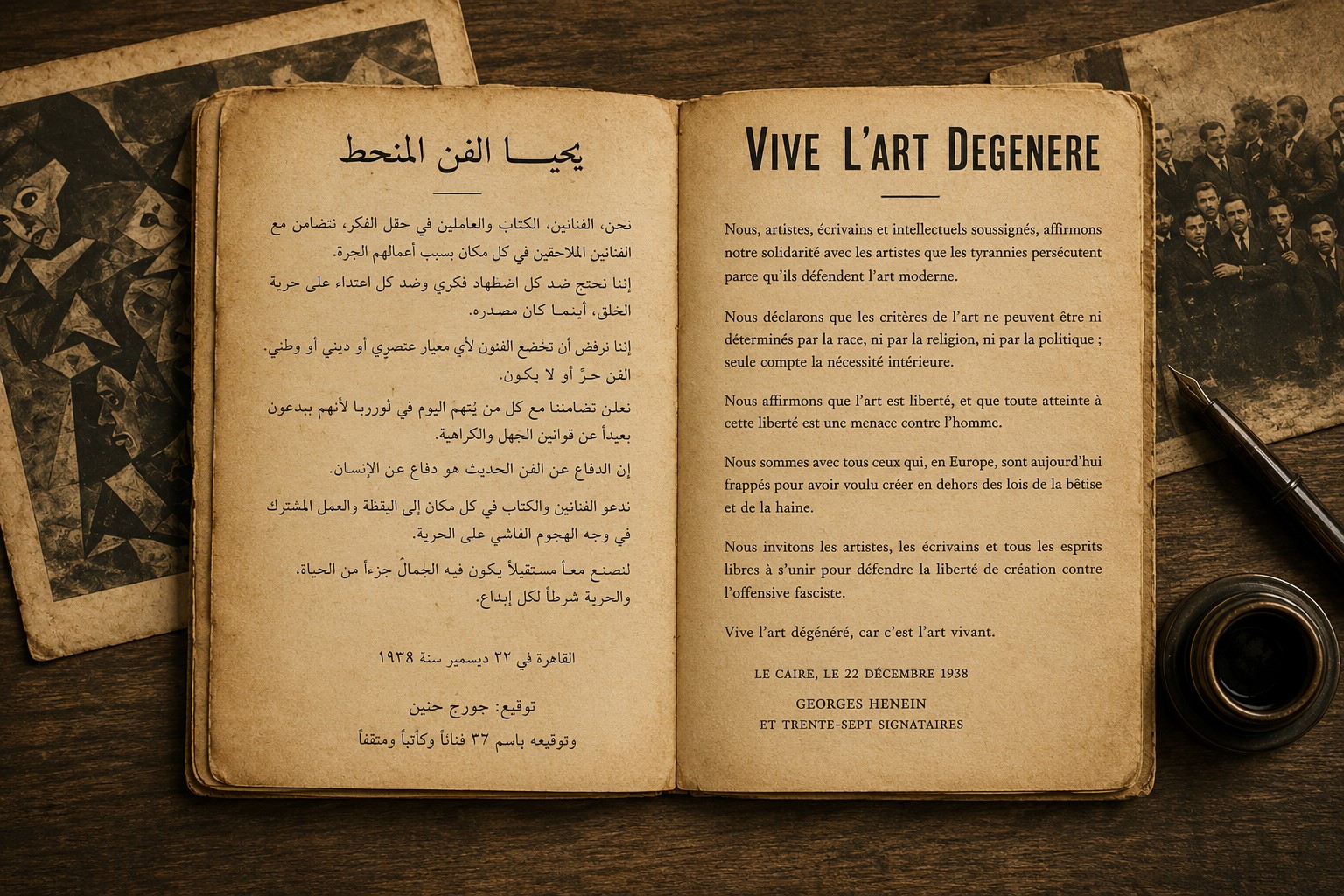
Less than a decade after Marinetti’s manifesto, Tristan Tzara wrote the Dada Manifesto 1918. If Futurism had pushed the manifesto’s certainty to its limits, Dada chose to play with that certainty from within, as though it had entered the house built by manifestos and begun removing the doors.
Tzara writes a manifesto while declaring himself against manifestos, just as he is against principles. He mocks the writer who, in order to produce a manifesto, is expected to become angry, issue judgements, and present what he says as final truth, then embraces contradiction rather than attempting to conceal it. The text would become one of the best-known examples of what might be called an “anti-manifesto.”
What is striking is that mocking the genre did not expel the text from the history of the genre. On the contrary, the Dada Manifesto remains one of the most famous manifestos of the twentieth century, as though the form possesses a peculiar ability to absorb objections directed against itself and continue living.
That tells us something important. If we require a manifesto to contain a clear programme, Dada gives us a text suspicious of programmes. If we demand consistency, it chooses contradiction. If we look for a system of principles, we find a writer openly distrustful of principles themselves. Even respect for the form in which one is writing does not seem necessary for a text to remain part of the manifesto’s history.
What, then, survives when these conditions fall away? Perhaps the act of taking a position and making it public, even when the position itself consists in doubting the solidity of all positions.
It is difficult to understand this playfulness if we separate it from the Europe of the First World War. Dada emerged from a world in which words such as “reason,” “civilisation,” and “progress” had become less innocent than they had long claimed to be, after modern civilisation had demonstrated its capacity to organise death on an industrial scale. In this context, absurdity ceased to be merely an artistic whim, and contradiction acquired another function: to cast doubt on a reason that promises order while producing catastrophe, and on a language that grants itself the authority to explain the whole world before demanding that others live inside its explanation.
The manifesto’s function expanded once again. It could now sabotage the language in which projects and programmes were written and unsettle the rules that had given the form its shape. Part of its longevity may lie precisely in this flexibility, in its ability to betray its ancestors without being easily expelled from the family.
Cairo, 1938: When an Insult Becomes a Banner
Had the story of the manifesto remained confined to London, Paris, Berlin, and Rome, it would have been easy to tell it according to one of the familiar narratives of modernity: Europe produces forms and ideas, and those ideas then begin their journey toward the rest of the world.
But ideas do not travel in sealed boxes, nor do they arrive in empty cities waiting to be filled.
When an idea moves from one place to another, it enters a history that was already there. It comes into contact with its languages, conflicts, institutions, and relations of power, and it changes in the process. In his essay “Traveling Theory,” published in The World, the Text, and the Critic, Edward Said traces what happens to ideas and theories when they leave the conditions of their first appearance and enter a different time, place, and set of conditions of reception. A travelling idea does not carry with it a meaning sealed against change. The new context puts it to new uses, may diminish some of its force, or may give it a force it did not possess where it first emerged.
Seen from this perspective, Cairo in the late 1930s becomes more than an “Arab chapter” added to a history written elsewhere.
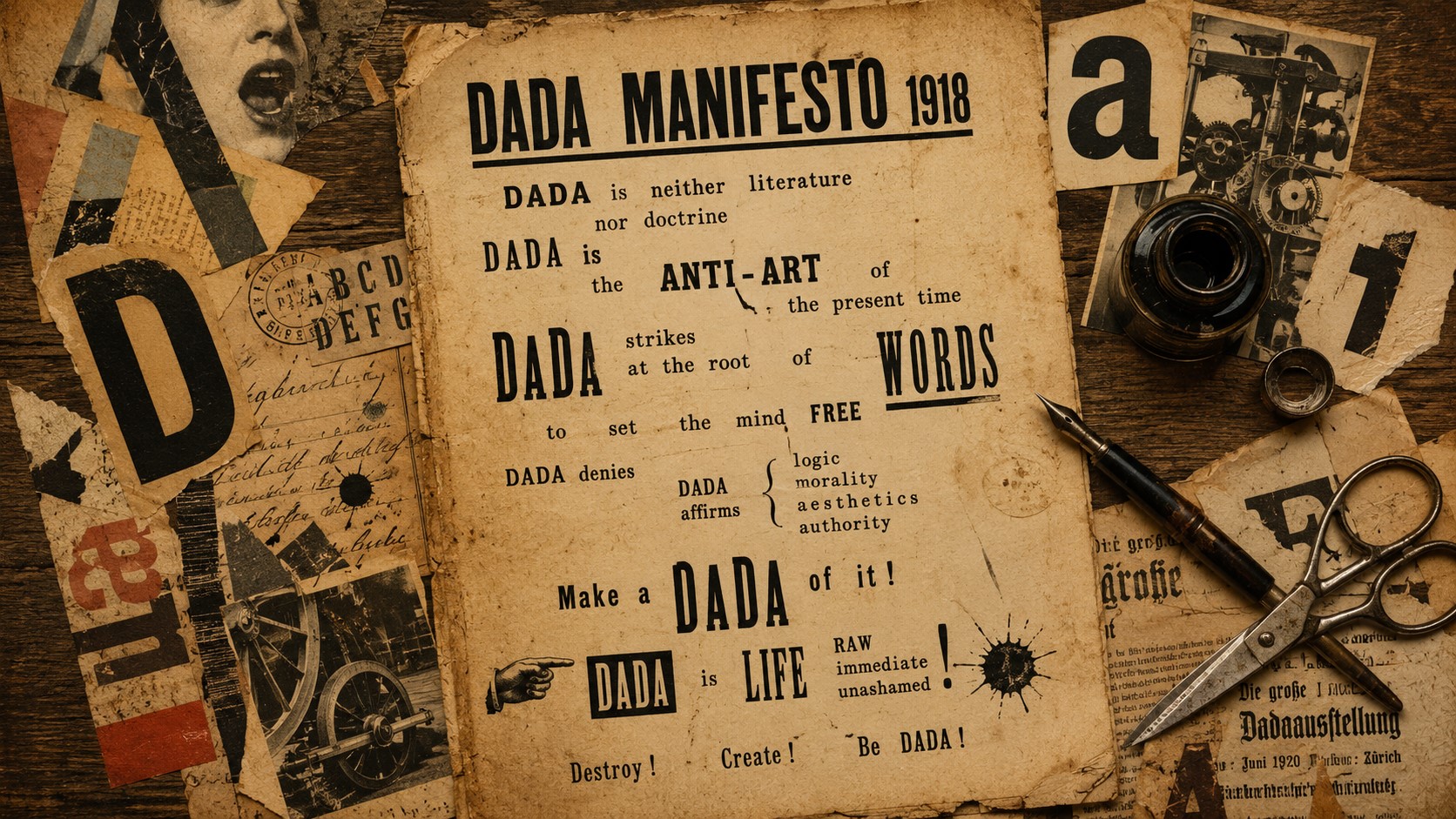
On 22 December 1938, a manifesto appeared in Cairo in Arabic and French under a title whose brevity was part of its intelligence: Vive l’art dégénéré, “Long Live Degenerate Art.”
Georges Henein wrote the text, which was signed by thirty-seven artists, writers, and intellectuals. The moment was tied to the emergence of the Art et Liberté group, which would become one of Egypt’s most remarkable Surrealist experiments. Its members moved within an international network of artists and writers while inhabiting an Egyptian moment with conditions of its own, shaped by British colonial domination, rising nationalisms, social and cultural conflicts, and urgent questions about freedom and the relationship between art and what takes place beyond the museum or the studio.
The title itself accomplishes in three words what might otherwise require pages of explanation.
The Nazi regime had used the label “degenerate art” to mark modernist art, condemn it, and push it beyond the boundaries of what could legitimately be recognised as art. The 1937 Entartete Kunst exhibition made that naming part of a broader cultural policy that determined what counted as legitimate art and displayed what it rejected as evidence of degeneration to be despised.
The artists in Cairo could have defended this art by insisting that it was not degenerate. But doing so would, in some sense, have left the authorities with the right to determine the meaning of the word and decide where it applied. They chose another path. They reclaimed the name itself and reversed its value by declaring, “Long Live Degenerate Art.”
With that small intervention, the direction of the word changed. What had been designed as a condemnation became a site of solidarity. What had been intended as a stigma turned into a banner that could be raised. The discussion shifted from trying to clear modern art of the charge of “degeneracy” to questioning the authority that had appointed itself the right to formulate the charge in the first place, and to determine what would be recognised as art and what would be pushed beyond its borders.
Here the manifesto enters a struggle older than the history of manifestos themselves: the struggle over who possesses the authority to name and who gets to fix the meaning of names. Who decides what is natural and what is deviant, what is respectable and what is corrupt, what deserves to be called art? If power can act on reality through the names it assigns to things and people, then seizing the name once used against you and changing its value can become a way of reclaiming part of the right to define yourself.
The importance of Vive l’art dégénéré goes beyond this linguistic reversal. Its signatories declared their solidarity with modern art being repressed in Europe, rejected the subjection of art to criteria of race, religion, and nation, and called on artists and writers to confront the fascist assault on creative freedom.
From Cairo, an issue that might initially have seemed European became part of an artistic and political position articulated within Egypt, without dissolving the Egyptian context into Europe or reducing Egyptian artists to mere echoes of what was happening there.
Art et Liberté was not a mailbox through which Cairo received the latest news of Surrealism from Paris. It was part of a network taking shape in more than one direction, drawing what it needed from the languages of Surrealism and the manifesto and placing them within local conditions inseparable from colonialism, nationalism, conservatism, and conflicts over the meaning of art itself. Perhaps the problem begins with the phrase “the movement of ideas,” which suggests that an idea reaches completion in one place and then travels intact to another. What happens in practice is usually more complicated. Ideas are rewritten as they move from one context to another, and the new place gives them questions, adversaries, and addressees that were absent at the moment of their first appearance.
Cairo therefore appears as one of the spaces in which the manifesto was reformulated and given a new meaning within its own context, rather than as a location to be appended to an already complete European history.
Vive l’art dégénéré also adds another function to this history. So far, we have encountered a text seeking to transform the political order, another announcing the birth of a new art, and a third mocking the very idea of declaration and the certainty that accompanies it. In Cairo, the manifesto moves somewhat away from the language of destruction and revolution without becoming any less political. It turns toward another task: defending something that has become endangered.
Here is an art being confiscated and condemned, and a power seeking to determine in advance what may appear and what must disappear. The manifesto makes the defence of that art’s freedom into a public position. It reminds us that declaration can also be used to protect something already in existence from being pushed toward disappearance.
This opens another possibility for the manifesto. It can turn toward what already exists when that existence becomes fragile, give it a public presence, and transform its defence from a matter concerning only those who produce it into a cause worth declaring.
At this point, the image we began with starts to look narrower than we had assumed. The very different trajectories that have carried the name “manifesto” have expanded the meaning of declaration itself and made it difficult to reduce the form to a programme, a theory, or a call for rupture. Perhaps this is why the question raised by Vallejo’s book was larger than the book from the beginning.
One movement nevertheless recurs from text to text, whenever a position leaves silence or the margins and claims a place for itself in public space. Sometimes that speech draws its legitimacy from an authority already in place. At other times, the act of speaking itself becomes an attempt to acquire the legitimacy it needs in order to be heard.
Perhaps this is one of the manifesto’s most enduring qualities. It begins from the assumption that something deserves to become visible, and that making it visible can itself alter the position of the speaker within the space they enter. In this sense, declaration does more than bring a position into public view. It places the speaker in a new relationship with those being addressed and with the power they confront, contest, or seek a share in.
This is where the question becomes more complicated. Whoever declares also participates in deciding what deserves to be seen, how it should be named, and who is being called to stand alongside it. Once “we” enters the manifesto, the writer’s voice begins to carry other voices within it, and the right to declare becomes tied to another, more sensitive right: the right to speak in the name of others.
Who is included in this “we”? What is supposed to bind them together? Did the group exist before the text, or did the text itself help imagine it and draw its boundaries? And what happens to those standing at those boundaries, hearing words spoken in their name without recognising themselves in them?
Perhaps this is the paradox the manifesto leaves us with at the end of this first journey. A form of writing that, over the course of its history, claimed for itself the right to appear and to speak eventually finds itself confronting the question of power once it begins speaking for others.
The second article will begin from a word that appears small, but carries within it a long history of belonging, representation, and exclusion: “we.”
Who Gets to Write a Book?
Who Has the Right to Write a Manifesto?
Who Has the Right to Write a Manifesto?
Más de Rita Barotta
Ver todo


Más en Window on Disaster
Ver todo
Lo último de Levant Time
Ver todo


