

Who Has the Right to Write a Manifesto?
Who Has the Right to Say “We”? (2)

This is the second in a three-part series that follows the manifesto as both a form of writing and a way of intervening in the world. The first article stayed with the right to declare, and with the peculiar authority speech can acquire once it enters public space. Here, the question shifts. What happens when that speech moves beyond the person who utters it and begins to speak in the name of others? The third article will return to the question that began this journey, and ask what remains of the manifesto when its forms and purposes keep changing.
By the end of the first article, the whole path had narrowed to a word almost too small for the history that had led us there: we.
Small as it is, “we” can carry an entire collective into a sentence. The moment it appears, the voice speaking is no longer solitary. Other lives gather inside it, with their bodies, experiences, interests, loyalties, injuries, and differences. Some may have helped write the words. Others may encounter them later and discover that they, too, have somehow been gathered into this pronoun, whether or not they ever agreed to stand beneath it.
Perhaps this is why “we” has always sat so comfortably inside the manifesto. The form has a taste for voices that grow larger as they speak, for groups that step suddenly into public view and demand to be seen and heard. We, the workers. We, the artists. We, the oppressed. We who have come to end what has been and announce what should come next.
And yet the more assuredly this “we” enters the sentence, the more difficult it becomes to ignore the question hidden inside it. Who are the people gathered here? Who decided that one voice, or a handful of voices, could draw so many lives into a single word?
In the first article, we saw how a manifesto can help produce the very collective it claims to speak for. That power becomes more charged once we enter the history of feminist manifestos, because across the twentieth century the category “women” itself begins to lose the apparent simplicity of a name capable of gathering everyone it invokes. It becomes a contested space, shaped by arguments over who can be seen within it and who disappears even as it is named.
So this will not be a chronological history of feminist manifestos. I am more interested in the moments when the collective pronoun stretches its borders a little wider and then, from somewhere along those borders, hears a voice it had failed to notice.
Seen this way, the history of the manifesto may also be a history of resistance to the word “we”.
Mina Loy, when “You” Enters the Sentence
In 1914, Mina Loy wrote a text with the disarmingly plain title Feminist Manifesto. It begins with a judgement that leaves little room for politeness: “The feminist movement as at present instituted is Inadequate.”
She then turns to women themselves. When she reaches the professional and commercial opportunities beginning to open up to them, she asks a question whose sharpness lies in its simplicity: “Is that all you want?”
Loy had moved close to the world of Italian Futurism and had written texts that engaged with it while also making fun of it, just as questions about women and their place in society were becoming increasingly present in her early work. There is also something strikingly ironic about the fate of this manifesto. For all the force of a voice seemingly designed to provoke its audience, the text remained unpublished in its own time and did not appear in print until 1982.
That is a curious fate for a piece of writing belonging to a form built around the very act of making oneself public. The manifesto raises its voice, yet for decades there is almost no public space in which that voice can be heard. The irony deepens when we look at how Loy chooses to speak.
Futurism had been deeply in love with “we.” Marinetti and his companions entered language as a group already certain of itself, sure of what it loved, what it despised, and what it wanted to throw out of history. Loy borrows some of that energy and some of the manifesto’s commanding tone, but she shifts the arrangement. She speaks to women more often than she settles comfortably inside a ready-made female “we.”
“You” moves to the front of the sentence. It addresses women who are asked to rethink what they have learned about marriage, chastity, love, and economic dependence on men, and to question promises of equality that might simply preserve the old structures of their lives under newer names. The text can be violent, unsettling even by contemporary standards, and some of its proposals need no defence for us to see what they do within the history of the manifesto. Loy takes a form that male avant-gardes had learned to wield with extraordinary confidence and carries it somewhere else, into a space where the group being addressed is no longer entirely certain that it is a group at all.
The distance between “you” and “we” becomes political. To say “you” to other women is to acknowledge that some space remains between the speaker and those she addresses, and that emancipation has not yet become a shared identity in which everyone can comfortably recognise herself. The woman reading Loy’s manifesto may be a wife who believes in the marriage Loy attacks, a woman for whom chastity remains a value, or someone who simply does not recognise herself in the version of liberation being offered to her.
Loy therefore places us very early before a problem that will follow us through the rest of this essay. Speech that wants to liberate a group can also assume the position of knowing that group better than it knows itself.
Perhaps that is why Loy’s “you” is more troubling, and more interesting, than any ready-made “we.” The collective is still a possibility, an address, something that might yet come into being. The manifesto does not meet a homogeneous audience already waiting for it. It is trying to awaken in the women it addresses a desire to leave behind the positions through which they have learned to understand themselves.
Power returns here by another door. Who gets to tell a woman that the life she has chosen is not free enough? Who gets to draw the outline of liberation for her, and then ask her to recognise herself inside it?
When One Woman Almost Invents Her Own Collective
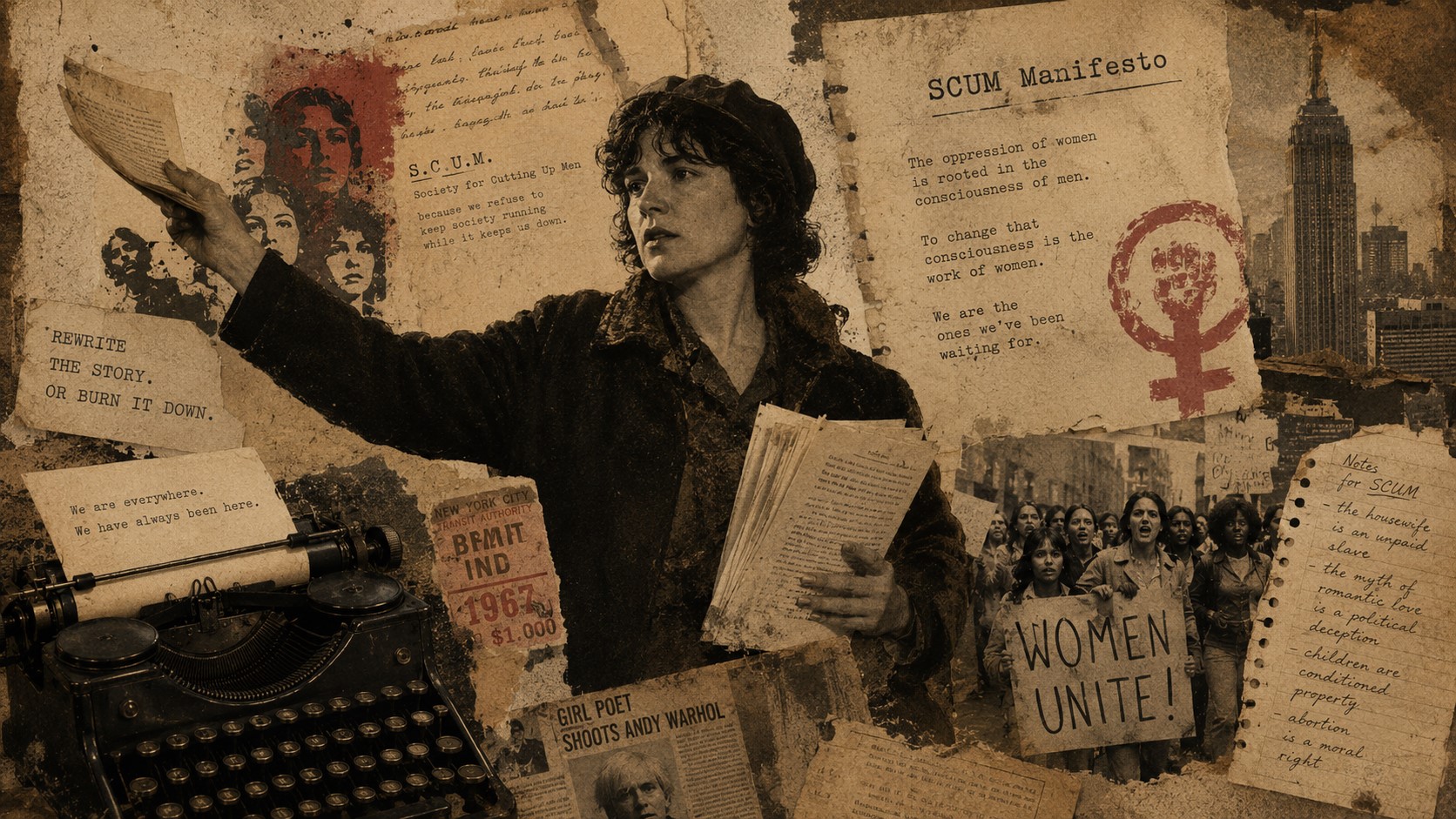
In New York in 1967, Valerie Solanas began distributing the SCUM Manifesto. She sold copies herself on the streets of Greenwich Village. This is a long way from the political organisation that commissioned Marx and Engels to write its programme, or from an avant-garde movement entering the pages of a major newspaper to announce its birth. Here we have a woman writing almost alone, and a text that speaks as though an entire revolutionary force already stands behind her.
The opening tells us immediately that Solanas did not come to the manifesto in search of moderation. “Life in this society being, at best, an utter bore,” she begins, before moving swiftly toward overthrowing government, abolishing money, full automation, and some of the text’s most extreme propositions concerning men.
The world Solanas describes is so exhausted and corrupt that, in her telling, it demands a radical transformation of political life, economic life, and relations between the sexes. Anger fills the page until it becomes a way of taking possession of speech itself, a refusal of the rules that require women to enter public life reasonable, measured, and polite enough to deserve a hearing.
And yet SCUM sounds, from the very beginning, like the name of a group. A reader can imagine an organisation, women who might belong to it, a project carried under that name. The closer we come to the actual moment of writing, however, the harder it becomes to locate a stable collective behind it. The text arrives before the group and behaves as though naming it might already be enough to give it a kind of reality.
With Solanas, a single voice fills the entire page. Anger gives it enough reach to speak of women, men, society, and the future as though she were standing at the centre of a map and could see the whole terrain at once.
We do not need to settle the old argument over how seriously or satirically the SCUM Manifesto ought to be read to understand what it adds to our question. A name exists. A voice speaks with enough confidence. Soon the reader begins to imagine those who might be standing behind it.
Solanas’s anger becomes a force in its own right. Women who have long been expected to explain their pain in a reasonable and civilised language find in the manifesto a form in which exaggeration and aggression can themselves take on political work. Solanas does not ask permission to be persuasive, nor does she make much effort to become acceptable within the system of speech she is attacking. Her voice imposes itself through sheer volume.
The problem of representation remains. The larger the voice becomes, the more people it may sweep into its speech without ever making them participants in it. SCUM brings us back to an almost elementary question. Can an individual declare a collective into existence? And if so, when does that invention become a political space in which others can meet, and when does it become a way of borrowing their voices?
When “We” Is Made in a Room
In New York in 1969, Redstockings published its manifesto. The text belonged to the rising Women’s Liberation Movement in the United States and took a radical position, understanding women as an oppressed group within a system organised around male dominance. This time, the manifesto was issued in the name of a collective that already existed and called on women to join in a common struggle.
But the “we” of Redstockings was not built on the page alone. It was also taking shape through a practice that became central to one strand of the feminist movement: consciousness-raising groups.
Women met in apartments and small rooms and spoke about marriage, sex, work, motherhood, beauty, fear, domestic labour, and all the details each of them may previously have thought belonged only to her own life. Then the stories began to answer one another. Patterns started to appear.
One woman believes that the problem she is having with her husband belongs to their particular relationship, and then another woman tells a story almost exactly like hers. A third speaks about a sense of failure, and gradually the group begins to see the social conditions that make the same feeling recur across so many lives. What had seemed individual begins to acquire a collective shape. What each woman had experienced as private pain becomes readable within a larger arrangement of power.
Consciousness-raising thus becomes a way of producing political knowledge from ordinary experience itself.
There is something almost scene-like about this moment in the history of “we.” The collective forms while women are speaking. They place their experiences beside one another and begin to notice regularities that were invisible when each story was lived in isolation. Their experiences are not identical, and the room does not magically dissolve their differences. Yet a “we” begins to emerge when what had long been sealed inside private life turns out to be connected to structures larger than any one person.
The pronoun carries a different force here than it did with Loy or Solanas. There is no longer a single writer addressing women, and no group name that seems almost to be invented by the text itself. There are women meeting, a shared practice, a language taking shape between them, and then a manifesto that gives that language a public form.
In such a moment, the word “women” can carry enormous political weight. If what each woman thought she was suffering alone is happening to others as well, then those experiences can begin to be read as effects of a shared position within a structure of power. “We women” can move scattered grievances toward analysis, and analysis toward organisation.
And it is precisely when the “we” succeeds that the question of its borders begins to appear.
No experience enters the room untouched by everything else. Each woman brings with her race, class, social position, sexuality, and her relationship to work, the state, and the family. What looks common when attention is fixed on relations between women and men may change considerably once other relations of power enter the frame.
If experience is going to serve as a source of political knowledge, then another question becomes unavoidable. Whose experiences made it into the room in the first place? Which women had the time, the space, the language, and the possibility of being present, so that their lives could help define what counted as “women’s experience”?
But Which Women?
In 1977, a text appeared that did not even carry the word “manifesto” in its title. The Combahee River Collective Statement was written by a group of Black feminists who had been meeting since 1974 and organising both within their own collective and in alliance with other progressive movements. Yet the statement performs much of what we have learned to recognise as the work of a manifesto. It declares a position, names the systems of power it seeks to confront, identifies the group speaking, and offers an understanding of the world meant to guide political action.
From the outset, the collective identifies itself as a group of Black feminists. That apparently simple qualification is enough to shift the entire geography of “we women.”
Black women do not enter political life from a single position that can be reduced to their oppression as women. Racism, sexism, class, and gendered domination work together in shaping the conditions of their lives. The Combahee statement therefore articulates an understanding of interlocking systems of oppression years before “intersectionality” became widely used in the form we know today.
The crucial move lies here. The problem cannot be solved by making the category “women” larger and adding a group that happened to have been forgotten. The category itself has to be examined. When the experience of some women is allowed to stand for “women’s experience,” others can remain present under the name “women” while disappearing from the substance of what the category describes.
When a Black woman tells a feminist movement that “we women” does not fully describe her experience, she reveals that the group’s claim to universality was built from particular positions that eventually forgot to name themselves as particular.
At the same time, the women of Combahee had to negotiate other collectives capable of saying “we Black people” while allowing the oppression of women to disappear inside that “we,” or “we on the Left” while racism and gender inequality were pushed into the category of secondary concerns. A Black woman can therefore find herself facing more than one collective pronoun promising belonging while asking her, as the price of entry, to divide her experience into parts.
This is perhaps what makes Combahee so decisive in the history of “we.” The collective does not simply replace one supposedly pure community with a more inclusive pure community. It exposes something far more difficult: the impossibility of innocence in the collective pronoun. Every “we” is spoken from somewhere. It carries a history. It illuminates some relations of power more clearly than others.
From here, we might say that the history of the manifesto is also a history of objections to the collective pronoun.
Whenever a “we” succeeds in gathering people under a single name, there remains the possibility that a voice will emerge from within it and ask what that unity has cost. The objection may feel like a threat to the movement. More importantly, it forces the group to look again at what had become invisible inside its own image of itself.
The question then becomes how to build a collective that knows its boundaries are neither natural nor permanent, and that the people gathered under one name will not necessarily meet power from the same place.
What If “We” Did Not Need a Common Origin?
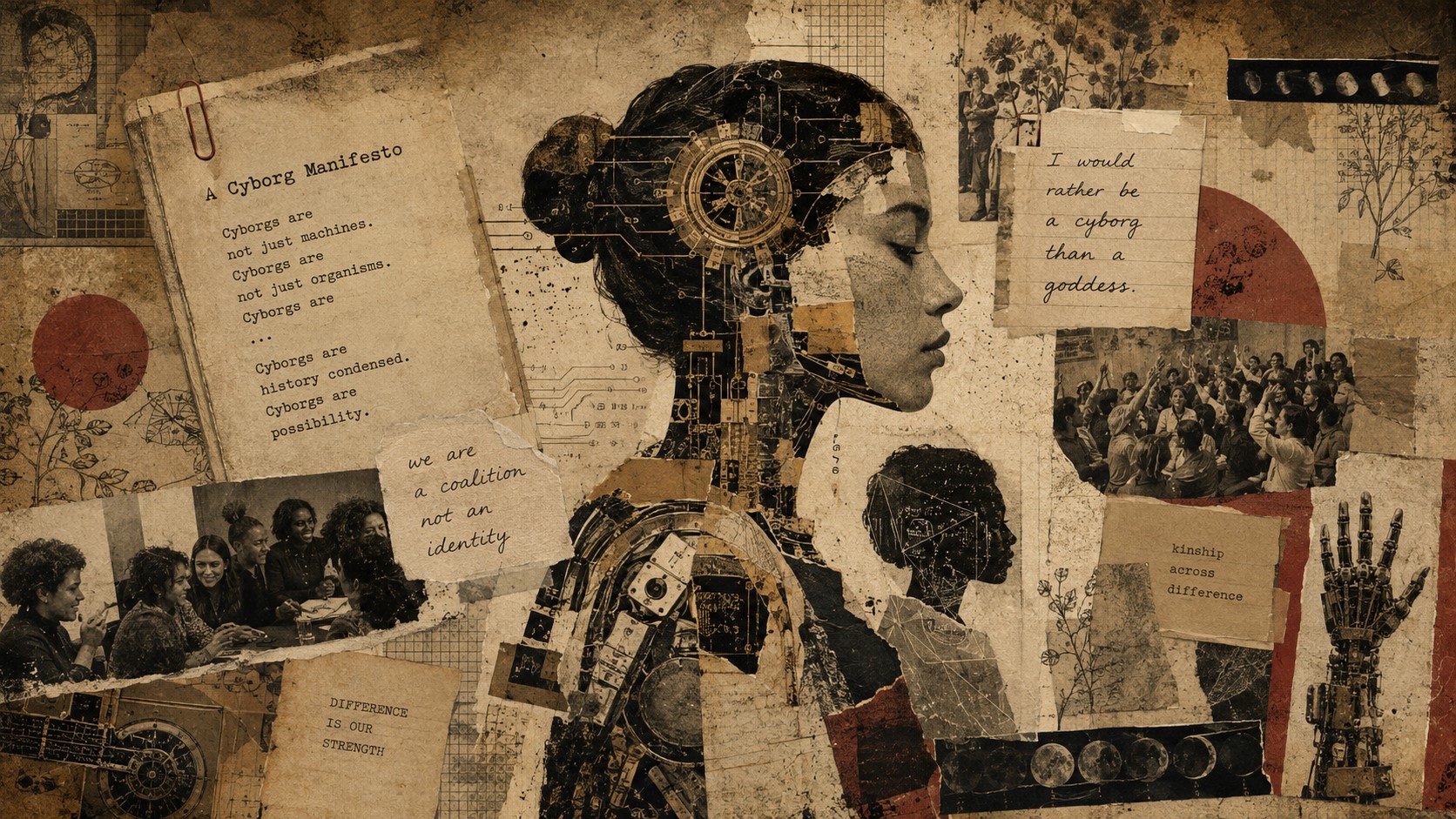
When Donna Haraway published the text that would later become widely known as A Cyborg Manifesto in 1985, the search for a stable feminist unity had become increasingly difficult. Haraway herself wrote about the crisis of political identity affecting parts of the American Left and feminist movements, and turned toward another way of imagining collective action, organised through alliance and affinity rather than through the endless search for a single identity capable of containing everyone.
Her cyborg is a hybrid figure, one that unsettles some of the borders we rely on to organise the world: human and machine, natural and artificial, body and technology. For our purposes, what matters most is what this figure does to the fantasy of a pure origin or an essential identity.
Political groups sometimes like to imagine that their members were, somewhere deep inside themselves, already a community before power divided them. In that story, liberation becomes a matter of peeling away what history has done to us until we recover an original unity that was there all along.
The cyborg unsettles that dream. It begins with mixture, unstable boundaries, partial identities.
And from there comes one of the text’s most fertile political possibilities. People can act together without first having to prove that they were the same to begin with. They can build alliances from different positions without requiring one another to dissolve those differences simply to make the word “we” possible.
Haraway thinks through this possibility in terms of affinity rather than identity. Alliances can grow out of political choices, relationships, shared interests, and forms of resistance, while identities remain partial and even contradictory.
For the manifesto, this shift unsettles the whole history of the collective pronoun. It becomes possible to imagine a “we” that no longer needs to tell itself that it is a single body.
The group begins to look more like a provisional political arrangement among subjects who know they cannot be reduced to a complete, finished identity. They choose to meet around something without turning that meeting into a story of common origin or pure belonging. The strength of “we” may lie precisely in knowing that it will never be able to say everything about the people gathered within it.
None of this makes politics easier. Alliances require negotiation. Difference does not disappear because we announce our respect for it, and the absence of a single identity does nothing to eliminate unequal power within a group. What changes is what we ask from the collective pronoun. “We” can become an agreement to act together while allowing difference to remain visible, rather than a promise that everyone gathered within it is fundamentally the same.
At that point, the search for the finally correct “we,” the one capable of holding everyone without friction or dissent, begins to lose its meaning. These texts suggest something else. The collective pronoun is itself a political practice. It brings people together so that common action can become possible, and in doing so it also draws the boundaries of that togetherness.
Those boundaries rarely stay quiet for long. A voice may appear there and say that the experience described as common was never hers. A group may discover that the name which once gave it strength has begun, in another moment, to hide differences that now need to be seen. The name may remain and acquire another meaning. Or an alliance may form without asking its members to become interchangeable versions of one another before they are allowed to act together.
Perhaps the political strength of “we” lies in keeping the possibility of common action open while allowing difference to remain visible. A collective name becomes most dangerous when it stops being a meeting place and begins to take away from those inside it the right to define themselves.
The manifesto makes this tension particularly visible, perhaps because it has always had a taste for long sentences and confident declarations. It speaks as though something has become clear enough to be announced, only for politics to return from inside that very clarity and open the questions again.
Every manifesto “we” therefore carries within it the possibility that a voice will emerge at its edge and say to those speaking in its name: you do not speak for me.
That voice need not mean that the collective has failed. It may be one of the things that keeps unity from hardening into silence.
But another problem now comes into view. The manifesto has changed its form, mocked its own rules, been written by individuals and collectives, addressed a “you,” spoken as “we,” and even imagined alliances that no longer depend on a homogeneous identity.
So what, in the end, still makes a manifesto a manifesto?
The third article will return to the small book that set this entire journey in motion, Irene Vallejo’s Manifesto for Reading, and ask what happens when the word “manifesto” is carried by a text more interested in caring for something than in tearing it down.
Who Has the Right to Write a Manifesto?
Who Has the Right to Write a Manifesto?
المزيد من Rita Barotta
عرض الكل


المزيد في Window on Disaster
عرض الكل
الأحدث من Levant Time
عرض الكل


