


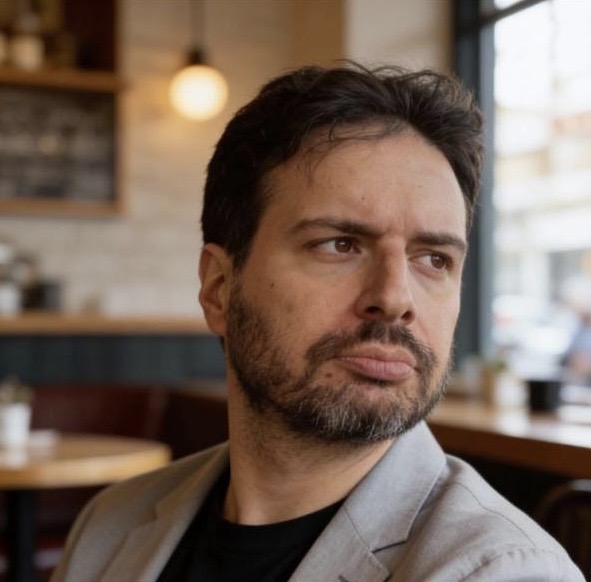
On 10 May 2000, Raymond Eddé passed away, at the end of an exile of more than two decades in Paris.
Eddé was, in the Lebanese political landscape, a wholly atypical figure.
A certain reading of history retains of him today the image of an idealist and stubborn man, cut off from reality – since he refused all political compromises that sought to plug temporary gaps in the dyke by reflex of immediate survival, at the expense of the fundamental values of the Republic and the elementary foundations of the State, from the Cairo Agreement to the Taif Agreement.
Unbending, the Amid? And yet, paradox of anachronism, it was the opposite that his own community reproached him for: his refusal to be swept along by currents of identitarian testosterone, and his rejection of the sweet songs of the sirens and the machine guns, unlike the popular parties and armed organizations of the era.
Like Michel el-Khoury, leader of the Destour, the Amid of the National Bloc continued to hold back the escalation to extremes, opposing the temptation of arms that was ravaging the Lebanese and Christian street, including among his own supporters. Violence ultimately wore down his resolve. Victim of a series of assassination attempts by the various belligerents, he chose to leave. Without knowing, no doubt, that this departure would be permanent.
The Man Who “Was Right”
A piece of political folklore has it that Raymond Eddé asked that the following be inscribed, as an epitaph, on his grave: “Here lies Raymond, who was right.” The Amid was anid – obstinate – whenever it came to holding firm on his backbone of political ethics.
Over time, however, the formula has not been without mixing admiration, irony and even a certain bitterness. As if it were the epitaph of a certain mode of political conduct – too idealistic, if not naive – that refuses to bend and adapt to Lebanese political realities. It defines almost an anthropological category: the honest but powerless Lebanese political figure, ill-suited to Machiavellian virtù. A “loser,” in a sense.
Thus, the petty-political Lebanese time has retained of Raymond Eddé the image of a man who saw the catastrophes coming, but who, by refusing compromises in order to keep his hands clean, ended up isolated, exiled, and almost transformed into a Maronite Cassandra – where instincts preferred to follow utilitarian and populist zaïms or “men of the field” in military fatigues.
And it is no doubt true that Eddé was himself a victim of his political rigorism when he refused Michel el-Khoury’s proposal to unite the Destour and the National Bloc to create a national counterweight to vatenguerrisme, at the beginning of the 1970s. “Never will the son of Emile Eddé take the hand of the son of Bechara el-Khoury!” he had replied to Sheikh Michel.
And this was probably one of the Amid’s political errors, since the absence of the political centre that this national axis might have represented opened the way to an escalation to extremes, and behind it, to a puppet master named Hafez al-Assad, who knew how to exploit internecine quarrels in order to reign for three decades over the land of the Cedar.
Function and Stature
Nevertheless, in the present circumstances, it may be worth dismantling once and for all the myth of “idealism” and “utopianism” that continues to surround Raymond Eddé – the unloved figure of Lebanese communitarianism, all the more so of its sectarian, identitarian, populist and martial tendency.
Raymond Eddé – and the author of these lines did not know him personally, but draws his conclusions from the man’s positions and trajectory – is without doubt the most unpopular of the Christian political leaders (unless it be, supreme irony, Bechara el-Khoury). Why? Because the power that interested him was not the political power coveted by traditional politicians. Eddé was in quest of an authority capable of genuinely embodying something beyond itself: a body of knowledge, an inner bearing, a coherence, an experience, a capacity for transmission, even a form of spiritual or intellectual nobility.
He distinguished instinctively between function and stature.
In this, he maintained a very ancient rapport with legitimacy – almost Greek or medieval in kind. True authority, not coming from status alone, necessarily had to flow from an adequacy between being, word and deed.
For him, authority seemed compelled to satisfy two simultaneous requirements, rarely united: a genuine verticality of knowledge, experience or thought, and an organic recognition from below, from the human real, from the terrain and the living community.
If he failed in the test of reality, it was not because he refused to roll up his sleeves. It was because he refused to play the strongman and the militiaman. A considerable difference.
He refused to succumb to the illusion of the solution through violence. And in that, he was indeed right. And unfortunately, Lebanon being what it is, he is right every day, without variation.
Eddé combined culture, depth and a certain popular recognition grounded in positions of principle, not in acts of war. Not popular in the raw electoral sense, but in the sense that his word genuinely reached people, circulated, transformed, generated free adherence rather than imposed obedience. Eddé created the political, there where others have done nothing but undo it for half a century.
One finds here something very Mediterranean, almost antique once again: the idea that authority is not merely an institutional mechanism, but a living relation between a person and a city. A legitimacy tested in duration.
In this, as in many other things, he was entirely coherent.
Perhaps too coherent for a politician?
The Beautiful Losers
Beyond this, was Raymond Eddé a “loser,” as an entire current “school” of political thought suggests – a school that measures success in terms of crowds drawn to rallies and ballot boxes? As, after him, figures like Nassib Lahoud or Samir Frangieh, to cite only a few?
The time has surely come to shatter once and for all the myth that a figure who does not seek the cult of personality as the foundation of its political legitimacy is necessarily to be discarded from politics or relegated to the margins, in the name of realism.
To be wrong with Sartre rather than right with Aron?
No.
Certain figures now constitute specific landmarks precisely because their knowledge has been tested, recognized, embodied. They have traversed the contradiction of the real world without entirely losing their backbone. They have embodied a form of truth that was not rewarded by immediate history. And this gives more weight to their words, not less.
These figures have often seen the disasters coming, understood the impasses, refused certain compromises – and then lost in spite of it all. Or sometimes because of it. There is in them something tragic in the noble sense: not so much the romantic posture of the “cursed” as the confrontation between lucidity and the balance of forces. They reveal something difficult to accept: that being right protects neither from failure, nor from isolation, nor from destruction – but perhaps from dishonour.
Leonard Cohen gave his second novel a sublime title: Beautiful Losers, translated into French as “Les Perdants magnifiques.” The translation diminishes the force of the oxymoron. These “losers” are not “magnificent.” They simply inhabit a register that is not the same as that of others. Their giant wings will not allow them to walk among the crowd.
Lebanon is full of tactical victors and historical losers. Many of those who won the symbolic or military wars left behind them emptiness, ruin or fear. While certain “vanquished” figures preserved a form of moral legitimacy because they had perceived something essential about coexistence, sovereignty, violence or human dignity.
Raymond Eddé is one of them.
He accepted to pay the price of his clear-sightedness rather than betray his reading of the real in order to belong to the camp of the victors.
One might say he was inhabited by an almost Sophoclean tension, preferring just defeat to degrading victory. Not out of a taste for defeat, no. But because a victory bought at the price of falsehood or blindness would have ended, in his eyes, by becoming another form of ruin.
And it is no doubt for this reason that he never truly wished, in his deepest self, to become president of a Republic that has not ceased, more than twenty years after his departure, to sell itself, again and again, to the highest bidder, rather than resolve to exist.
France: A Generation Sacrificed… in the Name of What?
Mohammad Hussein Shamseddine, the Amelit who laboured for "another Lebanon”
Useful Enemy, Real Enemy
The eternal return of tragedy?
Mais de Michel Hajji Georgiou
Ver tudo


Mais em A Thousand Plateaus
Ver tudo


O mais recente do Levant Time
Ver tudo


