

No “Sobhiyé” for the Poor Clares of Rayaq
The founding of a monastery in the Bekaa Valley, a major spiritual event

A monastery of the contemplative Order of the Poor Clares, founded by St. Clare in the 13th century along the lines of the Order of St. Francis, was established in Rayaq (population 16,000), a small town in the central Bekaa plain, on August 11, the feast of St. Clare. The new monastery was deliberately established in a rural setting, where its prayers will enrich Lebanon’s “breadbasket,” incorporated into Lebanon by Patriarch Hoayek after the famine of 1915.
Bishop César Essayan, apostolic vicar of the Latins in Lebanon, presided over the founding ceremony. The Christian population of Rayaq’s Christian quarter, Rayaq el-Faouka, turned out in force, extending an unforgettable and remarkably generous welcome to the five gray-habited nuns. Most of those present described the foundation as “a major spiritual event.”
The ceremony was, in fact, seen as a genuine “miracle” – the “return of God” to a region suffering from its distance from the capital and from the world’s spiritual desertification.
The Latin bishop of Lebanon confirms that sentiment: “I didn’t say it in my homily, but the sisters noted it: The people are talking about a miracle. It’s beautiful! But this is not a miracle like the others. The people are suffering from a kind of loneliness. For sisters from Italy to leave their monastery – even sell it – to come and settle in a remote corner of Lebanon means that the Lord has finally remembered them.”
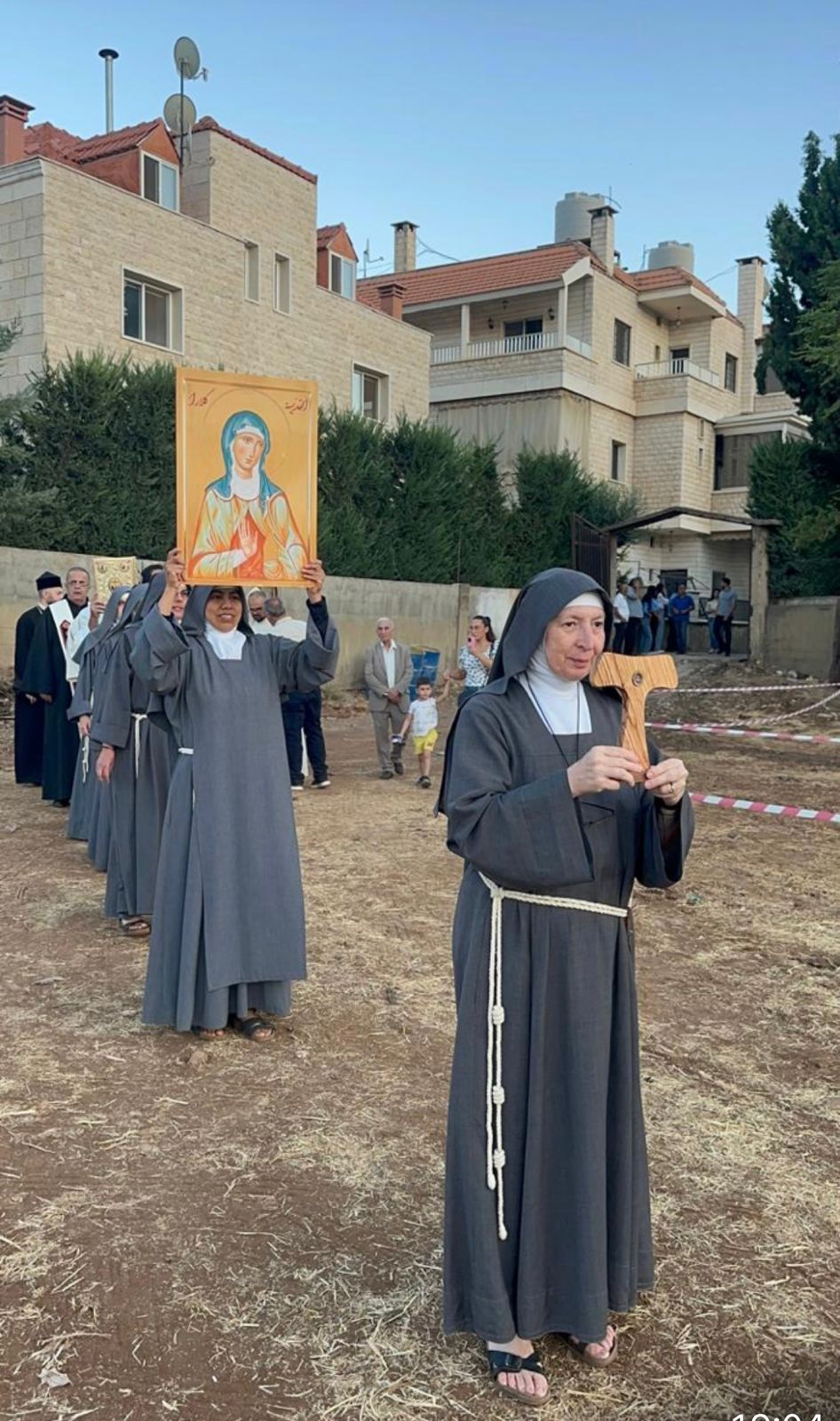
The relics of St. Clare are carried in procession around the grounds of the monastery. Leading the procession is Sister Damiana, the superior.
Sister Gloria, an Italian, 43, the group’s main spokesperson, was overcome by the same emotion: “When everything is dying, when people have no hope left, when young people want only one thing – to leave a country that seems to have no future – we are buying a house here!” she exclaims.
However, it will be several months before the five nuns – Damiana, Gloria, Celina and Maria Lucia, who come from Italian monasteries, and Maria Grazia, a sister from the Mexico City monastery – can move in. The delay is needed to complete the formalities for vacating and refurbishing the building, which is currently occupied, in effect, by several displaced families, as well as an adjoining plot of land intended to give the community a measure of self-sufficiency.
The Rise and Decline of the Town
Once a thriving town, Rayaq was known for its important railway station, which served, among other destinations, Damascus and Aleppo, where travelers could connect with the legendary Orient Express. It was also known for its military air base. The changing times, along with France’s closure of a large maintenance workshop, contributed greatly to its decline. Today, the town is home to Christians, mostly Greek Catholics, as well as a growing Shiite population, swollen by numerous families displaced by the war. The demographic shift has also been reflected in the composition of the municipal council. Yet by tradition, the town remains a kind of microcosm of Lebanon, with Maronite, Orthodox and Armenian minorities, each with its own church. The nearest urban center is Zahlé, the capital of the Bekaa, about 12 kilometers away.
One amusing relic of the French Mandate era has survived: Rayaq is one of the few places in Lebanon where people still play belote.
Rayaq Chose Us
The news of the foundation sent a ripple through the entire Bekaa. According to Sister Gloria, six exploratory trips were needed before the choice finally fell on Rayaq. In the end, the town was selected thanks to the people of its “Christian quarter,” who went to great lengths to find the building and land required for the project.
“We didn’t even know Rayaq existed,” Sister Gloria says. “It was the local people who, after learning that religious sisters wanted to settle in the area, came looking for us! Their gesture struck us as a clear sign from the Lord. Then came the arduous task, it seems, of studying Arabic!”
The foundation is the outcome of some 10 years of discernment, the community’s spokesperson explains. The initial impetus came from Lebanon. The monastery was established in response to a wish expressed by the local Church to see the Poor Clares – who already have a monastery in Yarzé, a villa district on the outskirts of Beirut – establish themselves in a less affluent area where they will be able to attract vocations.
The Example of the Trappists of Tibhirine
For the Poor Clares themselves, quite apart from Lebanon, it was the total self-giving of the Trappists of Tibhirine (Algeria) – the community whose members were abducted and martyred during the Algerian civil war (1994) – that sparked the desire for a total self-giving.
“This story deeply moved us, especially because it was an entire community, rather than a single person, that was being raised to the altars,” Sister Gloria explains.
The invitation to make a deep commitment to rural life in Lebanon, which had initially left them hesitant, was accepted after a friend of the community, Father Dominique Mathieu, was appointed Latin bishop of Iran (2024).
“Fully aware of the difficulty, he accepted out of faith,” Sister Gloria says. “His ‘yes,’ his courage and his trust in the Lord deeply challenged us, and we said to ourselves, ‘What about us?’ From then on, we seriously considered the possibility of coming here, and after much prayer, we decided to embark on this adventure.”
The Christian-Muslim dimension of the foundation is clear. All the more so because the Bekaa still bears the imprint of the violence that, during the years of the Lebanese civil war and the Syrian dictatorship, claimed the lives, 10 years apart, of the Jesuit priest Nicolas Kluiters, brutally murdered in 1985 near the Christian village of Barqa, whose cause for beatification is under consideration, and of the postulant Ghassibé Keyrouz, whom Father Kluiters had taken under his wing. Keyrouz was killed at the height of the deadly wave of sectarian killings in 1975, while on his way to Nabha to celebrate Christmas with his family.
In any event, the nuns know that while the echoes of the civil war are fading, those of war itself remain very much present, along with the bombings that accompany it, the destruction and its economic and social consequences: numerous families displaced from southern Lebanon; the silent exodus toward the cities or abroad of young graduates from all walks of life; and the – sometimes unwarranted – exodus of the Christian upper and middle classes, fleeing the reality of rural areas they see as “invaded” for urban centers that are religiously homogeneous.
A Flame Trembling in the Night
Despite everything, “in the mosaic of Christian communities living on the country’s periphery, the founding of a convent is a great sign of hope,” says historian Névine Hage-Chahine, who lives in Zahlé. “It is a spark, a fragile flame trembling in the night, but a flame, nonetheless. This flame will kindle the fire of prayer. A woman said to me, ‘But do you realize, we won’t see them!’ And yet, everything is there. The essential is invisible to the eye.”
Certainly, except when they go shopping, the people of Rayaq will not see “their” nuns. No “sobhiyé” with the Poor Clares. No mornings spent chatting over coffee. Yet if they listen closely, they will be able to hear their chants and, perhaps, help them on days of snow and bitter cold. These are vocations, too.
Like all young women in Italy, Sister Gloria says she attended university, went out with friends and experienced human love… But at 24, at the end of an inner journey whose secret is known to God alone, she says she eventually found her “home” behind the enclosure, in a radical offering of herself to Christ – an offering she herself had once judged “excessive.”
Forgiveness, the Key to Peace
What does the Lord of history tell you about the world, Sister Gloria? Do you ever feel anxious? Her answer suggests that the Poor Clares do not live apart from current events. With their eyes fixed on the statements of Pope Leo XIV, their unceasing prayer is that the logic of forgiveness, at the heart of the “Our Father,” will prevail over the logic of force; that no one will ever come to believe that war is inevitable; and that faith and hope in a peaceful resolution to conflicts will always be preserved.
“Yes,” Sister Gloria says, “sometimes I do feel anxious. We all do at times… What worries me most is that none of those who decide the fate of the world sees or announces the one solution to all conflicts, both those underway and those that will arise from them: forgiveness!”
The centrality of the Syriac language in the Maronite tradition: the place of faith (6/7)
A Young Lebanese Woman, an Aramaic Chant, and Leo XIV Moved to Tears
In France, Leo XIV is Reaping what John Paul II Sowed
The Centrality of the Syriac Language in the Maronite Tradition: The Place of the Liturgy (5/7)
Lebanon and Eastern Christians at the Heart of the Pope's Visit to France
More from Fady Noun
View All


More in Religion
View All


Latest from Levant Time
View All


