

In France, Leo XIV is Reaping what John Paul II Sowed
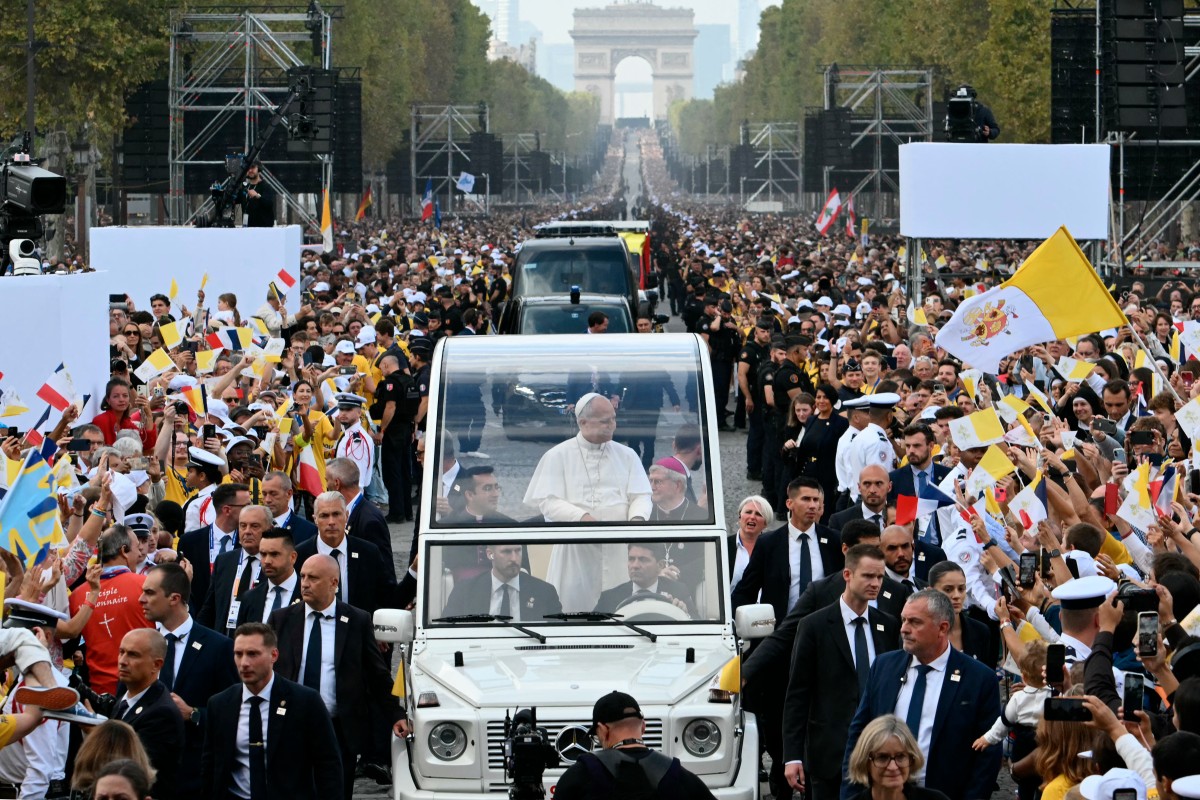
“We were on Mount Tabor… now we must come down from the mountain and root this renewal of faith in everyday life.” In these terms, poet Jean-Pierre Lemaire summed up the four memorable days of Pope Leo’s visit to France (Paris-Lourdes-Metz, September 25–28). In many respects, the visit bore the mark of total surprise, even of a “miracle,” to borrow an expression used by the Pope himself aboard the plane taking him back to Rome.
Leo XIV has had “a fortunate touch,” Catholic-world observers believe. Nearly half a century after John Paul II’s first visit to France in 1980—more than a generation later—he reaped what his predecessor had sown with his famous challenge: “France, eldest daughter of the Church, are you faithful to the promises of your baptism?” This harvest took the form of Christianity’s sudden visibility in a country believed to have become, according to the Washington Post, “the graveyard of Catholicism.”
Unanimously, the press around the world expressed its surprise at seeing a young and enthusiastic France, even if it remains a minority, contrasting with the image of a country whose churches are three-quarters empty and populated only by gray heads; a France open to Jesus, a France that believes in something greater than itself—and believes that this great thing is for it, within reach, within the reach of hope.
At UNESCO, explaining his decision to devote his first encyclical to artificial intelligence, Leo XIV also stressed the human being’s inherent thirst for meaning. “These systems can correlate data, but they cannot give meaning. Yet meaning is the oxygen of the mind,” he declared.
“France rediscovers Catholicism”
“The scale of the Mass celebrated by Leo (at Place de la Concorde) sent a strong message about the vitality of Catholicism in a country that believed it could free itself from its religious roots,” Vatican correspondent Justin McLellan analyzed in the pages of the National Catholic Reporter.
He also mentioned that police opened two additional areas during the Mass in response to the influx of worshippers.
The Church had planned for 600,000 participants, but ultimately 800,000 people attended the celebration, according to the Vatican. Italy’s La Republica went so far as to headline, the day after the Mass on the Champs-Élysées, “France rediscovers Catholicism.”
For its part, Il Messagero noted that “French Catholicism, which is losing ground as an inherited tradition, seems at the same time to be attracting a minority of young people precisely because it is no longer an imposed inheritance (…).”
“Perhaps that is the most political gesture of this visit: freeing France from its nostalgia for itself, and rekindling its desire for new horizons of fraternity,” historian Charles Mercier wrote in the daily newspaper La Croix.
A Syriac liturgical chant performed by Héléna el-Amil of Rmeich
In Catholic circles, it is commonly said that in every era of history, God raises up the saints it needs. In that respect, the spectacle presented to the Holy Father at the Stade de France will remain an unforgettable moment of historical insight. Leo was to tell the 80,000 young people present: “You are today’s saints!”
In fact, no one expected the grandeur of the show “In the Footsteps of the Saints,” presented to the Pope that evening; featuring galloping horses, it transformed the stadium space into an epic living tableau.
The sequence brought to life, century after century, the great figures of holiness who shaped France’s history, opening with Lazarus and Mary Magdalene arriving aboard a Phoenician trireme in the region that would become Provence.
This painting was accompanied by a 4th-century Syriac liturgical chant, “Abo Dqoushto” (Father of Truth), a prayer from the traditional Maronite liturgy addressed to God the Father and centered on Christ’s sacrifice, mercy, and salvation.
This hymn was performed in honor of Christianity’s Eastern roots by Héléna el-Amil, a native of the Maronite border village of Rmeich, a PhD graduate of Paris-Saclay University, and a parishioner of the Church of Our Lady of Lebanon on Rue d’Ulm.
For many, the spectacle symbolically “redressed the insult” done to Catholic France during the show held for the opening of the 2024 Paris Olympic Games: a sometimes bawdy performance that subjected what is most sacred to Catholic France to ridicule through an irreverent parody of Leonardo da Vinci’s famous painting of the Last Supper.
The historical evocation at the Stade de France followed a tribute paid earlier in the day by the Pope to the martyrs of the French Revolution during a private visit to the Catholic Institute of Paris.
The institute houses a historic convent that, during the Revolution, was turned into a prison for priests who had refused to swear allegiance to the Civil Constitution of the Clergy, which provided for the reorganization of the Church in France under state authority. The Pope was to pray at the exact spot where 114 priests were massacred in 1792 after a mock trial held in the sacristy.
The roots of France and Europe
In short, the pastoral visit enabled a Pope of great rationality to highlight not only the Christian roots of France, but those of all Europe—a human entity before it is a geographical one, shaped by centuries of encounters among cultures and peoples, invasions and assimilations; an ever-evolving entity now facing a new stage in its long history of encounters, with the arrival on the continent of many men and women fleeing war zones and persecution, or seeking a better life away from poverty and destitution.
“To understand this long history,” the Pope stressed at the Robert Schuman Convention Center in Metz, “we cannot overlook another Father of Europe: Saint Benedict” (6th century). “Aid to the poor, the sick, and the elderly; children’s education and universities; hospitals and medicine; architecture and engineering; the development of the sciences; law and the organization of cities and states themselves: so many things in Europe have been profoundly influenced by Saint Benedict and his monks! Without this monastic soil, European civilization as we know it would not exist.”
“Far from being an exclusively confessional criterion, recognizing European culture’s debt to Christianity helps us better understand how openness to transcendence has always been a constitutive dimension of the human person and a living source of civilization,” Leo XIV concluded.
How the European Union works
On dialogue between the Church and the Republic, the Pope noted “the great importance” of Article 17 of the Treaty on the Functioning of the European Union, which encourages “an open, transparent and regular dialogue with churches,” while “respecting and not prejudging the status they enjoy” in the Member States.
These words echoed those he had spoken at the Élysée Palace in the presence of President Macron on the first day of his visit, when he invoked the principle of “proper secularism” in advocating cooperation between the state and the Church, particularly in the field of education.
To the peoples who share the French language
By addressing France in French, Pope Leo was addressing all the peoples who share that language—especially the Lebanese, and in particular Christians, strengthened by their centuries-old openness to Western Christianity.
What he said should resonate deeply in the heart of a nation challenged, on the one hand, by Islamic currents resistant to integration and to “proper secularism,” and, on the other, by a dogmatic drift that, in the name of secularism, disguises the names of Christian holidays and bans Nativity scenes in municipal spaces.
Thus, by reminding Europe of what it owes to Christianity, the Pope is in a sense instilling new hope in all the peoples whose future depends in part on their international relations with the European Union.
As Archbishop Jean-Marc Aveline, president of the French Bishops’ Conference, aptly said in Metz: “For Europe, this is an immense responsibility, in a context where force increasingly seems to want to dispense with the law.”
“What the Church truly believes”
Asked on the plane taking him back to Rome whether he had crossed the red line in France separating political and religious matters, notably by speaking out against euthanasia, Leo acknowledged: “Of course, there may be political leaders, on the left or the right, who say that religion must remain solely in the private sphere (...).” But, he explained, “I went to France first and foremost to preach the Gospel, to proclaim the Good News, to reaffirm what Jesus Christ himself says when he declares: ‘I am the way, the truth and the life,’ that is, to speak of the truth that Jesus offers us.”
“Defending life,” he continued, “is something that, as you all know, the Church teaches and deeply believes in.” In France, “a law was recently passed, as it has been in other European countries and elsewhere in the world, and many debates are underway concerning end-of-life issues.”
But, he insisted, “in a place like Lourdes, where people seek something much deeper, they understand that their lives, even amid illness, disability, or various forms of suffering, have meaning.” And “because of Jesus himself, the Church wants to be close to these people and affirm the values that life itself, it seems to me, holds for us all. So I would say that if that is politics, then yes, I did it! But it was not to interfere in French politics. It was to teach what the Church truly believes.”