


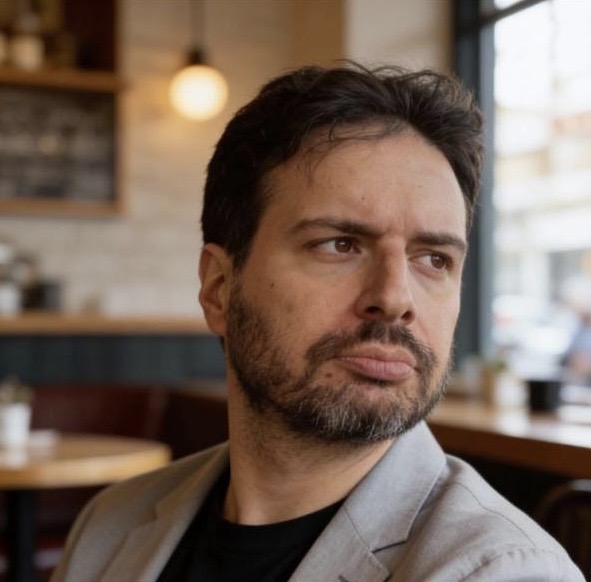
Forty days ago, Mohammed Hussein Shamseddine passed away. An exceptional mind, a Shia democrat, a thinker of the living together, and an inveterate supporter of preserving Greater Lebanon. This article is not so much a tribute as it is a precise testimony of everything this man—humble, discreet, and unknown to the general public—was and what he brought to the public debate.
He is a calm, slender, taciturn man. Every day, in the early afternoon, he arrives at the March 14 general secretariat, settles in quietly and gives himself over to his reflections, his readings, his writings. A new initiative, no doubt, is taking shape, worked out with his fellow travellers Samir Frangieh and Fares Souaid. The ideas Frangieh puts to paper, in French or in Arabic, pass through Shamseddine's hands — he reflects, reciprocates, adds his comments and observations. The intellectual and political osmosis between the two men, intensely human, is total, and the result always substantial, carried by a philosophical, humanist, profound vision of conviviality.
Dressed in a light grey suit and a shirt, invariably sober, with Gaulish moustache and features, he smokes cigarette after cigarette, drinks cup of coffee after cup of coffee. The air of a poet from the early nineteenth century, tinged with a left-wing intellectual from the early twentieth. Pessoa having met Trotsky in a café on Hamra Street in the 1970s.
Then the regulars of the general secretariat begin to arrive, one after another. The man remains placid. The body slight. Nearly motionless. The head, on the other hand, moves like a serene and composed racing engine, almost animated by a life of its own. Substantive debates follow one another, calibrated to the cultural and intellectual level of whoever is present. The master is not only a thinker; he is a pedagogue, an educator. And one approaches him as one would a sage, a druid arrived from another time.
This is not merely an impression, an energy he gives off. The man is genuinely a well of knowledge and wisdom. And, above all, he has no need to advertise it, to display his learning, to accumulate the idle chatter and pointless tirades that others rely on. He is precise, rigorous, laconic, and allows himself, from time to time, a flash of sardonic humour when irritated by some leader's discourse, attitude or political behaviour. Megalomania, populism, the absurd reign of the inspired historical leader? All of it irritates him to the point of genuine restlessness. His voice rises slightly, but no more than that. The British gentleman in him always prevails, even in revolt.
Despite the paroxysmal climate of hatred — the struggle against the assassinations, the shows of force, the acts of violence perpetrated by Hezbollah — the man refuses nonetheless the easy choice, the choice of instinct and impulse. He keeps a perfectly clear head. And the notion of living-together runs in his blood. He believes in it, unshakeably: in Greater Lebanon, the land of the Cedar as a “style of civilisation” and “one of the least inhuman societies in the world” — those two expressions of René Maheu and Georges Naccache that he cites constantly, as does Frangieh. “The philosophy of the pact and the spirit of consensus are the very essence of Lebanon,” he professes to all who will listen.

Mohammad Hussein Chamseddine and Sayyed Hani Fahs, two voices of Shiite moderation.
This man, to whom one owes, alongside Samir Frangieh above all, a large share of the documents and initiatives of March 14 since the Qornet Chehwan Gathering, is called Mohammed Hussein Shamseddine. He is a Shia from Arabsalim, in South Lebanon. He lives in the southern suburbs and has no intention of leaving, intimidation or no. Hezbollah, no more than anyone else, does not frighten him.
With good reason: Shamseddine is a resistant from the first hour. Formed in the ranks of Fatah, within which he founded, with others, the Lebanese Popular Organisation of South Lebanon, he turned the page on the war once the war was over, working ceaselessly toward a national reconciliation capable of bringing about an end to the Syrian occupation, without losing sight, naturally, of Israel’s diabolical role in fuelling sectarian conflict across the region. One of the fundamental principles of his personal code is moral and intellectual coherence.
The Permanent Congress for Dialogue
Under the guidance of Imam Mohammed Mahdi Shamseddine, of whom he is one of the disciples, and of Patriarch Nasrallah Sfeir, Mohammed Hussein Shamseddine founds, together with Hani Fahs, Samir Frangieh, Nassir al-Assaad, Saoud al-Mawla and Fares Souaid, among many others, the Permanent Congress for Lebanese Dialogue in 1993.
A concrete, clear-cut initiative, indirectly inspired by the thought of René Girard and his work Things Hidden since the Foundation of the World. Its purpose is to bring people from opposing trenches to sit together and think through the war, which is promptly done. At first, not knowing one another, the exchanges are tense. One must play mediator and “translate” as each person speaks, since the war and its physical and moral barricades have dismantled whatever common language, lexicon or conceptual approaches once existed. But the barriers gradually fall, and a shared esprit de corps, consensual and Lebanist, begins to emerge.
The Congress’s founding charter, drafted that same year, raises from the outset the question that no one, since the end of the fighting, had dared to formulate directly: how does one build a unified state without first answering the fundamental question of who we are and what we want? Because the Lebanese problem is not, in the first instance, institutional. It is a matter of identity, and therefore of philosophy. Lebanese identity is a complex identity, formed of a multitude of allegiances — familial, linguistic, cultural, religious, regional — that do not overlap and do not cancel each other out in succession, but integrate into a permanent process, always ongoing, always unfinished. To reduce them to a single belonging, national or confessional, is to open the way to violence. The Lebanese state, consequently, far from being an ordinary state, is called upon to govern not only individuals but communities, cultures, regions, sensibilities — and any mechanism that claims to simplify this complexity, in one direction or another, ends by crushing it.

With Anne and Samir Frangié, as well as Chawki Dagher, at the ceremony where Frangié received the Legion of Honour on October 10, 2016.
It is in this spirit that the manifesto for an understanding on the foundations of the Lebanese nation, published in May 1999 in An-Nahar and co-signed by some thirty intellectuals, politicians and academics of all confessions, gives public form to the Congress’s approach. What the manifesto rehabilitates is the “Lebanese dream” that the Lebanese failed to preserve: that “style of civilisation” grounded in Islamic-Christian conviviality, the culture of consensus raised to an art of living, openness to the world without dissolution in it — an original contribution, the text affirms, to universal civilisation, one the Lebanese had not known how to measure before losing it.
One of the Congress’s first concrete initiatives will be a gathering on what was then called the ihbat, the Christian post-war communal despondency, with the participation of Patriarch Sfeir and Imam Shamseddine.
Hezbollah, too, is invited to the dialogue within the same dynamic, through a committee set up by Tarek Mitri in 2001, which also brings together Amal and the Jamaa Islamiya. But it collapses in 2005, with the Syrian withdrawal and the polarisation of March 14 against March 8.
The logic of the Congress will snowball and, through a kind of positive contagion, break the communal straitjacket that enables Assad to divide the Lebanese and prevent them from forging a sovereignty-guaranteeing unity. The Qornet Chehwan Gathering, bringing together the main Christian forces, takes shape, followed by the Democratic Forum, grouping the left and Qornet Chehwan, then the Democratic Left, assembling the sovereignist left-wing forces dissenting from a Communist Party syrianised to excess. Walid Joumblatt also broadens his parliamentary bloc to include representatives of certain sovereignist Christian political tendencies. Everything converges toward the Bristol Gathering, quietly sponsored in the shadows by Rafic Hariri. The fate of the Syrian regime in Lebanon is sealed.
The Shamseddine philosophy
In the same vein, Shamseddine’s leitmotif, what he repeats incessantly to everyone, is that the problems of each community in Lebanon are not problems specific to that community stricto sensu. They are the problems of all Lebanese. And that, consequently, there is no partial, regional or communal solution to Lebanon’s problems — only national, cross-cutting solutions to the communities’ difficulties. For him, the famous post-war ihbat was not a problem that could be resolved by one community alone. It could only be addressed within a trans-communal, and therefore national, logic, one guaranteeing sovereignty and a national equilibrium grounded in living-together, justice and freedom. The Qornet Chehwan Gathering was never meant, in this sense, to become a new Christian Lebanese Front, but rather what it subsequently became: a composite dynamic, a plural opposition. Nor, in his view, is there any strictly Shia solution to the problem of Hezbollah, whose resolution is Lebanese, and passes through a community of cross-cutting efforts capable of refounding the state and its monopoly on violence.
Within this framework, he will never tire of recounting, to reproach a March 14 directorate that allows itself to be walked over, consumed by its internal quarrels and power games, or by the logic of cheap pseudo-compromises, insipid and spineless, the wise Arab parable that perfectly illustrates, for him, the March 14 complex: “A man is convinced he is a grain of wheat. Terrified of being eaten by a hen, he ends up being committed. After months of therapy, the doctors manage to convince him that he is a human being and not a grain of wheat. On the day of his discharge, no sooner has he stepped through the hospital door than he spots a hen and rushes back inside, trembling with fear. His doctor asks him:
— But surely, you now know perfectly well that you are not a grain of wheat!
The man replies:
— Of course I know! But does the hen?”
“The golden rule”
Why this coexistence-minded Lebanism, respectful of the communities and their specificities, but equally of justice, equity and citizenship? For Shamseddine, Lebanon’s “golden rule” is a sentence spoken in the 1950s by Hamid Frangieh, directed at Charles Malik, then Foreign Affairs minister, on the eve of his joining the Baghdad Pact: “If the Lebanese agree on something bad, it immediately becomes a source of good; and if they quarrel over something good, it becomes a factor of evil.” In other words, consensus is the foundation of the Lebanese formula, and no absolute truth can exist in Lebanon. “It is Lebanon’s golden rule, at the origin of the 1943 formula. Unfortunately, since Taëf, the political class understands nothing of this rule and does not believe in it.”
It is this same conviction that brings him, in 2004, to take the floor at a congress in Saydet al-Jabal and correct, with near-surgical precision, the misreadings the Lebanese political class has been committing since the end of the war. Three errors, he says, sum up the collective blindness: believing there was a winner and a loser, believing the defeated were beaten by their adversary, and failing to see that the defeat is first and foremost a defeat of the Lebanese by themselves, through their own disunion. To which he adds a fourth, perhaps the gravest: that of drawing one’s strength from abroad, as though sovereignty could be founded on dependence. The essential thing, he rules, is not that Christian and Muslim figures find themselves side by side in the same room. The essential thing is in the substance, in the philosophy of the pact — in the necessity of dispelling the fog, of recalling that consensus is not a casuistic method among others, but the very condition of Lebanon’s existence.

At the book signing for his work, Zaman Samir Frangié, on May 28, 2019.
For Shamseddine, the Lebanese state cannot be an ordinary state, governed by ordinary mechanisms. A simple state is necessarily reductive, and a reductive state is, by definition, totalitarian; unable to align itself with a society as complex as Lebanese society, it ends up seeking to reshape it to its own design, to “simplify” it. The true challenge is the opposite: to adapt the state to the needs of its society, rather than the society to the demands of a state poorly fitted to it.
He will therefore never cease working, from the 2000s onward, to rebuild these bonds, initiative after initiative, notably the Beirut Appeal of 2004, which draws the wrath of the Lebanese-Syrian security apparatus, alongside Samir Frangieh, Fares Souaid and Saoud al-Mawla. To him, too, is owed an essential contribution to the foundational working documents of March 14, including the one that, at the conclusion of the movement’s annual congress, defines “the culture of peace and of connection in the face of the culture of violence and exclusion,” drawing a cross-cutting fault line in the regional conflict then under way.
On the strictly Shia level, given everything set out above, it should come as no surprise that the man was an inveterate partisan of the wilayat al-umma developed by Imam Shamseddine and of the plurality of the marjaa, and fundamentally hostile to the Iranian wilayat al-faqih and to Khomeinist despotism. For Mohammad Hussein Shamseddine, the state project is the only viable guarantee for all Lebanese, Shia included, light years away from the supremacist fantasies sustained by this or that foreign power.
The loss of a “kindred soul”
After March 14’s self-sabotage, Hezbollah’s political victory, and the accession of the pro-Iranian party’s candidate Michel Aoun to the presidency, Mohammad Hussein Shamseddine’s faithful companion Samir Frangieh — his true political and intellectual twin, a man with whom he always worked in tandem, in resonance, in total synchrony — gravely ill and worn down by the wanderings and capitulations of the sovereignist political leaders, withdrew from the scene and faded away quietly. It was a political rupture, a clean severing of something whole. Shamseddine, whose loyalty was truly unshakeable, hastened, the following year, to write his friend’s biography, Zaman Samir Frangieh (The Time of Samir Frangieh), every page a testimony of friendship and gratitude, yet without emphasis, without the slightest grandiloquence. Simply a civic and civil commitment to Greater Lebanon and the culture of connection, of living-together, of peace. To honour Samir’s memory, Shamseddine effaced himself entirely. But he had no need to place himself centre stage — his modesty defended him against it. And, through Samir, it was of himself, of that same Lebanese coexistence-minded breath, that he spoke.
Mohammad Hussein Shamseddine slipped away as he had lived, in the most complete discretion, on the night of 1 to 2 March, at the hour when Hezbollah was initiating its war to avenge Khamenei. With the entire country engulfed in turmoil, his death passed almost unnoticed. In any case, few Lebanese, beyond the circles of Samir Frangieh’s friends and the former March 14 general secretariat, knew him or had heard of him — and that, for the rest, was always what he had wanted.
Yet history will record that it is largely to him, an honest, courageous and lucid Shia democrat, that most of the coexistence-minded and unitary political literature of March 14, in opposition to all tutelages, occupations and other parapolitical monstrosities, owes its existence. His path and his legacy constitute, in themselves, a testimony that Greater Lebanon, freed of its demons, possessed of a genuine state, reconciled with itself, is truly a “style of civilisation” that deserves to live.
Michel el-Khoury, or the Nobility of Effacement
The Sayyed Who Showed the Way
Mohammed Hussein Shamseddine, that Unknown Soldier
Salma Merchak, Resistance Through the Enlightenment
The story of Salma Mershak, who waited 5 years for justice for her son Lokman
Plus de Michel Hajji Georgiou
Voir tout


Les derniers articles de Levant Time
Voir tout


