

Leo XIV's encyclical on AI: Tower of Babel or Holy City (2/3)
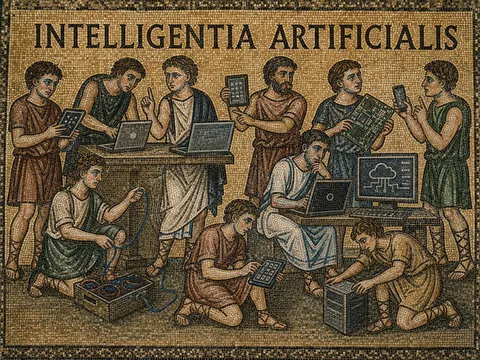

To illustrate his point and give it a biblical dimension, Pope Leo XIV uses, in his encyclical Magnifica humanitas on the digital age and Artificial Intelligence (AI), a metaphor: humanity must choose between building a new “Tower of Babel” or building the “Holy City.”
The story of the Tower of Babel is a biblical episode from the Book of Genesis. Shortly after the Flood, while all human beings spoke the same language, they set out to build a city and a tower whose top would reach the heavens, in order to make a name for themselves. Then God confused their language so that they could no longer understand one another, and scattered them over the face of the earth (Genesis 11:1-9).
The myth proved remarkably fertile in the history of ideas and inspired reflections on the origin of linguistic diversity, the power of collective effort, the sin of pride, the totalization of knowledge, and more.
The theme of the “Holy City,” introduced in the Book of Nehemiah, closes the New Testament and occupies a central place in the work of Saint Augustine. The Holy City symbolizes everything that is humanly and divinely possible and desirable: peace, justice, relations of friendship between Christ and his saints, doctrinal fidelity, and so on. For the Christian faith, it is up to humanity to rise above itself in order to build this City, following the major orientations of the Church’s social doctrine.
The irresponsibility of “Realpolitik”
Yet, describing the world in which we live, Leo XIV observes that, far from all the promises nations made after the Second World War, and the cry of “Never again war” that Europe had proclaimed, “the logic of armed balance and deterrence seems to be returning and imposing itself.”
“But unlike the bipolar scenario of the Cold War,” the Pope adds, “the multiplication of actors and fronts of conflict today makes this logic increasingly fragile. The intensification of confrontations leads to asymmetric and ‘hybrid’ wars, waged also on the economic, financial and digital fronts, with the use of disinformation and campaigns that fuel fear in order to influence public opinion.
In many countries, including countries of the Global South, the increase in military spending is presented as the only response to an uncertain future or to perceived threats, while the real cost is borne by the poorest, who see resources allocated to health, education and social services reduced.
“Behind all this,” Leo XIV insists, “lies a false ‘realism,’ based not only on the well-established logic of force, but also on a cultural and anthropological conviction, as though war were inevitably part of human nature.
It has always been so, people say, except for brief interludes, and it will always be so!
The problem is therefore no longer peace, which has been lost as a reference point in the international landscape, but how and when to act militarily, while claiming that it would be irresponsible not to prepare for inevitable confrontation.
What is truly irresponsible is Realpolitik, this form of political ‘realism’ that sows in consciences and in culture resignation to inevitable war, and that considers peace and dialogue to be utopian or irrational positions that ignore the risks at stake.” (§205)
The mode of production of the digital economy
On another level, Leo XIV elaborates on the mode of production of the digital economy. It rests, he says, “on the silent labor of millions of human beings, employed in activities that are barely visible but essential: data labeling, content moderation — often of very harmful content — and model training.
In many cases, these are young people, mostly women, who work laboriously for poverty wages. To this invisible fatigue is added another, even more brutal one: the extraction of the resources needed to produce the devices and microprocessors on which AI depends.”
“In certain regions of the world,” the Sovereign Pontiff stresses, “children and adolescents work, in dangerous conditions, crushing the materials from which rare earths are extracted. Bodies marked, mutilated, used so that the flow of computation may never be interrupted. In addition, criminal networks use online platforms, messaging systems, anonymous payments and profiling techniques to recruit, control and move victims of trafficking, often minors, turning men and women into ‘data’ to be tracked and ‘packages’ to be moved within the same digital circuits that sustain a large part of the global economy.”
He adds: “This reality deeply challenges the moral conscience of our time. It is not enough to invoke efficiency, nor to celebrate the benefits of innovation, if they rest on a chain of exploitation that remains deliberately invisible.”
Peace, the fruit of justice and charity
For Pope Prevost, “peace is not a naïve hope nor a mere absence of war,” but “the fruit, always possible, of justice and charity.”
Illustrating this statement, Leo cites J.R.R. Tolkien, the great British Catholic writer of the 20th century, who describes our responsibility through the words of Gandalf, one of the protagonists of The Lord of the Rings trilogy:
“It is not our part, however, to master all the tides of the world, but to do what is in us for the succor of those years wherein we are set, uprooting the evil in the fields that we know, so that those who live after may have clean earth to till.”
For us, whose arable lands and olive groves are sprayed with glyphosate and phosphorus, these words should resonate particularly strongly.
Next article:
Against the post-humanist illusion, the capacity for relationship and love (3/3)
Read also on the same theme:
Leo XIV’s Magnifica humanitas, a Foundational Text on AI (1/3)
The centrality of the Syriac language in the Maronite tradition: the place of faith (6/7)
A Young Lebanese Woman, an Aramaic Chant, and Leo XIV Moved to Tears
In France, Leo XIV is Reaping what John Paul II Sowed
The Centrality of the Syriac Language in the Maronite Tradition: The Place of the Liturgy (5/7)
Lebanon and Eastern Christians at the Heart of the Pope's Visit to France
المزيد من Fady Noun
عرض الكل


المزيد في Religion
عرض الكل


الأحدث من Levant Time
عرض الكل


