
Levant Time logo

Articles

News feature image
Diachronia

Philosophy as Cosmified Social Conflictuality (2/20)

From the Divided City to the Figures of the World: Immanence and the Aporias of the Universal
Author portrait
By Wissam Saadé
Published Nov 22, 2026 - 05:23
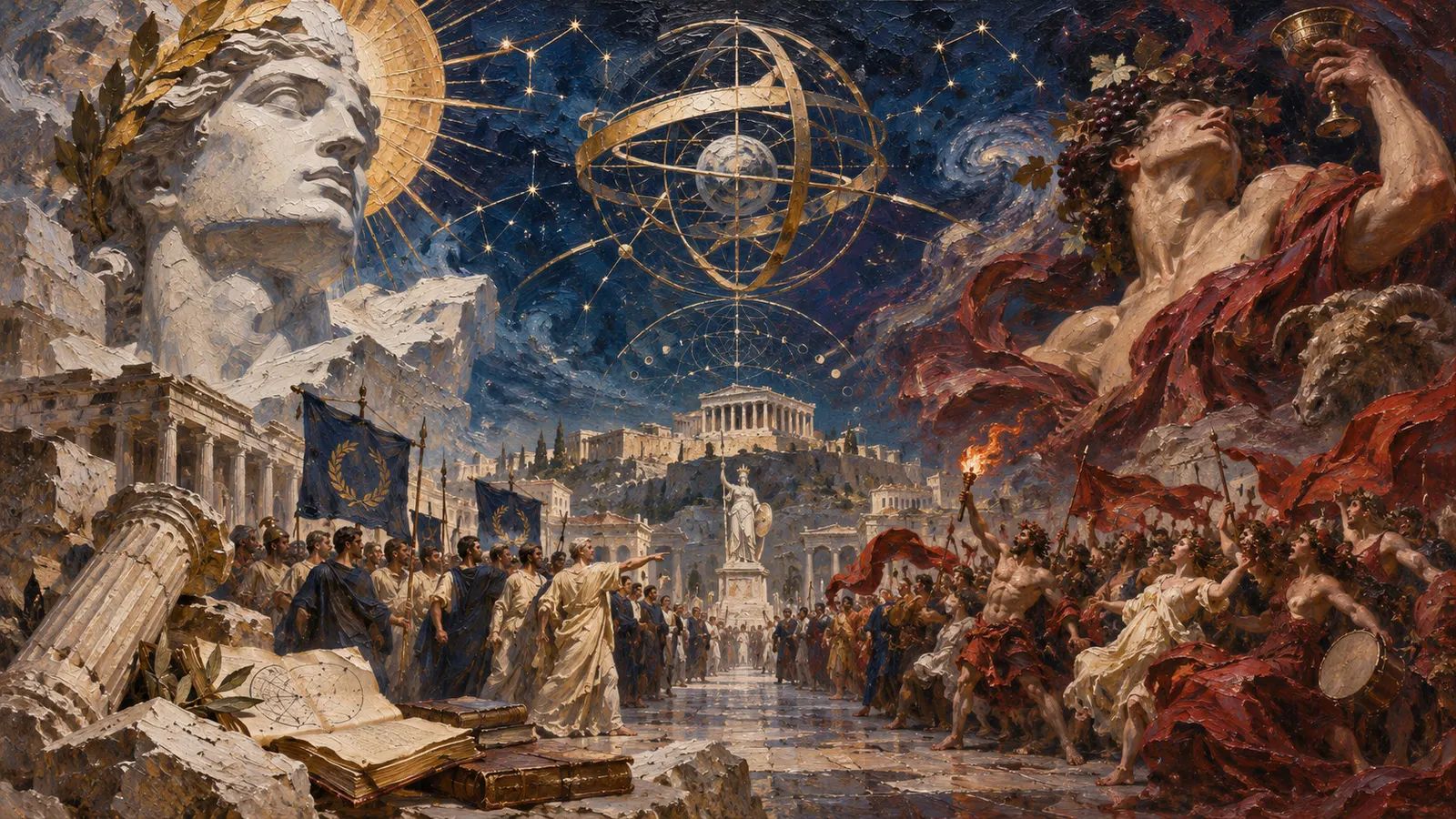
From Temperaments to Antagonisms: How Conflict Becomes a Problem of the World Bringing James, Neyrat and Benjamin into relation thus resolves nothing through the mere addition of perspectives. Rather, it makes a detour through Nietzsche necessary. In Beyond Good and Evil , Nietzsche suggests that the great philosophies bear, to some degree, the imprint of their authors’ involuntary confessions. His proposition does not authorize us to replace the examination of arguments with a psychological assessment of those who produce them. It shifts the question towards the values that make certain images of the world desirable, the drives that invest the categories of order, and the claim of those categories to free themselves from the conditions of their genesis. Conflict, then, is neither immediately a logical contradiction nor merely a clash of individual sensibilities: it also runs through the historical formation of the criteria by which certain things appear worthy of being known or saved. [11]
An Eye on the Event
Author portrait
By Hisham Dibsi - Published Nov 22, 2026 - 03:49
News feature image
(Photo by Sergei BOBYLYOV / POOL / AFP)
My recent visit to China was not merely an opportunity to discover a country undergoing enormous economic, urban and technological transformations. It also allowed me to observe some of the smaller details of everyday life and to try to understand the social culture and vision of the future underlying these transformations. At one point during my visit, I went to a panda park, where I witnessed the birth of panda triplets and observed the public interest generated by the event, as well as the way visitors responded to it. I was struck by the orderly way people moved around, their respect for the surroundings and nature, and their concern not to disrupt the order of the protected park. These were simple scenes, yet they revealed something about society’s relationship with public space and the organisation that makes collective life more harmonious.
Analyze
Author portrait
By Yakzan Takki - Published Nov 21, 2026 - 15:28
News feature image
In Toronto, Canada, Iranian scientist Kaveh Madani, born in Tehran in 1981, heads the United Nations University Institute for Water, Environment and Health, which coordinates research on water resources and makes policy recommendations. In 2026, he received the Stockholm Water Prize, widely regarded as the “Nobel Prize of Water,” notably for his work on the concept of “water bankruptcy,” at a time when the world is depleting its water resources faster than they can be replenished. Madani is seeking to use his position to make his voice heard within the Iranian diaspora, particularly during the war waged by the United States and Israel against Iran. He regularly speaks out on social media, where he has thousands of followers. He denounces abuses committed by the Tehran regime and draws attention to the environmental damage caused by the war in which his country is involved, including the toxic rainfall that followed missile strikes on oil depots in Tehran.
More Articles
Sort By: NewestOldest
Syria, Between Challenges and Opportunities: A New Beginning (1/4)

On December 8, 2024, the regime of Bashar al-Assad fell in Syria. After more than fifty years of bloody dictatorship and thirteen years of civil war that left more than 600,000 dead and displaced more than a quarter of the population, a new wind is blowing across Syria, bringing with it a wave of optimism. As in every country left in ruins after a civil war, in Syria, everything needs to be rebuilt. Thanks to its geographical location, its wealth of natural resources, and the support of the Gulf states, the new Syria of Ahmad el-Sharaa presents numerous opportunities. But at the same time, the country must face many challenges, particularly in terms of security and socio-political stability.

Lifting of Sanctions on Syria: early Signs of the Country’s Reconstruction

On November 6 th , the United Nations Security Council, driven by the United States, voted to lift UN sanctions against Syrian President Ahmad el-Chareh. This measure followed a similar decision earlier in the summer, when both the United States and the European Union ended their sanctions against Bashar el Assad’s Syria, which had been imposed during the civil war that began in 2011. The general lifting of sanctions will allow Syria to reintegrate into the Arab sphere and the global economy, paving the way for renewed investment and the reconstruction of the country. The Caesar Act The most emblematic measure among the sanctions targeting Assad’s Syria was the adoption of the Caesar Act by the United States in 2019. The law was named after a Syrian military photographer who smuggled out more than 50,000 photographs documenting abuses committed by the Baathist regime during the civil war.

Pope Leo XIV: The Land of the Cedar Has Adopted You…!

Your Holiness, You kindly chose this country of the Levant as your first destination after your election as head of the Catholic Church. We thank you for that! Your presence here resembled the shadow of a white cloud gliding through a dark sky that has been overcast for far too long, letting its light shine upon this geographical space described in history books as the land of milk and honey, the land of hospitality and conviviality, the land of the eternal Cedar—majestic, strong, and unwavering. A land of encounter and exchange among cultures and diverse communities; a land of life, love, and peace, regularly attacked and often violated.

The Abrahamic Family House, for a world of tolerance and peace

In 2019, Pope Francis was the first pope to make an official visit to Abou Dhabi. During this visit, Pope Francis and the Grand Imam of Al Azhar, Dr. Ahmed Al Tayeb, made history by jointly signing a document on human fraternity calling for tolerance, universal peace, and reconciliation between all religions. To commemorate this historical visit and in line with the charter of human fraternity, the government of the United Arab Emirates decided to build on Saadiyat Island the Abrahamic Family House, an architectural space of nearly 6,000 square meters dedicated to the three monotheistic religions. Inaugurated in 2023, it includes a church, a mosque, and a synagogue, as well as a forum.

Nostra Aetate, cornerstone of interreligious dialogue – The Roots (1)

The Vatican and the global Catholic community, including Lebanon, are currently marking the 60th anniversary of Nostra Aetate , the declaration promulgated by Pope Paul VI on the Catholic Church’s relationship with non-Christian religions. In Lebanon, a conference was held in Bkerké on November 8 to commemorate the event. The statement has often been called prophetic , and rightly so. It was written at a moment when, despite growing contact between peoples through modern transport and communication, religion was increasingly being used as a tool of violence across the five continents. The culture of religious and racial hatred had reached its darkest point in Europe during World War II, with the Holocaust and the extermination of millions of Jews by the Nazis.

A message to the entire Levant
By
Riccardo Cristiano
Published

Pope Leo gave the Lebanese what belongs to the Lebanese: recognition of their great resilience. But if we try to read his words on the serious global problem he identified for everyone through Lebanese eyes—let's say Lebanese eyes only, since he addressed these words to the whole world—we would understand that this resilience should be investigated: “A kind of pessimism and sense of powerlessness seem to have taken hold, where people are no longer able to ask themselves what they can do to change the course of history. Major decisions appear to be taken by a select few, often to the detriment of the common good, as if this were an inevitable destiny”.