Levant Time logo

Articles

News feature image
Diachronia

Philosophy as Cosmified Social Conflictuality (2/20)

From the Divided City to the Figures of the World: Immanence and the Aporias of the Universal
Author portrait
By Wissam Saadé
Published Nov 22, 2026 - 05:23
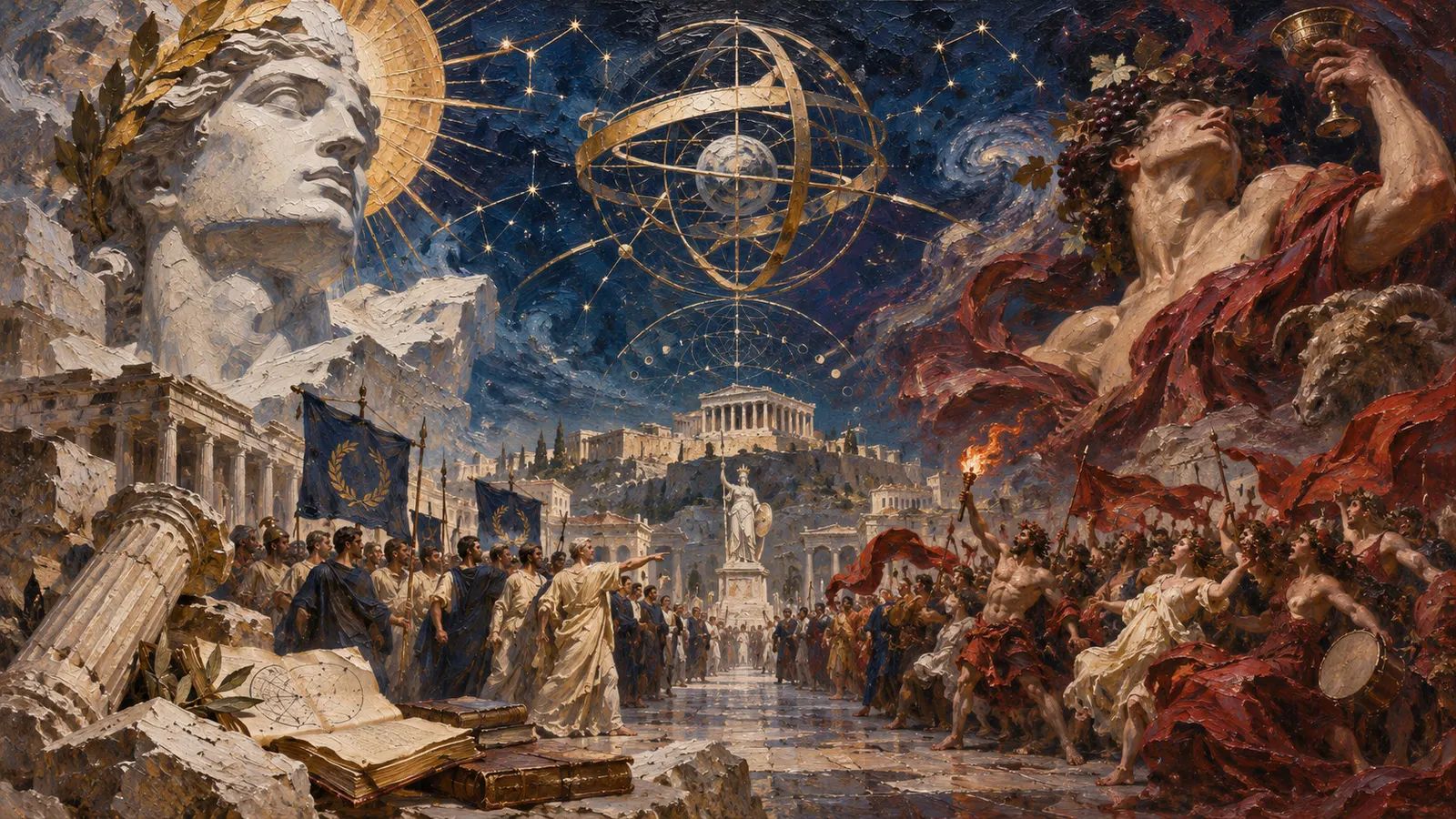
From Temperaments to Antagonisms: How Conflict Becomes a Problem of the World Bringing James, Neyrat and Benjamin into relation thus resolves nothing through the mere addition of perspectives. Rather, it makes a detour through Nietzsche necessary. In Beyond Good and Evil , Nietzsche suggests that the great philosophies bear, to some degree, the imprint of their authors’ involuntary confessions. His proposition does not authorize us to replace the examination of arguments with a psychological assessment of those who produce them. It shifts the question towards the values that make certain images of the world desirable, the drives that invest the categories of order, and the claim of those categories to free themselves from the conditions of their genesis. Conflict, then, is neither immediately a logical contradiction nor merely a clash of individual sensibilities: it also runs through the historical formation of the criteria by which certain things appear worthy of being known or saved. [11]
An Eye on the Event
Author portrait
By Hisham Dibsi - Published Nov 22, 2026 - 03:49
News feature image
(Photo by Sergei BOBYLYOV / POOL / AFP)
My recent visit to China was not merely an opportunity to discover a country undergoing enormous economic, urban and technological transformations. It also allowed me to observe some of the smaller details of everyday life and to try to understand the social culture and vision of the future underlying these transformations. At one point during my visit, I went to a panda park, where I witnessed the birth of panda triplets and observed the public interest generated by the event, as well as the way visitors responded to it. I was struck by the orderly way people moved around, their respect for the surroundings and nature, and their concern not to disrupt the order of the protected park. These were simple scenes, yet they revealed something about society’s relationship with public space and the organisation that makes collective life more harmonious.
Analyze
Author portrait
By Yakzan Takki - Published Nov 21, 2026 - 15:28
News feature image
In Toronto, Canada, Iranian scientist Kaveh Madani, born in Tehran in 1981, heads the United Nations University Institute for Water, Environment and Health, which coordinates research on water resources and makes policy recommendations. In 2026, he received the Stockholm Water Prize, widely regarded as the “Nobel Prize of Water,” notably for his work on the concept of “water bankruptcy,” at a time when the world is depleting its water resources faster than they can be replenished. Madani is seeking to use his position to make his voice heard within the Iranian diaspora, particularly during the war waged by the United States and Israel against Iran. He regularly speaks out on social media, where he has thousands of followers. He denounces abuses committed by the Tehran regime and draws attention to the environmental damage caused by the war in which his country is involved, including the toxic rainfall that followed missile strikes on oil depots in Tehran.
More Articles
Sort By: NewestOldest
The Levant: Let Us Dare to Hope for Peace
By
Jawad Pakradouni
Published

The following question was posed to one of the artificial intelligence programs: Has the Levant ever experienced a true period of peace since its existence? The answer is grim. The region has known periods of calm, but never lasting peace. The only period that can be described as stable was the Pax Romana , from the first to the third century. A peace imposed by the sword, a pax manu militari . A peace at the price of blood, the toll of which even artificial intelligence would be unable to assess. The various conflicts were motivated primarily by religious reasons, linked to other political or territorial considerations.

Europe Facing Its Demons
By
Michel Hajji Georgiou
Published

No — the war unleashed by Russia against Ukraine cannot be dismissed as a peripheral disturbance or reduced to a mere dispute over territory, whatever the assorted Putinists would have us believe. The Russian aggression exposes a deeper fracture: a clash between two visions of the world. On one side, freedom and the rule of law; on the other, the nostalgia for an imperial order, resurrected under the guise of a mythologized “golden age,” built upon domination and terror. What unfolds today upon Ukrainian soil is nothing less than the deliberate attempt to resurrect the imperial logic of Russia and to impose it as the political paradigm of this century. The battle for the Donbas is not a local skirmish. It is a test for the whole of Europe — for its courage, its memory, and its very future. Nothing less. The regime of Vladimir Putin does not merely seek to annex land. Putin aims to restore an imperial architecture with explicit historical referents: Peter the Great, Catherine II, and the idea of a “civilizational space” sanctified by the myth of the “Russian world,” wherein peoples are not political subjects but ethnic matter to be absorbed, reshaped, or erased.

The Last Taboo Has Fallen: Lebanon Will Not Be the Last to Sign a Peace Agreement!

Direct negotiations between Lebanon and Israel have officially begun with the aim of reaching a peace agreement. Their fundamental condition is the disarmament of Hezbollah. Other points, both essential and secondary, are on the table, notably economic cooperation enabling both countries to move forward on the path to recovery, the reconstruction of South Lebanon, and security and stabilization on Israel's northern border. Before going into detail and analysis, before examining the various perspectives, and before reviewing the events that have led Lebanon to pay the heaviest price in the Arab-Israeli conflict for over half a century, a simple question arises: what is the alternative to peace with Israel, to Lebanon's recovery, and to the country's reconstruction? There is no clear answer. The state has been absent for decades, and the Iranian militia based in Lebanon decides, unilaterally, when to launch a war, when to conclude a truce, when to negotiate, when to support Gaza, when to provoke Israel, or when to destabilize neighboring Arab countries. It builds tunnels to continue the wars instead of constructing shelters and hospitals. Until the day Hezbollah trapped itself in a strategic dead end. The war it instigated to serve the Iranian project under the slogan of "unity of fronts" is one it can no longer end. Tehran has gradually withdrawn the cover it provided to Hezbollah. It seeks to buy time to preserve the regime and maintains Hezbollah for future use. But Israel now refuses to tolerate any continued threat posed by Hezbollah. He pushed this militia back north of the Litani River, which proved simpler than carrying out Nabih Berri's famous quip to his visitors, who were warning him about the deteriorating situation, suggesting that the Litani River should be moved to the border with Israel! As a result, Hezbollah is no longer acting according to the old rules of deterrence. In fact, it isn't reacting at all. It has endorsed a truce, but a truce is merely a respite between two wars. The Lebanese leaders, long absent and hesitant, even overwhelmed by the de facto reality, have finally woken up. They have taken the initiative, but hesitated, then failed to follow through. What they will not accomplish, Israel will do in their place—but the price to pay will be far higher.

The Levant in Turmoil: Lebanese and Syrian Perspectives (2/3)

The Levant has, over the past two years, witnessed profound and dramatic upheavals that have reshaped the region’s geopolitical landscape. The chain of events set in motion since Hamas’s deadly attack on Israel from the Gaza Strip on 7 October 2023 seems to have paved the way for the emergence of a new Middle East, as Israel’s Prime Minister, Benjamin Netanyahu, repeatedly asserts. As 2025 draws to a close, what overall picture, what prospects, and what political and security assessment can be made of this region? By stepping back and looking at the wider picture, it becomes easier to examine closely the developments under way and the sweeping changes that have unfolded across Lebanon, Syria, Israel, Gaza (and the Palestinian territories), as well as Iran.

Lebanon, a land of encounter, a land of Christian unity

“Thank you for coming” is probably one of the phrases Leo XIV heard most often during his stay in Lebanon. For many, the popular welcome given to the Pope came as a surprise. Leo XIV praised the “simplicity” of our faith. He must have rediscovered in Lebanon something of the faith of the peasants of Peru, that of a people untouched by the intellectual sophistication of the West. “Wow! Thank you to Peru, and especially to Chiclayo, for having so beautifully shaped this man of God, so full of zeal and compassion,” wrote a retired engineer on Facebook who spent three days glued to the television. Mother Marie Makhlouf, the superior of the Sisters of the Cross, and the two women who received the comfort of his embrace, in Bkerké and at the port, would certainly agree. Now, Pope Leo XIV knows Lebanon intimately, and the people saw the joy of the encounter on their faces.

A Policy of Denial and Collective Suicide
By
Jawad Pakradouni
Published

In the French baccalaureate history textbook, there's a chapter on page 138 entitled "The Birth of the State of Israel." However, strangely enough, it jumps from page 137 to page 140, with the two pages of the aforementioned chapter stuck together. This way, our children will be spared learning about the creation of a country that our own refuses to recognize, and therefore doesn't officially exist… Imagine the results on the baccalaureate exam if this topic is ever asked. Meanwhile, the army of this non-existent country is decimating everything in its path or during its overflights. One might conclude that we are being attacked by ghosts or spirits. We don't need regular forces or so-called paramilitary "resistance," but an exorcist.