
Levant Time logo

Articles

News feature image
Diachronia

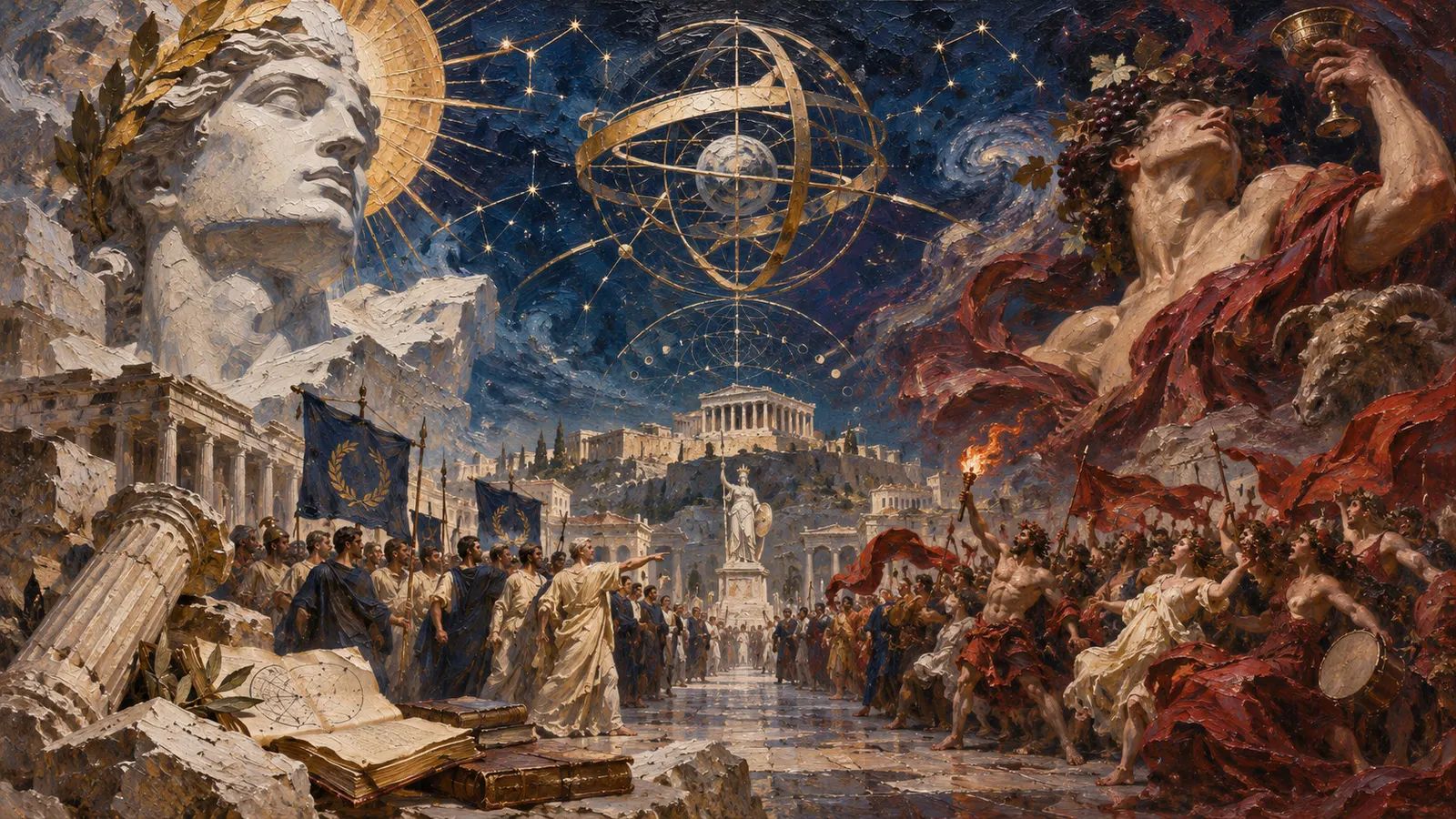
Philosophy as Cosmified Social Conflictuality (2/20)

From the Divided City to the Figures of the World: Immanence and the Aporias of the Universal
Author portrait
By Wissam Saadé
Published Nov 22, 2026 - 05:23
From Temperaments to Antagonisms: How Conflict Becomes a Problem of the World Bringing James, Neyrat and Benjamin into relation thus resolves nothing through the mere addition of perspectives. Rather, it makes a detour through Nietzsche necessary. In Beyond Good and Evil , Nietzsche suggests that the great philosophies bear, to some degree, the imprint of their authors’ involuntary confessions. His proposition does not authorize us to replace the examination of arguments with a psychological assessment of those who produce them. It shifts the question towards the values that make certain images of the world desirable, the drives that invest the categories of order, and the claim of those categories to free themselves from the conditions of their genesis. Conflict, then, is neither immediately a logical contradiction nor merely a clash of individual sensibilities: it also runs through the historical formation of the criteria by which certain things appear worthy of being known or saved. [11]
An Eye on the Event
Author portrait
By Hisham Dibsi - Published Nov 22, 2026 - 03:49
News feature image
(Photo by Sergei BOBYLYOV / POOL / AFP)
My recent visit to China was not merely an opportunity to discover a country undergoing enormous economic, urban and technological transformations. It also allowed me to observe some of the smaller details of everyday life and to try to understand the social culture and vision of the future underlying these transformations. At one point during my visit, I went to a panda park, where I witnessed the birth of panda triplets and observed the public interest generated by the event, as well as the way visitors responded to it. I was struck by the orderly way people moved around, their respect for the surroundings and nature, and their concern not to disrupt the order of the protected park. These were simple scenes, yet they revealed something about society’s relationship with public space and the organisation that makes collective life more harmonious.
Analyze
Author portrait
By Yakzan Takki - Published Nov 21, 2026 - 15:28
News feature image
In Toronto, Canada, Iranian scientist Kaveh Madani, born in Tehran in 1981, heads the United Nations University Institute for Water, Environment and Health, which coordinates research on water resources and makes policy recommendations. In 2026, he received the Stockholm Water Prize, widely regarded as the “Nobel Prize of Water,” notably for his work on the concept of “water bankruptcy,” at a time when the world is depleting its water resources faster than they can be replenished. Madani is seeking to use his position to make his voice heard within the Iranian diaspora, particularly during the war waged by the United States and Israel against Iran. He regularly speaks out on social media, where he has thousands of followers. He denounces abuses committed by the Tehran regime and draws attention to the environmental damage caused by the war in which his country is involved, including the toxic rainfall that followed missile strikes on oil depots in Tehran.
More Articles
Sort By: NewestOldest
The Levant in Turmoil: An Elusive Peace (1/3)
By
Jean-Patrick Dayras
Published

The Levant unmistakably reached a crucial tipping point on 7 October 2023, as Hamas launched a deadly attack on Israeli territory from the Gaza Strip. The circumstances and repercussions of this swift and bloody offensive sent a seismic shock through Gaza and Israel, of course, but also across other key centers of the Levant, notably Lebanon and Syria, and, by extension, Iran and Yemen. The devastating impact of Hamas’s attack on Gaza and its population has once again brought the entire Israeli-Palestinian conflict to the forefront. Some had hoped that the events of 7 October 2023 might lead to a breakthrough in the longstanding Middle Eastern conflict, which has blighted the region for over seven decades. At this stage, this is far from being the case, at least in appearance. It is particularly regrettable that the Palestinian Authority has been unable to regain the initiative and embark on a swift and promising dialogue with Israel.

Baptized a “message-country,” Lebanon awaits the communion of peace

Pope Leo XIV has chosen Lebanon – baptized by his predecessor, Saint John Paul II, as a “message-country” – for his first apostolic trip outside Italy. Under the theme “Blessed are the peacemakers,” the visit pierces through Lebanon’s war-scarred history like a ray of light. “Blessed are the peacemakers”: four words that set the tone. They leave their mark on the unfolding events and the course of history itself, as well as on the schedule of the visit, which is packed with official and ecumenical meetings, culminating in the solemn Mass to be celebrated along Beirut’s seafront. Yet, one must ask: does Lebanon truly need a communion of peace?

Leon XIV and the Lebanese Exception
By
Youssef Mouawad
Published

What a source of concern—and even of irritation—for Roman authorities, these Eastern Catholics do indeed generate! Had they vanished from the Levant, diplomatic relations between Rome and the Muslim countries of the Eastern Mediterranean would have been far smoother. That being said , things were never simple for Vatican diplomacy, on dealing deal with the Maronite community. Very early on, the Maronites asserted themselves politically as an autonomous entity rooted in a mountain stronghold, and what is more they never hesitated in insisting upon their distinctiveness. This set them apart from the other Christian communities of Syria and Iraq, which had long submitted to the rule of the majority and produced, for the most part, quiet individuals and compliant citizens.

The Pope in Lebanon: Without Peace, the “Message-Country” Will Not Survive

Pope Leo XIV is set to bring a powerful message to Lebanon: “Blessed are the peacemakers.” A unifying call, with deep religious resonance, that resonate cross its religious communities, while carrying a clear political weight for a country exhausted by decades of conflict – a nation for whom the time has come to leave the tunnels of violence behind and step into the light of peace. Firstly: Supporting the Christian Presence and Affirming Its National Role This message stems from the Holy See’s careful attention to what Lebanon has endured – and continues to endure – particularly its Christian population. For the Vatican, Lebanon is the most sensitive “laboratory” in the Middle East for Muslim–Christian coexistence, and a potential model of what John Paul II, three decades ago, described as a “message-country.”

/