
Levant Time logo

Articles

News feature image
Diachronia

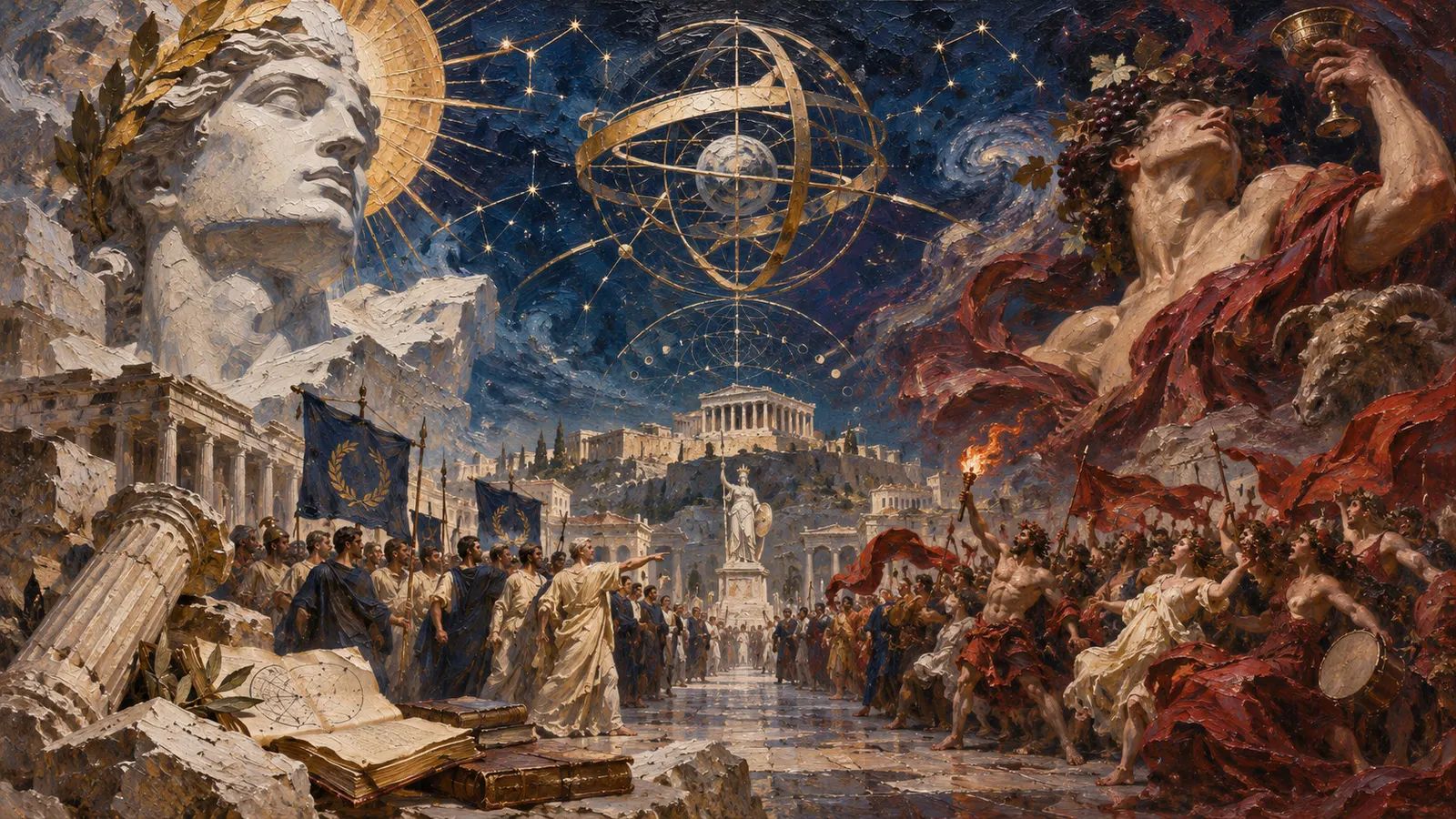
Philosophy as Cosmified Social Conflictuality (2/20)

From the Divided City to the Figures of the World: Immanence and the Aporias of the Universal
Author portrait
By Wissam Saadé
Published Nov 22, 2026 - 05:23
From Temperaments to Antagonisms: How Conflict Becomes a Problem of the World Bringing James, Neyrat and Benjamin into relation thus resolves nothing through the mere addition of perspectives. Rather, it makes a detour through Nietzsche necessary. In Beyond Good and Evil , Nietzsche suggests that the great philosophies bear, to some degree, the imprint of their authors’ involuntary confessions. His proposition does not authorize us to replace the examination of arguments with a psychological assessment of those who produce them. It shifts the question towards the values that make certain images of the world desirable, the drives that invest the categories of order, and the claim of those categories to free themselves from the conditions of their genesis. Conflict, then, is neither immediately a logical contradiction nor merely a clash of individual sensibilities: it also runs through the historical formation of the criteria by which certain things appear worthy of being known or saved. [11]
An Eye on the Event
Author portrait
By Hisham Dibsi - Published Nov 22, 2026 - 03:49
News feature image
(Photo by Sergei BOBYLYOV / POOL / AFP)
My recent visit to China was not merely an opportunity to discover a country undergoing enormous economic, urban and technological transformations. It also allowed me to observe some of the smaller details of everyday life and to try to understand the social culture and vision of the future underlying these transformations. At one point during my visit, I went to a panda park, where I witnessed the birth of panda triplets and observed the public interest generated by the event, as well as the way visitors responded to it. I was struck by the orderly way people moved around, their respect for the surroundings and nature, and their concern not to disrupt the order of the protected park. These were simple scenes, yet they revealed something about society’s relationship with public space and the organisation that makes collective life more harmonious.
Analyze
Author portrait
By Yakzan Takki - Published Nov 21, 2026 - 15:28
News feature image
In Toronto, Canada, Iranian scientist Kaveh Madani, born in Tehran in 1981, heads the United Nations University Institute for Water, Environment and Health, which coordinates research on water resources and makes policy recommendations. In 2026, he received the Stockholm Water Prize, widely regarded as the “Nobel Prize of Water,” notably for his work on the concept of “water bankruptcy,” at a time when the world is depleting its water resources faster than they can be replenished. Madani is seeking to use his position to make his voice heard within the Iranian diaspora, particularly during the war waged by the United States and Israel against Iran. He regularly speaks out on social media, where he has thousands of followers. He denounces abuses committed by the Tehran regime and draws attention to the environmental damage caused by the war in which his country is involved, including the toxic rainfall that followed missile strikes on oil depots in Tehran.
More Articles
Sort By: NewestOldest
What Is Integral Ecology, According to Pope Francis?

As Pope Leo XIV visits Lebanon — and with the 30th UN Climate Change Conference in Belém, Brazil, ending with few tangible results — it is worth revisiting the concept of « Integral Ecology », a central idea in Pope Francis’s 2015 encyclical « Laudato Si’ ». The document outlines a deeply human and inclusive vision of ecology — one that calls for both spiritual renewal and social justice. The term integral ecology reflects a holistic approach to the relationship between humankind and the environment. It promotes a worldview where environmental, social, cultural, and spiritual dimensions are inseparable. As the French Catholic Church site explains, this concept rests on “the conviction that ecological conversion is not confined to environmental issues alone” but also draws on hope, respect for all life, and a commitment to human dignity and fraternity. The Church, in this view, bears a moral responsibility for the care of Creation.

The "Gathering of Lebanese Shia" to the Pope: in favor of the State’s monopoly on weapons

The “Gathering of Lebanese Shia” sent a message to Pope Leo XIV stating that the Lebanese State’s exclusive control of weapons “is the essential foundation for building a strong and just State.” Supporting peace “in accordance with Arab initiatives and international legitimacy,” the Gathering stressed its commitment to “acting exclusively under the authority of the State and the rule of law, and to supporting everything that strengthens its presence.” The “Gathering of Lebanese Shia” brings together academics, journalists, senior professionals, and Shiite citizens known for their sovereigntist stance, fundamentally opposed to Hezbollah’s political project.

Miscount in Toynbee’s Prediction
By
Nabil Manuel Younes
Published

In 1957, the historian and philosopher of history Arnold Toynbee delivered a lecture at the Cénacle Libanais entitled « Le Liban, expression de l’Histoire ». After exploring the complexity of Lebanese history and its interactions with surrounding civilisations, and after analysing how Lebanon—owing to its geographic position and its multi-confessional composition —has long served as a meeting point as well as a battleground for competing religions and identities, Toynbee concluded his talk with a remarkably prescient warning. He said: If, in the Levant, the frontier between the two global empires—American and Russian—were to be drawn along the crest of Mount Anti-Lebanon, the Lebanese Republic would risk sharing the fate of the State of Israel. Like Israel, Lebanon would not be viable if it were to find itself in a permanent state of hostility with its neighbors to the East.

Del Toro: Exorcising the Man from His Monster
By
Michel Hajji Georgiou
Published

Is it true that a filmmaker essentially explores a single theme—or a single universe—through the whole of their work, in the sense that everything ultimately forms a coherent whole, as Jean-Luc Godard suggested? Guillermo del Toro seems to fit this theory perfectly. The Mexican director, who has just delivered (on Netflix) his own version of one of cinema's most exploited figures—Mary Shelley's Frankenstein —appears driven by a foundational, almost obsessive, even prophetic intuition that is indeed detectable throughout his entire body of work and gives him a rare coherence. For del Toro, the monster is never the monster. Deformed otherness, scarred flesh, unnatural anatomy are never synonymous with actual monstrosity in his work. Quite the opposite: in the Mexican director's vision, the monster is the most human figure of all—one bearing the weight of suffering, loneliness, rejection, humiliation, but also love. Admittedly, he is far from the first to venture onto this terrain. But in an increasingly dehumanized world, his project rings with an even more striking truth.

In Nicaea, the Pope Preaches the Creed of Christian Unity

The city of Iznik, ancient Nicaea, marked a key stop on Pope Leo XIV’s visit to Turkey, as the pontiff led a service dedicated to Christian unity on the shores of Lake Iznik, south of Istanbul. The ceremony brought together Orthodox and Protestant leaders for a prayer service among the ruins of a submerged 4th-century basilica. The Mass commemorated the 1,700th anniversary of the First Ecumenical Council of Nicaea, convened in 325, twelve years after the Roman Empire legalized Christianity. Standing beside Patriarch Bartholomew I of Constantinople and other church leaders, Pope Leo XIV recited the Nicene Creed — a statement of faith still recited by millions of Christians worldwide. The creed was first adopted at the very council that gathered in Nicaea almost 17 centuries ago.

From Leo XIII to Leo XIV (Open Letter)
By
Amine Jules Iskandar
Published

By treating borders and constitutions as sacred and untouchable, today’s Lebanese politics forget that these tools exist for one purpose: the well-being of the human person — the one Your Holiness came to listen to in their suffering. Most Holy Father, During your visit to Lebanon, a grand national scene will be prepared to show prosperity and joy, where the splendor of religious sites will outshine that of state institutions. But has Your Holiness come to see the life of palaces, or the life of a people worn down by fifty years of conflict, poverty and exodus, with no light on the horizon? Allow us, Holy Father, to share words that you will not hear in official halls. Lebanon is exhausted. No society can survive endless wars and crises by treating only the symptoms without ever diagnosing the cause. There is, undoubtedly, corruption at the national level, and the expansionist ambitions of our neighbors at the regional level. But there is also a structural problem rooted in the very formation of our state.