
Levant Time logo

Articles

News feature image
Diachronia

Philosophy as Cosmified Social Conflictuality (2/20)

From the Divided City to the Figures of the World: Immanence and the Aporias of the Universal
Author portrait
By Wissam Saadé
Published Nov 22, 2026 - 05:23
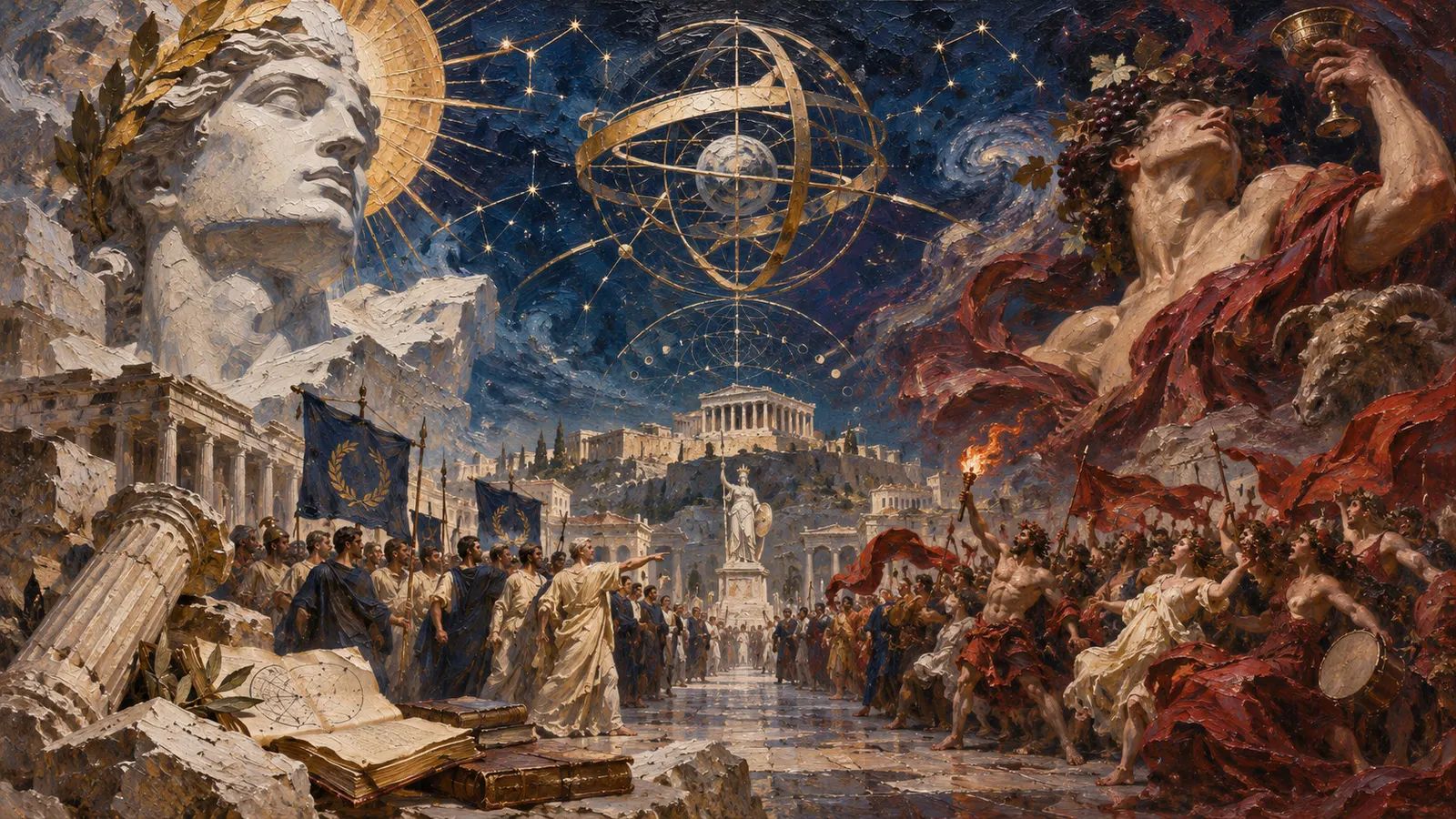
From Temperaments to Antagonisms: How Conflict Becomes a Problem of the World Bringing James, Neyrat and Benjamin into relation thus resolves nothing through the mere addition of perspectives. Rather, it makes a detour through Nietzsche necessary. In Beyond Good and Evil , Nietzsche suggests that the great philosophies bear, to some degree, the imprint of their authors’ involuntary confessions. His proposition does not authorize us to replace the examination of arguments with a psychological assessment of those who produce them. It shifts the question towards the values that make certain images of the world desirable, the drives that invest the categories of order, and the claim of those categories to free themselves from the conditions of their genesis. Conflict, then, is neither immediately a logical contradiction nor merely a clash of individual sensibilities: it also runs through the historical formation of the criteria by which certain things appear worthy of being known or saved. [11]
An Eye on the Event
Author portrait
By Hisham Dibsi - Published Nov 22, 2026 - 03:49
News feature image
(Photo by Sergei BOBYLYOV / POOL / AFP)
My recent visit to China was not merely an opportunity to discover a country undergoing enormous economic, urban and technological transformations. It also allowed me to observe some of the smaller details of everyday life and to try to understand the social culture and vision of the future underlying these transformations. At one point during my visit, I went to a panda park, where I witnessed the birth of panda triplets and observed the public interest generated by the event, as well as the way visitors responded to it. I was struck by the orderly way people moved around, their respect for the surroundings and nature, and their concern not to disrupt the order of the protected park. These were simple scenes, yet they revealed something about society’s relationship with public space and the organisation that makes collective life more harmonious.
Analyze
Author portrait
By Yakzan Takki - Published Nov 21, 2026 - 15:28
News feature image
In Toronto, Canada, Iranian scientist Kaveh Madani, born in Tehran in 1981, heads the United Nations University Institute for Water, Environment and Health, which coordinates research on water resources and makes policy recommendations. In 2026, he received the Stockholm Water Prize, widely regarded as the “Nobel Prize of Water,” notably for his work on the concept of “water bankruptcy,” at a time when the world is depleting its water resources faster than they can be replenished. Madani is seeking to use his position to make his voice heard within the Iranian diaspora, particularly during the war waged by the United States and Israel against Iran. He regularly speaks out on social media, where he has thousands of followers. He denounces abuses committed by the Tehran regime and draws attention to the environmental damage caused by the war in which his country is involved, including the toxic rainfall that followed missile strikes on oil depots in Tehran.
More Articles
Sort By: NewestOldest
The Levant in Turmoil: Iran Caught in the Tornado (3/3)

The two years following Hamas’s 7 October 2023 attack on Israel have marked a decisive turning point not only for the Levant region but for the entire Middle East. In this ongoing regional upheaval, Iran has not escaped unscathed; indeed, it has been severely affected. In a context of heightened geopolitical turbulence, the Islamic Republic of Iran now faces a dual challenge: to regain its prestige on an international level, and, simultaneously, to restructure itself internally so as to be prepared for the various scenarios that could rapidly emerge on the horizon. Bluster on the international stage is no longer an option. Iran’s dual support for the Houthis and Hezbollah, in particular, must be carefully weighed in light of the risks involved, foremost among them those posed by President Donald Trump, who, for the time being, remains the most powerful figure on the international stage. Should China – his main competitor – force him into a direct, fierce confrontation with them, one could then expect President Trump to settle any dispute in a manner that safeguards his reputation and almost unassailable position. China has no desire to intervene in a Middle Eastern powder keg; it prefers to wait for the right moment to exploit the situation to its advantage.

Open Letter to Leo XIV: Rekindling the Torch of Francis
By
Michel Hajji Georgiou
Published

Holy Father, at the moment when you are about to set foot on the soil of Lebanon and Turkey, on the threshold of this wounded Levant that was once one of the cradles of believing humanity, we dare to write to you. The aim is not to add one more voice to the concert of protocol speeches. That would be of absolutely no interest. Empty formulas, glittering but soulless, you will hear in abundance during your visit. This letter asks of you something at once simple and vertiginous: to take up the torch. The torch of Francis. That of an integral humanism which strove, against all odds, to grasp the Gospel in its most naked form: the dignity of every human being, fraternity as the only possible horizon of politics, religion freed from identitarian idols.

Bashar al-Assad Still Haunts Damascus
By
Michel Hajji Georgiou
Published

One year to the day, Bashar al-Assad collapsed, dragging down with him half a century of dynastic tyranny, disguised as modernist “secularism” and as a bulwark against chaos. Good riddance. Good riddance to a regime that turned Syrians into the raw material of an industry of terror, in the name of a pseudo-Arabism grafted onto the so-called “alliance of minorities,” alternately handed over to Iran and Russia, and, ultimately, so convenient for Israel. Good riddance to a power that transformed the Alawite community into both a human shield and a commercial asset, and that survived only by incarcerating “God Himself” in the underground hell of Saydnaya. Good riddance, too, to the comforting fiction according to which barbarism was the price to pay to avoid something far worse: chaos, Islamism, a war of all against all. Syria paid the highest price to prove that the worst option was him.

God's party must be disarmed, but above all "de-Hezbollahized"

Even under heavy bombardment, even upon being chased by Syrian revenge or international justice, Hezbollah’s zealots will never dissolve into the national melting pot. They will not behave like the partisans of the Amal Movement, who are so typically Lebanese in their flaws, their rhetoric, their compromises and convenient settlements. And there is indeed some reason for that, as our contemporary history offers a precedent that still raises doubts. No one has forgotten what happened to the Lebanese Forces upon accepting the Taif Agreement and laying down their arms. They paid the heavy price: their leader was imprisoned, and their cadres were persecuted and even liquidated.

Syria Between Challenges and Opportunities: Security, Reconstruction, and Reintegration (2/4)

In our previous article, we explored Syria’s various economic assets. Thanks to its fertile land and strategic location, Damascus holds major—yet largely untapped—economic potential. Moreover, the fall of Bashar al-Assad’s regime in December 2024, the rise of Ahmad al-Shareh to power, the lifting of U.S. and European sanctions, and the Syrian-Saudi summit held in July 2025 have launched a new dynamic of reconstruction and reintegration into the Arab sphere and international trade. But not everything is rosy in post-Assad Syria, and many challenges still lie ahead. Security The new leadership’s first and enduring challenge remains security. After more than 13 years of civil war, during which sectarian and ethnic factions fought relentlessly, the country is still plagued by sectarian-driven unrest, particularly along the coast and in Sweida. Added to this are recurring clashes along the Lebanese border with groups affiliated with Hezbollah, as well as Israeli airstrikes.

The Arab Gulf States and Their Cultural Rise
By
Micha Moussallem
Published

A quick glance at the developing cultural and artistic landscape in the Gulf countries reveals the colossal resources devoted to a wide range of often lavish and avant-garde projects aimed at promoting art and culture, on bases that may vary from one country to another. A similar enthusiasm is evident across the board, reflecting a shared desire for openness and exchange with the world of culture and art. All of these projects undoubtedly serve to promote a kind of "cultural diplomacy"—if one can call it that—and to boost the cultural influence of these countries on an international scale. However, it would be a mistake to reduce the achievements already made and those already planned to a mere marketing exercise. Beyond the somewhat grandiose scale of the projects underway, other, far more important motivations are at play.