
Levant Time logo

Articles

News feature image
Diachronia

Philosophy as Cosmified Social Conflictuality (2/20)

From the Divided City to the Figures of the World: Immanence and the Aporias of the Universal
Author portrait
By Wissam Saadé
Published Nov 22, 2026 - 05:23
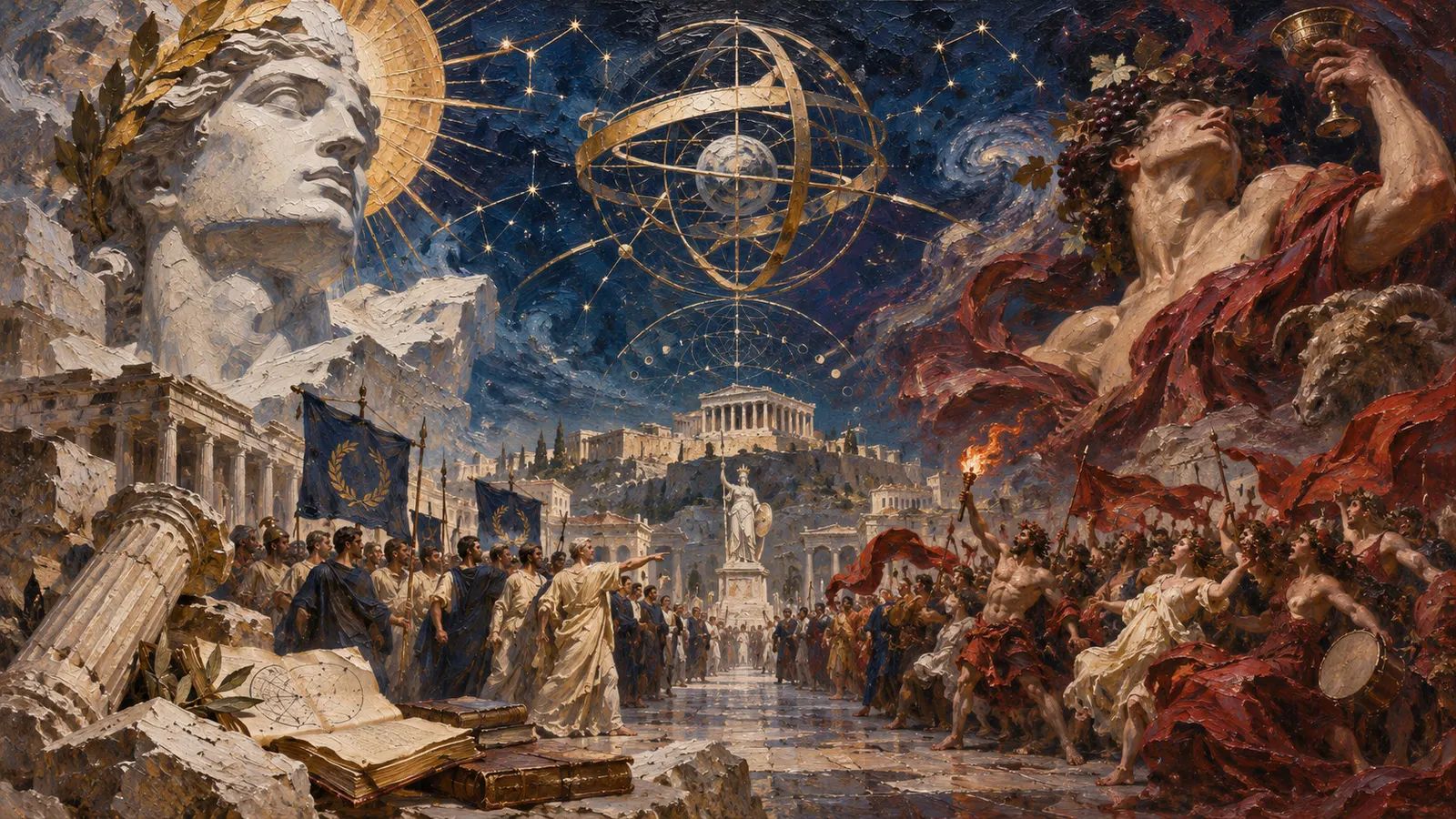
From Temperaments to Antagonisms: How Conflict Becomes a Problem of the World Bringing James, Neyrat and Benjamin into relation thus resolves nothing through the mere addition of perspectives. Rather, it makes a detour through Nietzsche necessary. In Beyond Good and Evil , Nietzsche suggests that the great philosophies bear, to some degree, the imprint of their authors’ involuntary confessions. His proposition does not authorize us to replace the examination of arguments with a psychological assessment of those who produce them. It shifts the question towards the values that make certain images of the world desirable, the drives that invest the categories of order, and the claim of those categories to free themselves from the conditions of their genesis. Conflict, then, is neither immediately a logical contradiction nor merely a clash of individual sensibilities: it also runs through the historical formation of the criteria by which certain things appear worthy of being known or saved. [11]
An Eye on the Event
Author portrait
By Hisham Dibsi - Published Nov 22, 2026 - 03:49
News feature image
(Photo by Sergei BOBYLYOV / POOL / AFP)
My recent visit to China was not merely an opportunity to discover a country undergoing enormous economic, urban and technological transformations. It also allowed me to observe some of the smaller details of everyday life and to try to understand the social culture and vision of the future underlying these transformations. At one point during my visit, I went to a panda park, where I witnessed the birth of panda triplets and observed the public interest generated by the event, as well as the way visitors responded to it. I was struck by the orderly way people moved around, their respect for the surroundings and nature, and their concern not to disrupt the order of the protected park. These were simple scenes, yet they revealed something about society’s relationship with public space and the organisation that makes collective life more harmonious.
Analyze
Author portrait
By Yakzan Takki - Published Nov 21, 2026 - 15:28
News feature image
In Toronto, Canada, Iranian scientist Kaveh Madani, born in Tehran in 1981, heads the United Nations University Institute for Water, Environment and Health, which coordinates research on water resources and makes policy recommendations. In 2026, he received the Stockholm Water Prize, widely regarded as the “Nobel Prize of Water,” notably for his work on the concept of “water bankruptcy,” at a time when the world is depleting its water resources faster than they can be replenished. Madani is seeking to use his position to make his voice heard within the Iranian diaspora, particularly during the war waged by the United States and Israel against Iran. He regularly speaks out on social media, where he has thousands of followers. He denounces abuses committed by the Tehran regime and draws attention to the environmental damage caused by the war in which his country is involved, including the toxic rainfall that followed missile strikes on oil depots in Tehran.
More Articles
Sort By: NewestOldest
The Royal Opera House Muscat, between tradition and cutting-edge technology

The Muscat Opera House is one of the most iconic landmarks in Oman. It was built in 2011 at the request of Sultan Qaboos bin Said. Great lover of art and opera, the Sultan wanted to create a cultural exchange center between Oman and the rest of the world, as well as a platform to promote both global and local artistic performances. A symbol of Oman’s cultural diplomacy since its inauguration, the Royal Opera House Muscat is an architectural masterpiece which cleverly combines the classical style of opera houses with Omani architectural tradition. It successfully blends Islamic influences with contemporary design and high-tech requirements needed for such a building.

The Papal Visit and the Israeli Threat: Between Symbolism and Realities

The visit of Pope Leo XIV to Lebanon was not merely a passing religious or pastoral stop; it was a profoundly political moment in one of the region’s most sensitive phases. A visit that carried messages to Lebanon’s domestic scene as much as it carried messages outward — specifically to Israel, and to the international powers holding the threads of the regional game. Yet the question that resonated strongly after the Pope’s departure was this: Did the visit put an end to the idea of an Israeli attack on Lebanon? The answer is not simple. Between the immense symbolic value of the visit and the cold strategic calculations along the southern border, one clear truth emerges: the visit granted Lebanon a temporary psychological and political breathing space, but it did not erase the logic of war. Still, together with the escalating French diplomatic activity and the President’s visit to the Sultanate of Oman, it helped create a new political and diplomatic deterrence network — one that may slow down a decision for war, and perhaps even redraw its terms.

Why Lebanon Urgently Needs a Comprehensive Law to Protect Women

In Lebanon, women remain acutely vulnerable to a wide range of abuses and acts of violence, largely because there is still no political will to enact meaningful legislative reform to dismantle entrenched discrimination. The figures speak for themselves: up to November 2025, 89% of all reports made to hotline 1745 – dedicated to domestic violence – came from women. In 57.5% of these cases, the aggressor was the husband. In 2024 alone, at least 17 women were killed; in 60% of those cases, the perpetrator was their spouse. Confronted with this alarming reality and staying true to its mission since its creation in 2005, Kafa – an NGO fighting gender-based violence and exploitation – is calling for the adoption of a comprehensive law, an “essential tool”, it argues, to prevent and combat this phenomenon. To highlight the urgency of such legislation, the organization launched “Ayb”, or “Shame on You”, on 25 November, marking the start of the international “Sixteen Days of Activism Against Gender-Based Violence Against Women and Girls”, which runs until 10 December, International Human Rights Day.

Syria, Between Challenges and Opportunities: commitments to large-scale investments (3/4)

In our two previous articles, we examined Syria’s various assets as well as the numerous challenges it faces. Since the fall of Bashar al-Assad’s regime, the country has entered a new era, bringing with it huge opportunities. The formation of a new government led by Ahmad al-Charaa, and Donald Trump’s announcement of the lifting of U.S. sanctions, has triggered Syria’s reconstruction. Since then, donations, investments, and capital have poured into the country. It is therefore worth looking at the sectors that would benefit most from these capital inflows and the impact they could have on Syria’s future economic development.

Môrice Awwad, the man who returned to language its maternal womb

Passing away on December 9, 2019, Môrice Awwad remains an exception in the Lebanese cultural and literary landscape. This is the portrait of a rebellious man — shortlisted in 2015 for the Nobel Prize in Literature — and of his visceral relationship with the mother tongue, the vernacular, Lebanese, which he turned into his banner, his matrix-territory, and his reason for being. Môrice Awwad was born in 1934 into a Greater Lebanon still at its first hesitant steps, yet already traversed by the tension of everything to come: independence, the golden age, then violence and the return to servitude. But it is not his birth that matters so much as the birth of language inside him. One must imagine that Awwad was immersed — almost literally — in a Lebanese linguistic placenta, strange as the image may be, in the entrails of his mother. “I remember hearing my mother cry when I was still inside her,” he would later write. From childhood on, in the house in Bsalim, a bond forms — and it will never come undone: the language of his mother — spoken Lebanese — becomes his first home. The only one that will never crack.

“Nostra aetate”: A Gesture That Says It All (2/4)

In our first article, we looked at the circumstances that gave rise to Nostra aetate , the Vatican II declaration on the Church’s relationship with non-Christian religions. Clear and precise, the text leaves nothing in the shadows and avoids a different “substitution”: replacing the Church’s mission with dialogue. But that is another story. Regarding the Jews, Nostra aetate explicitly rejects the notion of collective responsibility for Christ’s death, as some have interpreted passages of the Gospel, including the crowd’s cry: “His blood be on us and on our children!” It makes clear that “what happened during the Passion cannot be ascribed indiscriminately either to all the Jews then living, or to the Jews of today.”