
Levant Time logo

Articles

News feature image
Diachronia

Philosophy as Cosmified Social Conflictuality (2/20)

From the Divided City to the Figures of the World: Immanence and the Aporias of the Universal
Author portrait
By Wissam Saadé
Published Nov 22, 2026 - 05:23
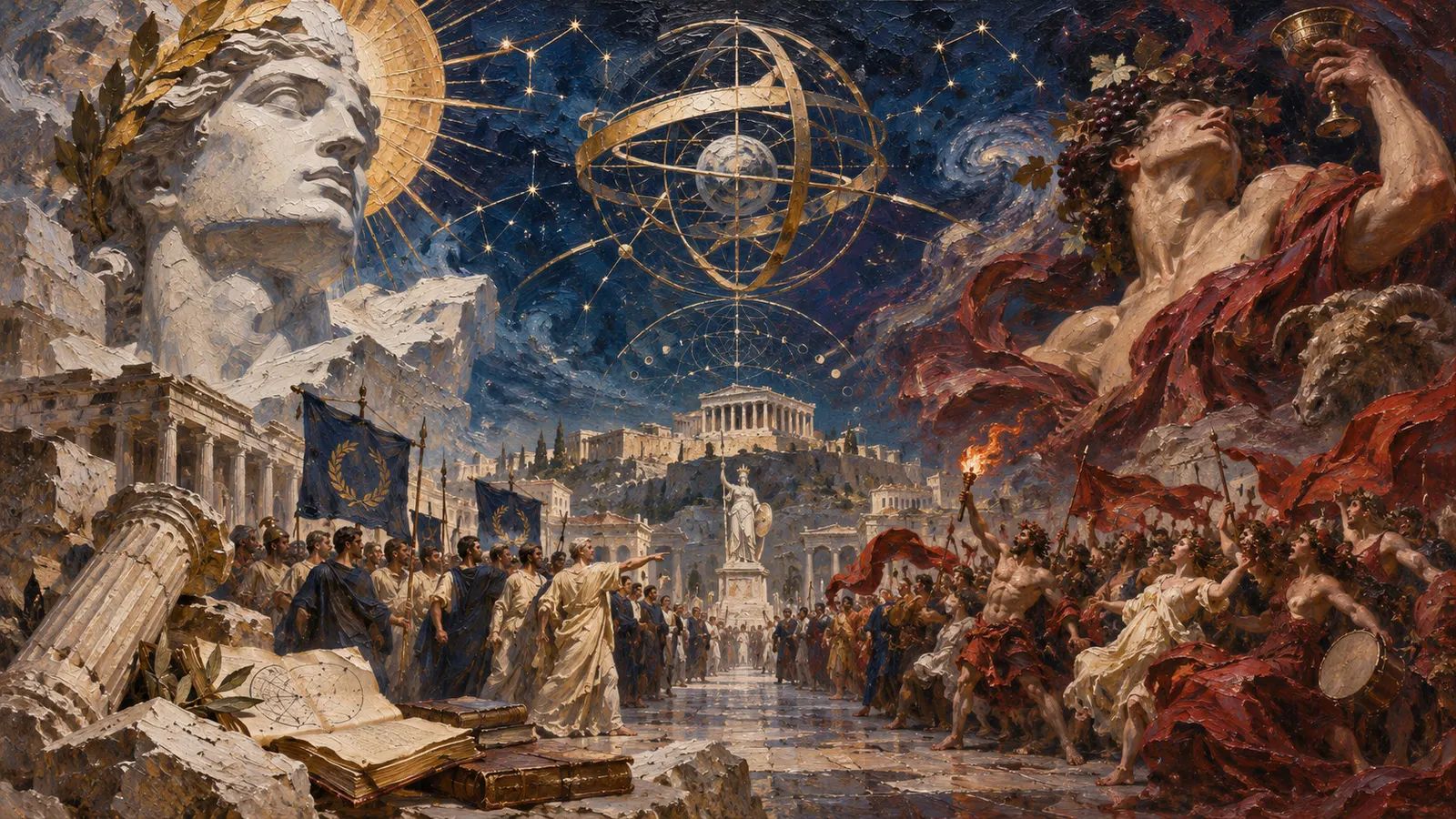
From Temperaments to Antagonisms: How Conflict Becomes a Problem of the World Bringing James, Neyrat and Benjamin into relation thus resolves nothing through the mere addition of perspectives. Rather, it makes a detour through Nietzsche necessary. In Beyond Good and Evil , Nietzsche suggests that the great philosophies bear, to some degree, the imprint of their authors’ involuntary confessions. His proposition does not authorize us to replace the examination of arguments with a psychological assessment of those who produce them. It shifts the question towards the values that make certain images of the world desirable, the drives that invest the categories of order, and the claim of those categories to free themselves from the conditions of their genesis. Conflict, then, is neither immediately a logical contradiction nor merely a clash of individual sensibilities: it also runs through the historical formation of the criteria by which certain things appear worthy of being known or saved. [11]
An Eye on the Event
Author portrait
By Hisham Dibsi - Published Nov 22, 2026 - 03:49
News feature image
(Photo by Sergei BOBYLYOV / POOL / AFP)
My recent visit to China was not merely an opportunity to discover a country undergoing enormous economic, urban and technological transformations. It also allowed me to observe some of the smaller details of everyday life and to try to understand the social culture and vision of the future underlying these transformations. At one point during my visit, I went to a panda park, where I witnessed the birth of panda triplets and observed the public interest generated by the event, as well as the way visitors responded to it. I was struck by the orderly way people moved around, their respect for the surroundings and nature, and their concern not to disrupt the order of the protected park. These were simple scenes, yet they revealed something about society’s relationship with public space and the organisation that makes collective life more harmonious.
Analyze
Author portrait
By Yakzan Takki - Published Nov 21, 2026 - 15:28
News feature image
In Toronto, Canada, Iranian scientist Kaveh Madani, born in Tehran in 1981, heads the United Nations University Institute for Water, Environment and Health, which coordinates research on water resources and makes policy recommendations. In 2026, he received the Stockholm Water Prize, widely regarded as the “Nobel Prize of Water,” notably for his work on the concept of “water bankruptcy,” at a time when the world is depleting its water resources faster than they can be replenished. Madani is seeking to use his position to make his voice heard within the Iranian diaspora, particularly during the war waged by the United States and Israel against Iran. He regularly speaks out on social media, where he has thousands of followers. He denounces abuses committed by the Tehran regime and draws attention to the environmental damage caused by the war in which his country is involved, including the toxic rainfall that followed missile strikes on oil depots in Tehran.
More Articles
Sort By: NewestOldest
Liquidity, the Fuel that Powered the Markets in 2025 (3/3)

If artificial intelligence supplied the narrative fuel for the extraordinary market performance of 2025, liquidity supplied the oxygen. And while much attention focused on the policies of Western central banks, the most persistent — and ultimately destabilising — source of global liquidity came from elsewhere: Japan. For decades, Japan was treated as an anomaly — an economy trapped in deflation, operating under its own monetary logic and largely disconnected from global cycles. In 2025, that perception proved dangerously outdated. Japan did not merely remain accommodative; it became one of the principal enablers of global risk-taking. For years, the Bank of Japan accumulated trillions of dollars’ worth of bonds and equities on its balance sheet while holding interest rates near zero.

Lebanon after the holidays: a postponed war or a suspended peace?

As the holidays come to an end, anxiety once again settles over the Lebanese, crystallizing around a question that has become existential: is Lebanon heading toward a new war, or will the country remain trapped in a fragile truce, liable to collapse at any moment? Yet this question, as crucial as it is, no longer suffices on its own. Behind it looms a deeper, more perilous one: if military initiative comes from the Israeli side, and Hezbollah has refrained from responding since the ceasefire, is this a sign of incapacity or of choice? And who, in the first place, holds the right to decide matters of war and peace in Lebanon?

2025… A Distinctly Moroccan Year
By
Khairallah Khairallah
Published

The year 2025 was distinctly Moroccan. It marked Morocco’s victory in the war it had endured for half a century, ever since it peacefully recovered its Saharan provinces from the former Spanish colonizer. Why did that war occur? And why did it continue for half a century? Why was the Algerian regime never able to acknowledge that the war of attrition it waged against Morocco, using an instrument called the Polisario, was nothing more than an overt war that would sooner or later turn against it? A series of questions reveals, among other things, Morocco’s resilience in the face of the challenges it confronted, as well as the fact that the Sahara issue has always been a national cause, one that touches every citizen of the Kingdom at the core.

Those Whom the Gods Wish to Destroy, They First Make Mad !

Who can believe that the Shiite community—especially that of South Lebanon—will withstand this perfidious war of attrition? Day after day, Israeli strikes taunt it, challenge it to retaliate, and impose a hellish pace. If, at the outset, Hezbollah’s restraint was synonymous with self-control, that is no longer the case. And the Party of God can no longer claim to be exercising self-discipline after a year of provocation. Hence the question of whether it will finally choose the path of confrontation or yield to the demands of disarmament ? Will the perseverance of the israeli army ultimately overcome the legendary patience of civilians? For discontent is rising among an exasperated Twelver population. Worked up to a fever pitch, it sees no way out of this conflict, nor any benefit in it. And who could still deceive it when the evidence is so clear: the day after October 7, it was sacrificed on the altar of Palestine, and now, a year later, it is immolated on the altar of Iran’s nuclear ambitions.

AI: The Technological Revolution That Powered the Markets in 2025 (2/3)

No single force shaped the trajectory of financial markets in 2025 more decisively than artificial intelligence. AI became the dominant narrative through which investors justified elevated valuations, extreme concentration, and rising risk-taking. It offered a forward-looking story powerful enough to neutralise concerns about slowing growth, mounting debt, and geopolitical fragmentation. At its core, AI is a genuine technological revolution — a productivity leap comparable to electrification or the internet — and it is already reshaping entire industries. But financial markets do not price long-term societal benefits; they price microeconomic realities: corporate cash flows, capital intensity, and sustainability. It is at this level that a growing disconnect emerged.

The National Museum of Beirut, Against All Odds
By
Micha Moussallem
Published

The survival of the National Museum of Lebanon is a miracle. Located on the demarcation line that divided the capital between the warring parties, the building was the target of gunfire and shells. But the country's main archaeological museum, which houses exceptional collections ranging from prehistory to the Mamluk period, was able to be reborn just after the war. The museum’s construction The idea for the museum emerged in the early 20th century, when plans were made to bring together in one place the collection of Raymond Weill, a French officer stationed in Lebanon. The building was constructed between 1930 and 1937 during the French Mandate, thanks to the efforts of the Friends of the Museum Committee led by Bechara El Khoury, then Prime Minister and Minister of Education. It was officially inaugurated on May 27 1942, following the designs of architects Antoine Nahas and Pierre Leprince Ringuet, in a monumental ochre-stone style inspired by antiquity.