
Levant Time logo

Articles

News feature image
Diachronia

Philosophy as Cosmified Social Conflictuality (2/20)

From the Divided City to the Figures of the World: Immanence and the Aporias of the Universal
Author portrait
By Wissam Saadé
Published Nov 22, 2026 - 05:23
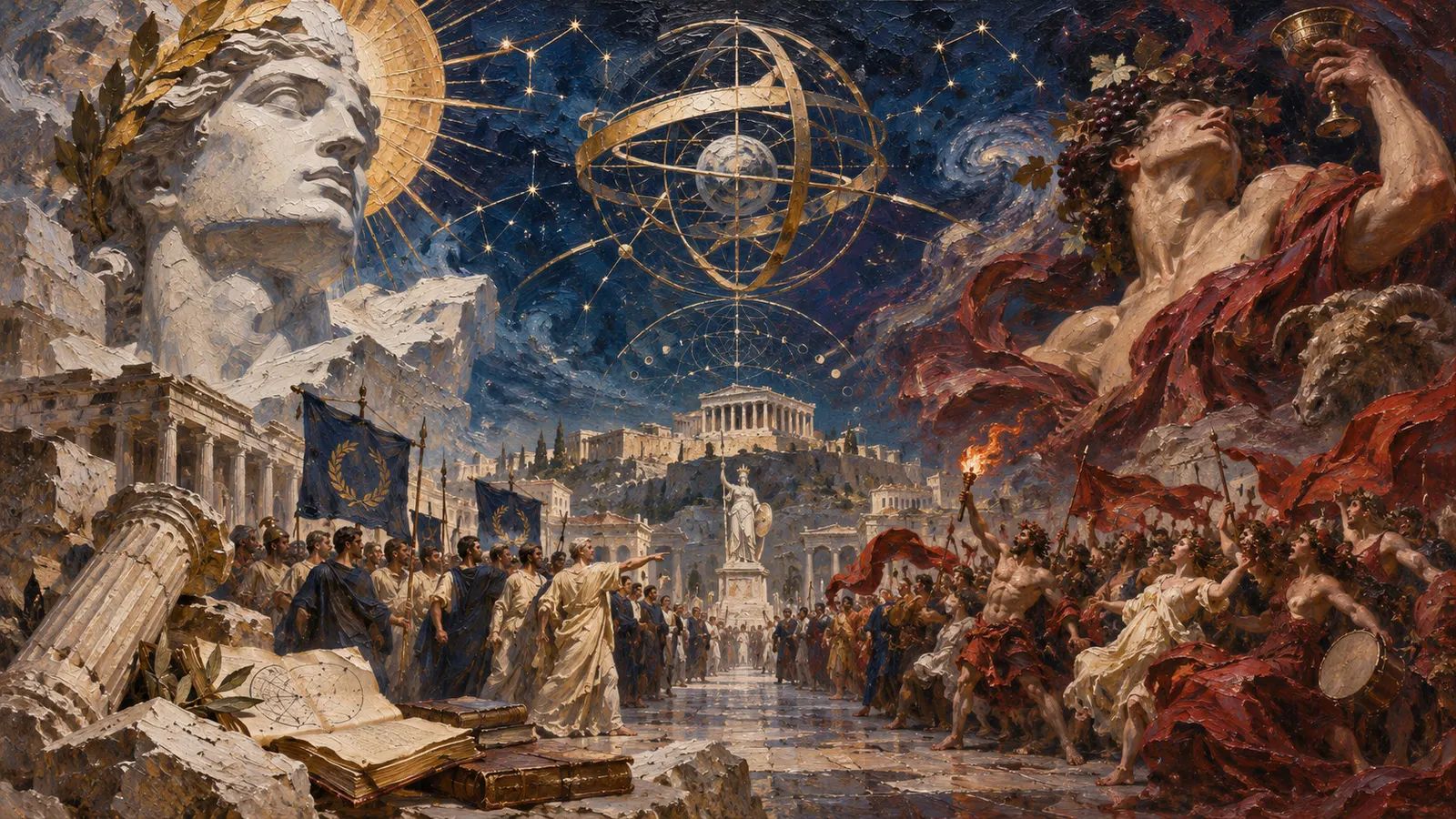
From Temperaments to Antagonisms: How Conflict Becomes a Problem of the World Bringing James, Neyrat and Benjamin into relation thus resolves nothing through the mere addition of perspectives. Rather, it makes a detour through Nietzsche necessary. In Beyond Good and Evil , Nietzsche suggests that the great philosophies bear, to some degree, the imprint of their authors’ involuntary confessions. His proposition does not authorize us to replace the examination of arguments with a psychological assessment of those who produce them. It shifts the question towards the values that make certain images of the world desirable, the drives that invest the categories of order, and the claim of those categories to free themselves from the conditions of their genesis. Conflict, then, is neither immediately a logical contradiction nor merely a clash of individual sensibilities: it also runs through the historical formation of the criteria by which certain things appear worthy of being known or saved. [11]
An Eye on the Event
Author portrait
By Hisham Dibsi - Published Nov 22, 2026 - 03:49
News feature image
(Photo by Sergei BOBYLYOV / POOL / AFP)
My recent visit to China was not merely an opportunity to discover a country undergoing enormous economic, urban and technological transformations. It also allowed me to observe some of the smaller details of everyday life and to try to understand the social culture and vision of the future underlying these transformations. At one point during my visit, I went to a panda park, where I witnessed the birth of panda triplets and observed the public interest generated by the event, as well as the way visitors responded to it. I was struck by the orderly way people moved around, their respect for the surroundings and nature, and their concern not to disrupt the order of the protected park. These were simple scenes, yet they revealed something about society’s relationship with public space and the organisation that makes collective life more harmonious.
Analyze
Author portrait
By Yakzan Takki - Published Nov 21, 2026 - 15:28
News feature image
In Toronto, Canada, Iranian scientist Kaveh Madani, born in Tehran in 1981, heads the United Nations University Institute for Water, Environment and Health, which coordinates research on water resources and makes policy recommendations. In 2026, he received the Stockholm Water Prize, widely regarded as the “Nobel Prize of Water,” notably for his work on the concept of “water bankruptcy,” at a time when the world is depleting its water resources faster than they can be replenished. Madani is seeking to use his position to make his voice heard within the Iranian diaspora, particularly during the war waged by the United States and Israel against Iran. He regularly speaks out on social media, where he has thousands of followers. He denounces abuses committed by the Tehran regime and draws attention to the environmental damage caused by the war in which his country is involved, including the toxic rainfall that followed missile strikes on oil depots in Tehran.
More Articles
Sort By: NewestOldest
Freedoms: The Soul of the Republic
By
Michel Hajji Georgiou
Published

Probably the most overused concept in Lebanon, freedom is nevertheless neither a luxury nor a slogan. It is our very condition of possibility—the discreet breath that has allowed this improbable country to stand upright between sea and mountains, between languages, rites, memories, and wounds. Without it, only a fractured territory of armed tribes remains. With it, Lebanon becomes a space—fragile, conflict-ridden, yet alive—where an attempt is still made to allow worlds that elsewhere turn their backs on one another to coexist. Today, that freedom is under threat. Everywhere. On one side, it is undermined by real or self-proclaimed “minorities” who, in the name of legitimate recognition, slide toward the outright negation of the other—toward cancel culture, the policing of words, works, and nuance. Emancipation then turns into a permanent tribunal, debate into an inquisition, criticism into blasphemy. On the other side, freedom is besieged by populisms, fundamentalisms, and authoritarian nationalisms bearing names such as Trump, Putin, Orbán, and their local avatars—cardboard strongmen who promise order and deliver only fear.

An Israel–Greece–Cyprus Front Against Turkish Influence

The signing of a trilateral military cooperation plan between Israel, Greece, and Cyprus for 2026 marks a significant step in consolidating a security axis in the Eastern Mediterranean. Officially, the agreement, disclosed last Sunday by the Israeli army, provides for reinforced joint exercises, cross-training, and strategic military dialogue. But beyond its technical framework, it is part of a broader logic of collective deterrence, in a context of Turkey's rising military, diplomatic, and maritime power, particularly around exclusive economic zones, energy routes, and disputed airspaces. The project, discussed for several months, to establish a rapid reaction force - non-permanent but quickly deployable on land, at sea, and in the air - illustrates a major doctrinal evolution. It is no longer just about punctual or bilateral cooperations, but rather the progressive construction of a credible multinational operational capability. In a region marked by the war in Gaza, Syrian instability, persistent tensions in Lebanon, and competition over gas resources, this approach aims as much to prevent crises as to respond to them.

The Gulf States: Seeking a very specific power (3/3)
By
Jean-Patrick Dayras
Published

The Gulf States have emerged and become rich, certainly, thanks to the exploitation of their resources, but they have carried out, through rapidly crossed stages, a true cybernetic conversion that amounts to a revolution in the proper sense. The era of soft power in which they engaged was achieved through reorientations, observations, transformations, and adaptations, thanks to which they became a regional power. They subsequently expanded their capabilities and developed their multi-service area of action, which conferred upon them a global status. But these states did not want to stop there. The dynamism that allowed them to achieve their sought-after goals did not stop at this stage. The will and energy that characterized all these existential transformations led them to board the train configuring a new world, that of networks, data, their processing and management: the world of flows, connectivity, and also of space. They are becoming important actors in the new globalization scheme; they are at the « smart power » stage.

Happy New Year 2026!
By
Jawad Pakradouni
Published

Dear fellow citizens, On Thursday, January 1st, 2026, Lebanon will be transfigured! Electricity will run 24/7, without generators or parallel subscriptions. All wrongdoers and the corrupt will be tried, from the smallest sparrow to the old crow, no matter how high its perch. The State will function— function in the true sense of the word, not extract . A State where the basic services of the Republic will be efficient rather than inoperative. At the same time, the remote pilots of the MKs will be technically unemployed, given that Hezbollah will be demilitarized north, east, and west of the Litani. The big Question—with a capital Q—is: how does this happen (even if on January 1st your head is still buried in the letter or the verb)?

Why is Israel betting on Somaliland?
By
LevantTime .
Published

Somaliland's official recognition by Israel, announced last Friday by Benjamin Netanyahu, offers a new perspective on Red Sea security, the stability of the Horn of Africa, and global geopolitical balances. While the Israeli government intends to capitalize on the positive outcomes of its diplomacy, opinions diverge within the Hebrew State and worldwide. The territory of Somaliland, located in northwest Somalia, covers 175,000 km² and is populated by approximately five million inhabitants. It corresponds to the former colony of British Somaliland, while Italy had occupied the rest of the country.

Al-Qard Al-Hassan Operates in a Legal Grey Zone

Al-Qard Al-Hassan, formally registered as a charitable association, has increasingly assumed the role of a parallel financial institution in Lebanon since the country’s economic collapse began in late 2019. As the banking sector imploded and depositors lost access to their savings, the organisation stepped into an institutional vacuum. While its services address real needs in a context of state and financial failure, its growing footprint raises serious legal and systemic concerns. Founded during Israel’s 1982 invasion of Lebanon, Al-Qard Al-Hassan was registered in 1987 with the Ministry of Interior as a non-profit association. It remains legally governed by the 1909 Ottoman Law on Associations, which restricts activities to non-commercial, non-profit purposes. Yet in practice, the organisation regularly grants loans and manages gold-backed guarantees—activities that go well beyond its declared legal mandate.