
Levant Time logo

Articles

News feature image
Diachronia

Philosophy as Cosmified Social Conflictuality (2/20)

From the Divided City to the Figures of the World: Immanence and the Aporias of the Universal
Author portrait
By Wissam Saadé
Published Nov 22, 2026 - 05:23
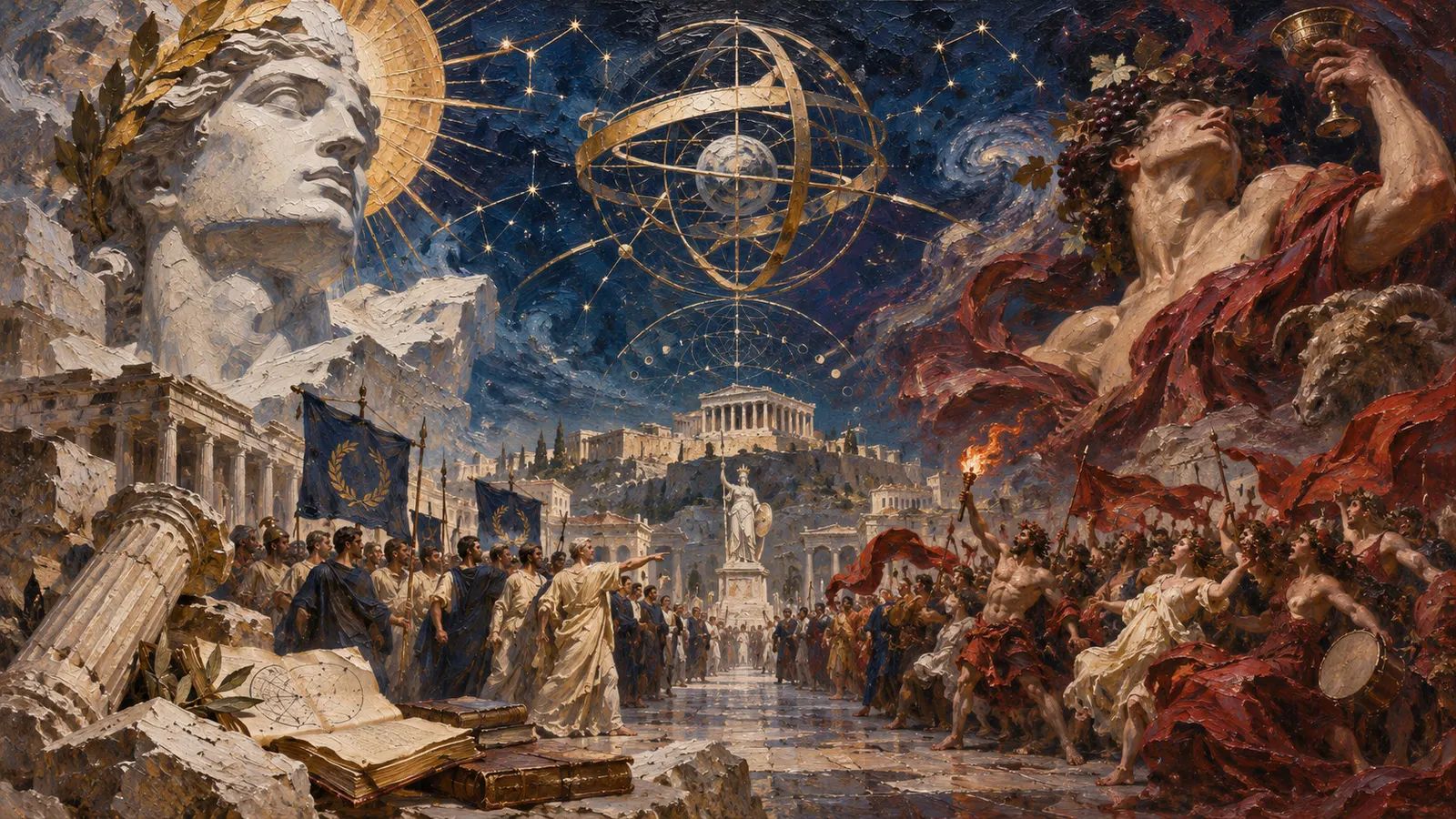
From Temperaments to Antagonisms: How Conflict Becomes a Problem of the World Bringing James, Neyrat and Benjamin into relation thus resolves nothing through the mere addition of perspectives. Rather, it makes a detour through Nietzsche necessary. In Beyond Good and Evil , Nietzsche suggests that the great philosophies bear, to some degree, the imprint of their authors’ involuntary confessions. His proposition does not authorize us to replace the examination of arguments with a psychological assessment of those who produce them. It shifts the question towards the values that make certain images of the world desirable, the drives that invest the categories of order, and the claim of those categories to free themselves from the conditions of their genesis. Conflict, then, is neither immediately a logical contradiction nor merely a clash of individual sensibilities: it also runs through the historical formation of the criteria by which certain things appear worthy of being known or saved. [11]
An Eye on the Event
Author portrait
By Hisham Dibsi - Published Nov 22, 2026 - 03:49
News feature image
(Photo by Sergei BOBYLYOV / POOL / AFP)
My recent visit to China was not merely an opportunity to discover a country undergoing enormous economic, urban and technological transformations. It also allowed me to observe some of the smaller details of everyday life and to try to understand the social culture and vision of the future underlying these transformations. At one point during my visit, I went to a panda park, where I witnessed the birth of panda triplets and observed the public interest generated by the event, as well as the way visitors responded to it. I was struck by the orderly way people moved around, their respect for the surroundings and nature, and their concern not to disrupt the order of the protected park. These were simple scenes, yet they revealed something about society’s relationship with public space and the organisation that makes collective life more harmonious.
Analyze
Author portrait
By Yakzan Takki - Published Nov 21, 2026 - 15:28
News feature image
In Toronto, Canada, Iranian scientist Kaveh Madani, born in Tehran in 1981, heads the United Nations University Institute for Water, Environment and Health, which coordinates research on water resources and makes policy recommendations. In 2026, he received the Stockholm Water Prize, widely regarded as the “Nobel Prize of Water,” notably for his work on the concept of “water bankruptcy,” at a time when the world is depleting its water resources faster than they can be replenished. Madani is seeking to use his position to make his voice heard within the Iranian diaspora, particularly during the war waged by the United States and Israel against Iran. He regularly speaks out on social media, where he has thousands of followers. He denounces abuses committed by the Tehran regime and draws attention to the environmental damage caused by the war in which his country is involved, including the toxic rainfall that followed missile strikes on oil depots in Tehran.
More Articles
Sort By: NewestOldest
Palestine: a peace hijacked by extremes
By
Michel Hajji Georgiou
Published

Contrary to popular belief, the Palestinian question is not trapped in a stalemate by historical inevitability, nor by an irreconcilable, atavistic hatred. It is methodically neutralized by a convergence of interests between extremes who, while clashing in bloodshed, share a common obsession: preventing the emergence of a political solution based on mutual recognition and equal rights. On one side, an Israeli power captive to an absolute security logic, transformed over the years into a governing ideology. On the other, Islamist movements that thrive on the collapse of politics, the sacralization of violence, and the hijacking of the Palestinian cause for the benefit of regional agendas. Caught in the middle, a population held hostage, and a prospect of peace deliberately sabotaged.

Christmas Tale: the Two-State Solution and the Star of Hope

It is said that one night, when the sands once crossed by the Magi seemed weary of having witnessed so many footsteps passing without ever meeting, a new star began to shine brighter than all the others. Those who were most attentive lifted their heads and sighed as they searched the sky, sensing that something new and mysterious, born of the Great Unknown, was making itself known. The star did not appear over an untouched land. It shone above a Middle East scarred by walls, checkpoints, ruins, conflicting prayers, and thousands of dead, widows, and orphans. At the same moment, in a narrow street of Bethlehem, a family was setting up a small nativity scene in front of their home. Nothing elaborate: burlap salvaged from a rice sack, a few battered plastic figurines, a baby Jesus wrapped in yellowed cloth, sheep without shepherds, and a Virgin Mary and Saint Joseph with faded colors. A boy asked his father:

Financial Markets in 2025: A Year that Defies Economic Gravity (1/3)

As Santa prepares to make his annual descent down chimneys around the world and 2025 draws to a close, global financial markets present a picture that would have seemed implausible — if not outright impossible — at the beginning of the year. Most major equity indices are ending the year at, or near, all-time highs, marking a third consecutive year of exceptional performance. In the United States, the benchmark S&P 500 Index is up approximately 17% at the time of writing, following gains of 23% in 2024 and 24% in 2023. This represents a cumulative advance of roughly 77% over three years — and an extraordinary rise of more than 1,000% since the beginning of the secular bull market in March 2009.

Christmas and the Price of Redemption
By
Michel Hajji Georgiou
Published

The meaning of Christmas challenges us more than ever, in a world that is increasingly fragmented, increasingly “nihilistic” — in the existential sense. Beyond its commercial and festive character, or even its spiritual and religious dimension, Christmas is, in principle, a hand extended toward humanity in all its flaws, its inequities, its imperfections. Without distinction. This is not about engaging in supermarket morality, nor in secularized spiritualism, but about sincerely questioning what this moment signifies, beyond immediate experience — beyond that delightful synesthesia of lights, songs, and flavors, or the joy of gifts reflected in the innocent eyes of young children.

Al-Qard Al-Hassan reportedly initiated a «post-liquidation» phase

Under the effect of American sanctions, restrictions imposed by the Banque du Liban, and losses sustained during the last war with Israel, Hezbollah has sought to reconfigure its main financial arm, Al-Qard Al-Hassan. This “repositioning,” presented as “legal,” aims to preserve its grip on the parallel economy and its social base. Founded in 1982, the Qard Al-Hassan association operates outside the legal banking framework. Iranian funds initially contributed to the association's capital. These were supplemented by Lebanese capital, particularly from entrepreneurs in Africa, over several years. According to the US Treasury Department, which listed Qard Al-Hassan in 2007 on its list of sanctioned entities and then strengthened these sanctions in 2021, this association manages financial volumes comparable to those of a medium-sized bank, while escaping all official supervision.

“The Iranian Empire”: Israel and the Alliance of Minorities, a Paradoxical Stability (5/5)

It seems necessary to dwell for a moment on the insidious game played by Israel, acting as a puppet master, in the context of the geostrategic ambitions of the Iranian Islamic Republic. For half a century, Tel Aviv found in the “alliance of minorities” (Alawites, Christians, Druze, Lebanese Shiites, Kurds) a geopolitical buffer against the Sunni hinterland. The Israeli «periphery doctrine» (1950s-70s) was indeed based on an axiom: ally with minorities to break the Sunni encirclement. In this context, the Alawite regimes in Damascus — Hafez and then Bashar al-Assad — were declared but predictable enemies; ideologically stable; obsessed with their internal survival; and perfectly dissuadable. Israel preferred a cynical and rational Assad to a nationalist or Islamist Sunni Syria. And the Western world, both the United States and European countries, followed suit with the Hebrew state, purely out of utilitarianism. The henchmen of the Assad regime rendered so many good and loyal services to European intelligence agencies over the past four decades… why get rid of such an accommodating enemy?