


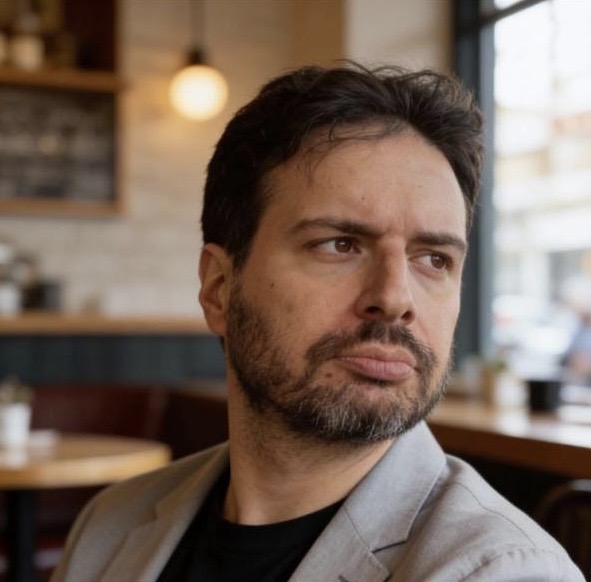
Passing away on December 9, 2019, Môrice Awwad remains an exception in the Lebanese cultural and literary landscape. This is the portrait of a rebellious man — shortlisted in 2015 for the Nobel Prize in Literature — and of his visceral relationship with the mother tongue, the vernacular, Lebanese, which he turned into his banner, his matrix-territory, and his reason for being.
Môrice Awwad was born in 1934 into a Greater Lebanon still at its first hesitant steps, yet already traversed by the tension of everything to come: independence, the golden age, then violence and the return to servitude.
But it is not his birth that matters so much as the birth of language inside him. One must imagine that Awwad was immersed — almost literally — in a Lebanese linguistic placenta, strange as the image may be, in the entrails of his mother. “I remember hearing my mother cry when I was still inside her,” he would later write. From childhood on, in the house in Bsalim, a bond forms — and it will never come undone: the language of his mother — spoken Lebanese — becomes his first home. The only one that will never crack.
“My language is my mother’s language,” he said. And it was no slogan. The language inherited from the maternal figure was a physical truth, an incorporated memory, a fidelity preceding any act of will. The mother tongue is, in some sense, the Lacanian mirror stage that gives the child its first awareness of self. All the more so since the father figure is absent. There is a foreclosure of the Name-of-the-Father — violent and absent — pushed to its extreme, such that Môrice, born Khoury, “adopted” the name Awwad until his death, and even further, twisting it into Môrice Kfargharib. The father’s name replaced by the name of uprootedness, of the foreigner. The vernacular axis will remain intact until the end — and in this context one better understands the desire to territorialize language as an anchoring point so as not to dissolve.
His entire existence — the Ghazir seminary, returns to the village, years in printing presses, French readings, religious hesitations, assumed poverty, nights of writing — orbits around this single center of gravity: never abandoning the first language, the one given in a gesture of tenderness and necessity.
To write, for Awwad, is not to separate verb from body: “When I write, I caress a body,” he said. And that body is always the same: the mother-language.
The language-matrix: the place before language
Everyone talks about the “Lebanese dialect.” Not Môrice Awwad, who speaks instead of a womb.
He does not see Lebanese as an inferior speech, but as a matrix, a birthplace, a space where something begins anew with each syllable. The qāf becomes a hamza — as though he wished to amputate the word of an oppressive, outdated figure — the father? The final h disappears because it never breathed in the houses. Rules give way to breath. None of this is a linguistic bricolage born of chauvinistic narcissism. It is a return to origins — to the language before grammar, before separation, before school, before the State.
When he translates The Little Prince or the New Testament, Awwad does not “vulgarize.” The process is one of integration, of reincarnation into the national uterus. He gives the text a grain, a warmth, a tremor, and brings the word back to the place where it becomes flesh. Leonard Cohen sang: “Show me the place where the Word became a man,” with its double spiritual and erotic resonance. Awwad does not even need to be shown the place of creation. He knows it. He lived there for nine months before breathing. And he offered it the Word.
The “naquis” of language: tradition, rupture, continuity
Môrice Awwad moves between several worlds: Levantine oral tradition, Christian thought, classical Arabic poetry, Latin and French influences, the traces of war. He refuses to choose: he carries them all. In this sense, his thought is not “separatist,” not enclosed within the illness of identitarian narcissism. If it were, he would remain entirely foreign to the infinite spaces that refuse all enclosure — the spaces of poetry-freedom. But he never yields on the essential: neither classical Arabic nor literary French can express what only the matrix-language knows how to say. He remains a poet-passer, but also a poet-insurgent: he refuses that Lebanese be relegated to folkloric ornament; he rejects the idea that only sacred languages can carry the universal. He forges a modernity that does not declare itself — it writes itself within tradition. His work does not balance two poles: it resolves an inner conflict. The mother-language triumphs over the school-language.
The total coherence: language, homeland, combat
In Môrice Awwad, everything holds together. The man may appear theatrical, even eccentric in his flair for panache, his excessive eroticization of the Word, his persona of a wild poet. Yet he is perfectly coherent. There is not poetry on one side and engagement on the other. The same language serves to write a love poem, denounce an injustice, and say “Lebanon.” Eroticism transmutes, when the moment requires it, into patriotic songs, and he finds himself engaged in struggles for sovereignty, liberty, and human rights — but never as a follower. Rather from the deep conviction that defending the matrix-language is necessarily defending the motherland and the mother-territory. One might even say he ends up eroticizing them both.
His place within the engaged Lebanese intellectual lineage appears precisely here: at the crossroads between Kamal Al-Hage and Said Aql. With Aql, he shares the audacity of extracting Lebanese from its subordinate status, without falling into ideological excess. With Al-Hage, he shares the idea that language is an ontological pillar. But here their paths diverge. Al-Hage, a disciple of Bergson, despite his “Lebanist nationalism,” remained faithful, until his assassination, to Arabic as an essential philosophical language, bearer of duration, becoming, and spiritual mission. Awwad crosses the threshold the philosopher did not: he leaves behind the inherited language to embrace the real territory, the one spoken in the villages, in the kitchens, in the mouths of mothers. Where Al-Hage inscribes Lebanon in the metaphysics of Arabic, Awwad inscribes it in the living matter of Lebanese. It is no longer theory or spirit, but body and flesh. The first spiritualizes the nation; the second incarnates it. The first writes for consciousness; the second for breath.
Awwad pushes Lebanese nationalism to its most radical conclusion: the country is not a concept — it is a language that comes from the womb.
Kazantzakis and the fraternity of womb-languages
This matricial gesture draws Môrice Awwad close to a discreet constellation of writers who understood that poetry begins when language consents to become flesh again. Kazantzakis liberating the demotiki, Lorca bringing Castilian back to the Andalusian duende, Joyce fracturing English to let Dublin seep through, Pasolini elevating Romanesco to epic stature, Darwish breathing the village back into classical Arabic, Theodorakis revitalizing the rembetiko in Greece under the colonels. All did, in their respective worlds, what Awwad does in Lebanon: they returned to language its womb, its night, its grain, its wound. Their works, so different, share the same conviction: a language lives only when it returns to the one — or the place — that engendered it.
The mother-language, the school-language: a Lacanian reading
In a seemingly simple phrase, Môrice Awwad reveals his entire inner mechanism: “Lebanese is the mother’s language; classical Arabic is the language of schools.” In other words, the first heals and envelops: it is love, tenderness, warmth. The second corrects, disciplines, imprisons in a mental lattice. The Lebanese language is freedom and life as one emerges from the womb; Arabic is a cold, soulless boarding school.
In Lacanian terms, this is lalangue: the bath of signifiers where meaning has not yet separated from the body. Awwad says it, in his disarming audacity, in his own way: My hand is immersed in the Lebanese language like an embryo in its mother’s womb. How many writers have had the courage to probe their soul deeply enough to restore the language to such amniotic intimacy? And when he confesses having cried only twice — at his mother’s death and at Assi Rahbani’s — he spontaneously links the two matrices of his life: the biological one and the musical one of the country. Roland Barthes would have recognized in this the grain of the voice: not the word, but its density.
The work: engendering Lebanon in its language
The 57 books — poetry, theater, novels, translations, liturgy — that Môrice Awwad leaves behind, as the testament of his mother-work, are less genres than returns. Each text brings something back to the first world, to the first voice. To translate the New Testament into Lebanese is to say: the Word must become voice before becoming concept. To Lebanese-ize The Little Prince is to ask the world to begin again in the mouth of a child from here. The poet does not seek universality; he creates it through fidelity to the most intimate local root: the oldest womb.
The poet of the matrix
Despite appearances, Môrice Awwad did not seek to give Lebanon a new language. His path is not identitarian. It is not, strictly speaking, political. Awwad merely returned language to the entrails of the land — of his mother, whether of flesh or of limestone. He returned to language a womb-earth. Or, more exactly, a place of origin. A reason to survive in a regional environment perceived as desert-like, cold, synonymous with death, the opposite of the placenta of life.
In a country where everything increasingly decomposes — borders, institutions, identities, and above all culture — Awwad reminds us that the only thing that does not collapse is that which returns to the beginning: the mother-language. That which distinguishes us. That which identifies us.
In this sense, Môrice Awwad’s struggle was not linguistic. It was vital. A country may lose its sovereignty, its parties, its armies, its symbols, its dreams and illusions, even its bearings. But it survives only if it keeps its matrix-language.
And this is why, even today, he remains what he always was: the man who returned to language its maternal womb.
Lionel Messi or the Re-enchantment of the World
Hassan Rifai, the Wise Rebel
Samir Kassir: Those Absences That Haunt Us
To My Brother Nassir al-Assaad
The Troubling Testament of Ghassibé Keyrouz, Right-Hand Man of Nicolas Kluiters, SJ (3/3)bla
المزيد من Michel Hajji Georgiou
عرض الكل


المزيد في Homage
عرض الكل


الأحدث من Levant Time
عرض الكل


