

The Dream and the Tomb: A Journey to the Land of the Wayuu (1/2)
The Wayuu are a cross-border indigenous nation inhabiting the region spanning the La Guajira Peninsula, at the northernmost tip of Colombia, and part of Venezuela's Caribbean coast. The Wayuu take great pride in their title as the "never conquered people." What follows is an account of a desert crossing made alongside them during Easter 2026 — an opportunity to share certain aspects of their philosophy of travel.
Many people in Colombia are quick to label the Wayuu a "very closed" people. By that they mean a culture that is deeply resistant to the arrival of outsiders on the community's ancestral territory. Their highly traditional customs are said to defy, in an archaic and violent way, the progressive advances of modern law. "You'll see," a Spanish colleague who had visited Wayuu territory told me,"I've never seen people so rough and violent — people who practice an eye for an eye and put children to work in absolute poverty at roadside checkpoints." This kind of remark carries an implicit indictment of the "noble savage" myth: don't expect to find in the Wayuu the original goodness of humankind. But then, who ever said we should aspire to find a perfect model when it comes to human societies?
I had a privileged connection with Paola, from the Uliana clan — a Wayuu psychologist and educator. After two years of regular exchanges during which she taught me the basics of Wayuunaiki, Paola urged me to come and discover her homeland of La Guajira.Terechija pia püntapa yamüin, "I'll be waiting for you here", she had told me. A short stay came together, and through Paola's friendship and guidance, it allowed me to glimpse certain features of the mindset and psychology — if such terms can even apply here — of a people long referred to asguajiro in Spanish colonial chronicles.
I am neither an anthropologist, nor a psychologist, nor a historian; yet I will try, by drawing directly on the words of the Wayuu themselves, to share certain aspects of their culture that deserve to be better known — at a time when ideas around identity, memory, territory, and justice seem to be set in stone. These are notions that, in various parts of the world, are fueling a very real necropolitics.
A people open to the world?
The Wayuu are the first to proudly claim their title as a people "never subjugated" by the Spanish during the Conquest. And the chronicles of the era do indeed describe them as "savages," "scoundrels," and "rebels" on the fringes of the new imperial order — terms that, in the colonial pen, were used to designate those who had wounded the hidalgo honor of the conquistadors by resisting them.
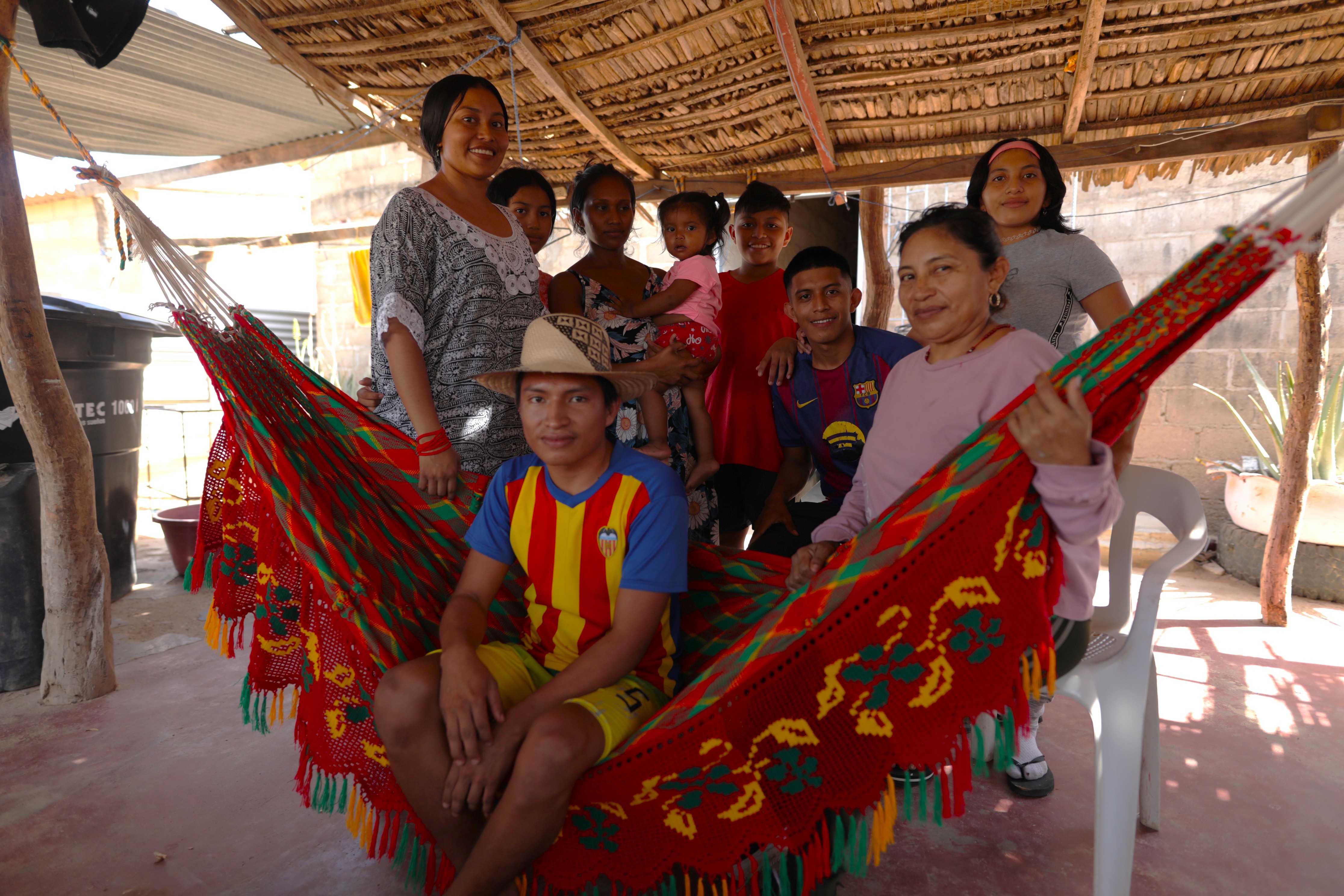
Paola's family.
"The alijunas (here, the Spanish) could do nothing against us", Paola told me as we crossed the desert on motorcycles alongside her brother Joheinner, "they came, but we were armed with fearsome poisoned arrows." She also told me, later on:"The Wayuu, and the Uliana in particular, are known for their friendliness and generosity. But if they feel threatened, they become aggressive."
One might therefore assume that cultural contact and intermingling among the Wayuu were almost nonexistent, thanks to their formidable warrior qualities. Moreover, the newcomers of the 16th and 17th centuries struggled to penetrate the arid landscape of this Caribbean refuge that the La Guajira Peninsula represented. As a result, after the arrival of the Europeans, the Wayuu drew a clear line between themselves and the Other — or rather, all others. Even the name they call themselves, Wayuu, means "the People" or "the Human Beings," a deeply human tradition well described by Claude Lévi-Strauss in his reflections on barbarism.
Paola explained to me:«In the Wayuunaiki language, the term alijuna means 'one who strikes hard.' It was originally applied only to the conquistadors because of their violence. Today, it simply refers to all non-Wayuu people: other First Nations, Afro-descendants, other mestizo Colombians, tourists, foreigners — everyone who is not Wayuu.»
Based solely on colonial accounts, the Wayuu might give the impression of being completely cut off from world affairs and particularly insular. Yet this apparent parochialism doesn't capture their true reality. Nothing is more foreign to the Wayuu than the idea of permanence.
Diplomatic sophistication
The Wayuu travel — and they travel far. For centuries, they were semi-nomadic, moving between the northern and southern parts of their peninsula according to the seasons and the resources each region had to offer. Likewise, after adopting a certain model of cattle herding, they constantly sought out greener pastures for their modest herds through small-scale transhumance. One explanation for their tenacious resistance to Spanish colonization attempts was their technical adaptation through contact with other Europeans: the domestication of the horse and mastery of firearms — conditions that, according to Finnish historian Pekka Hämäläinen, similarly enabled a degree of independence among the Comanches in what is now the United States.
The Wayuu owed this technological mastery, which other peoples on the continent so sorely lacked, to their diplomatic acumen. As Wayuu anthropologist Weidler Guerra Curvelo has analyzed, from the 17th century onward they built strong networks of commercial and political alliances with the English, the French, and above all the Dutch — who were at the time sworn enemies of Spain.
The Wayuu understood the political rivalries of their era. They traded as far afield as Jamaica, then under British control. In the 18th century, the Wayuu cacique Antonio Paredes — who would lead one of the most significant Wayuu uprisings in 1769 — sailed to the Caribbean island of Curaçao, then under Dutch rule. He returned triumphant, having signed a trade agreement.
But the Wayuu concept of travel did not end with the independence of the Latin American states that would become Colombia and Venezuela over the course of the 19th century. Today, the Wayuu proudly embrace the nickname pueblo sin fronteras, or 'people without borders.' The boundary between Colombia and Venezuela does nothing to diminish the autonomy of Wayuu territory, which straddles both states. This transnational dimension, guaranteed by the constitutions on either side of the imaginary line drawn in the sand, is made tangible through citizenship rights: many Wayuu people hold dual nationality — both Venezuelan and Colombian.
The Wayuu regularly cross back and forth across the border — for a wedding, a funeral, to buy a motorcycle, or to attend a second funeral wake, a Wayuu tradition in which, at the end of the mourning period, the deceased is exhumed so that their remains can be cleaned and given a final resting place.
Consider how much time these compelling traditions required before modern communications: news of a given celebration had to be sent out months in advance so that everyone involved could gather at a set location. The Wayuu travel, then, and they travel far to stay connected with relatives scattered across clans and territories.
The losers of the marijuana boom
But this freedom of movement has had its downsides: the Wayuu came out of the bonanza marimbera, the golden age of marijuana trafficking in the 1970s and 1980s, during which they were used to move goods through the border's gray zone. Violence raged, and paramilitary actors from the Colombian conflict—as well as Venezuelan mob figures—made them pay dearly for their presence. A tragedy remarkably explored in the film Pájaros de Verano (Birds of Passage, 2018), which Paola recommended to me.
The Wayuu travel primarily for work. Rural exodus has hit Wayuu youth hard in recent years. First, to the capital, Bogotá. «Motoshonosü tain chajachinpa Samatchipa! «I had completely forgotten you were in Bogotá!», Paola told me. She didn't hesitate to move there alone for five years to study in the city, nicknamed Samatchipa—"Cold Place"—in Wayuunaiki.
On the Venezuelan side, many have migrated in recent years to escape the harsh living conditions imposed by American sanctions. Sometimes the road leads to exile: many Wayuu have found themselves on routes toward the United States, fleeing—for political or economic reasons—the chaos and repression that defined Chavista Venezuela.
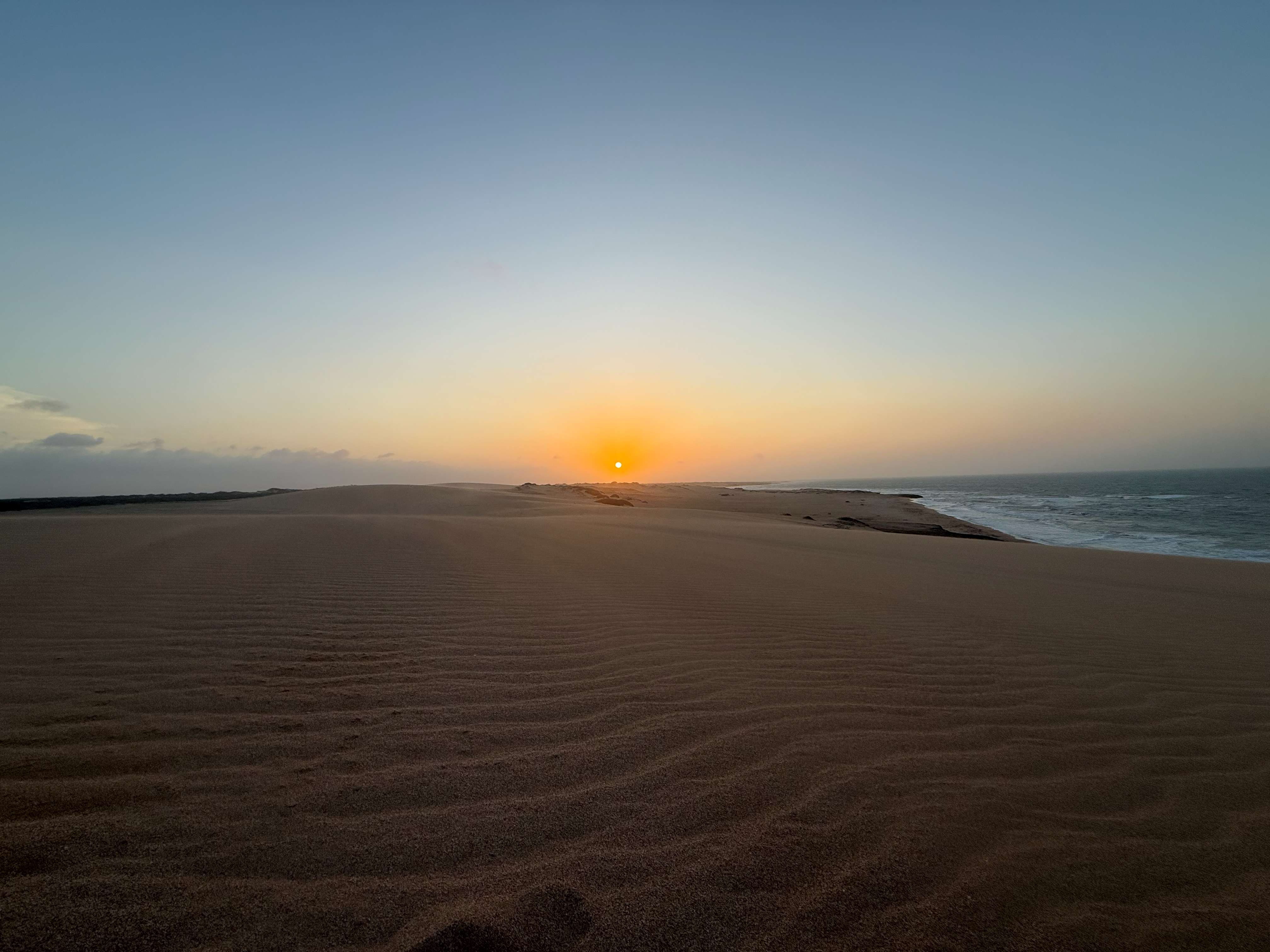
The northern tip of the La Guajira Peninsula.
Not only did the Wayuu travel, but part of the world came to them, effectively integrating them into a "global consciousness" shaped by migration and outside political forces. La Guajira was, like so many other parts of Latin America, a destination for enslaved populations. Their descendants, along with internal Colombian migrants, make up a well-established Afro-descendant community in the region, found even in remote villages such as the corregimiento of Nazareth, nestled in the lush Sierra de la Macuíra—a true oasis and Paola's place of origin.
Muslim and Arab migrations
In Lower Guajira, Arab and Muslim migrations continue to shape the landscape, notably in the city of Maicao, which is home to the largest mosque in Colombia. The Wayuu are familiar with the term mezquita, mosque, and refer to all Muslim populations in the area—who are in fact more South Asian than Middle Eastern—by the term árabes, the Arabs.
The Wayuu have also embraced various religious denominations, though none has managed to supersede the clan, giving rise to a certain syncretism. The arrival of the Capuchins—barefoot friars—nearly 120 years ago resulted in a Catholic majority. This is true of Nazareth, which Paola took me to visit, where one of the region's largest and oldest educational institutions stands: the Indigenous Boarding School, founded in 1911 by Fray Crispín de la Palma.
Some communities, ranging from a few dozen to a few hundred inhabitants, have adopted one of the evangelical denominations; Jehovah's Witnesses can even be found among them. This has not prevented the Wayuu, to this day, from practicing ancient cultural rites. Dreams, animal sacrifices, dances, sabedores, rituals, and the old gods all still have their place—at a time when other peoples in similar circumstances have completely abandoned certain traditions.
The Colombian imagination readily cites Wayuu endogamy as evidence of their supposed "closeness" to outsiders. Yet this endogamy is quite relative. For a little under a century and a half, contact between the Wayuu and what is called "mainstream society" (meaning: non-Wayuu) has intensified. Today, between one-third and just under half of the total population of the Colombian department of La Guajira is Wayuu.
In ports and trade, particularly around the towns and villages of the Colombian Lower Guajira and the coastal region of Maracaibo in Venezuela, countless relationships — with outcomes ranging from happy to tragic — quickly gave rise to a de facto mixing of peoples. Evidence of this, according to my guide Paola, is the obvious difference in features and complexions among the Wayuu, especially between those from the Upper Guajira and their neighbors to the south.
And it is far from uncommon, on the streets of Riohacha, Uribia, or Maicao, to see couples made up of one Wayuu person and one alijuna. Rather than creating a sense of identity loss among the Wayuu, this reality goes hand in hand with the observation that, in a society built around clan ties, such mixing does not disrupt the transmission of culture and language. Those are threatened by other factors, which we will return to later.
But then, one might ask: if this openness extends to every level — territory, marriage, family — and if language, customs, or even ethnic background don't necessarily define what it means to be Wayuu, how do they manage to maintain such a strong sense of shared identity and cohesion? How, in the end, do they identify with such remarkable ease who is Wayuu and who is not? Because a Wayuu is defined, above all, by their clan.
A territory defined by its dead
But what exactly is the clan for the Wayuu? It is a sense of belonging to a territory. And among the Wayuu, territory is defined by its dead. A Wayuu is Wayuu because they know where to return: the land where their ancestors are buried. Territory, for them, is not the political construction bounded by borders born of conflict and the assertion of power, as it is for Western states as described by historian Norbert Elias. Clan, family, territory are nothing other than references to those who are no longer here: the land is governed by the memory of the departed. Territory is where the cemetery lies, where each clan first settled over the long course of time, and it is defined by the pastures and water sources that mark the landscape surrounding that cemetery.
Paola told me: "You find Wayuu people everywhere anyway!" Her mother Francisca, pouring me coffee and handing me an arepa, added: "Oh, absolutely! In the United States, in Europe, everywhere!" Paola continued in an almost epic tone, turning to the subject of the dead: "But the Wayuu always returns to their territory. If they die out there, their clan and family will go to the ends of the earth to bring them back and bury them here, on their land. The territory is defined by the cemeteries, the water sources, and other landmarks."
Does this contradict the idea that an outsider, an alijuna, can perfectly integrate into a Wayuu clan that has not been ethnically homogeneous for generations? Not at all: a quick glance at mixed couples almost invariably reveals a Wayuu woman living with an alijuna man. Wayuu culture is matrilineal (but not matriarchal — Paola was insistent on that point), and the ashipa, the clan that matters, is the mother's group. As a result, the man — whether Wayuu or alijuna — will almost always go to live on his wife's territory, and it is her family's cemetery that determines the clan, the territory, and the inheritance tied to it. A warm welcome to those who come from elsewhere — their children's graves will ultimately rest where their Wayuu mother first drew breath.
"It's perfectly normal, look." Paola gestured with a glance toward her cousin's husband, who was visibly white.Paola m’indiquait d’un regard le mari de sa cousine, visiblement blanc. «He's a paisa, from the Medellín region. Many paisas have come to La Guajira. He married my cousin, and look at their daughter — she speaks wayuunaiki, she is wayuu, but she looks very different from me, different hair, chinitos. He's the one who came to live on his wife's territory. A Wayuu can build his own home anywhere on his territory. You know we don't need a title deed? It's her territory. Being married to her, he can make use of it.»
At the beginning of this reflection on the openness of the Wayuu people, I argued that nothing is more foreign to them than the idea of permanence. This is because the outcome of this perpetual movement is return — a return to the land of one's ancestors. But to return, one must first leave! And wander the world. Before coming back, whether dead or alive.
I give the last word to the master of wayuu speech, Livio Simón Suárez, the poet from Nazareth, whose house Paola pointed out to me as we passed by. His verses, written in Spanish, beautifully capture the hope of the wayuu Ulysses, poised between departure and return:
«Los caminos de mi tierra están tristes por tu partida.
Wayuu regresa pronto que tus caminos te esperan
para besar tus cuarteados pies»
(Your departure saddens the paths of my land,
Wayuu! Come home soon, for the roads are waiting
to kiss your cracked and weary feet.)
The Importance of Dream and Speech Among the Wayuu (2/2)
Plus de Maxime Pluvinet
Voir tout


À lire aussi dans Reportage
Voir tout

Guyana, the unexpected big winner of the oil shock
The Qadisha Valley Remembers Padre Escobar
Venezuela: Alex Saab Back in U.S. Custody
In the Footsteps of Sélim Abou SJ: Lost Fragments of The Paraná
Les derniers articles de Levant Time
Voir tout


